
AI agents are moving through the same maturity curve that web applications, mobile backends and cloud services went through before them. The first question is whether the system can do something useful at all. The second question is whether it can keep doing that useful thing safely, repeatedly and observably when the happy path disappears.
Most early agent demonstrations answer the first question. They show an agent browsing a site, calling a tool, writing a file, updating a CRM record or coordinating a small set of tasks. That is valuable, but it does not prove that the agent is ready to operate as production software.
The production question is different. Once an autonomous agent runs across real tools, real accounts and real business processes, teams need to understand what state the agent depends on, what failure means, and what recovery should preserve.
This is the category Molted is focused on: the operating environment around autonomous agents after they leave the demo stage. Molted provides managed OpenClaw & Hermes hosting at scale and agent runtime infrastructure with persistent workspaces, browser automation, 1,000+ integrations, recovery, communication channels, APIs, dashboards and deployment options for teams operating agent fleets in production.
A Healthy Container or VM Is Not Always a Healthy Agent
Traditional infrastructure checks are necessary, but they are not sufficient for autonomous agents. A virtual machine can be online. A container can be running. A Kubernetes pod can pass a basic liveness probe. None of that proves that the agent inside can still complete useful work.
An agent may need a valid browser session, access to a persistent workspace, working credentials, tool permissions, a clean queue of pending tasks, and enough context to understand what it was doing before an interruption. If any of those pieces are broken, the process can appear healthy while the operator is effectively unusable.
That distinction matters because many infrastructure systems were designed around stateless services or services with externalised state. Autonomous agents often combine process state, file state, conversation state, browser state and external tool state in ways that are harder to inspect from outside the runtime.
Runtime State Extends Beyond Memory
For ordinary services, teams often think of runtime state in terms of memory, database records, queues and caches. For autonomous agents, the runtime state can be broader.
A production agent may maintain files that represent work in progress, logs that explain past actions, browser profiles containing session cookies, credentials for third-party tools, inboxes or phone numbers used for communication, and local context that helps it continue a task after a handoff. Some of this state is persistent. Some is temporary. Some is sensitive. All of it can affect whether the agent can operate correctly.
This is why treating an agent only as a process misses important operational questions. If a restart loses the browser session, the agent may no longer reach the SaaS dashboard it needs. If a workspace is deleted or overwritten, the agent may lose the audit trail required to understand a failed action. If credentials expire silently, the agent may keep retrying a tool call that will never succeed.
Failure Is Often Partial
Software teams are used to binary failure modes: the service is up or down, the request succeeds or fails, the database is reachable or unreachable. Agent failures are often more partial.
An agent may complete three steps of a task, fail on the fourth, and leave the system in a state that is neither cleanly complete nor cleanly rolled back. It may send a message but fail to update the record that tracks the message. It may open a browser session, change a setting and then lose context before documenting what changed.
This makes recovery more complex than simply restarting the process. The question is not only, “Can the agent run again?” It is, “What was already changed, what is safe to retry, what requires human review, and what state must be restored before the agent continues?”
Production readiness therefore requires action-aware recovery. Teams need logs, workspace diffs, checkpoints, replayable context and clear escalation rules when automated recovery would be risky.
Readiness Checks Need to Move Inside the Runtime
A basic liveness check asks whether a process is alive. A useful agent readiness check should ask whether the agent can actually operate.
That may include checking whether required tools are connected, whether browser automation is available, whether the workspace is readable and writable, whether credentials are valid, whether task queues are in a consistent state, and whether the agent can reach the external services it depends on.
The exact checks will vary by architecture, but the principle is consistent: agent readiness must inspect the operational surface, not only the hosting layer. This is especially important when agents rely on websites without stable APIs, because browser sessions and page-level changes can become production dependencies.
Guidance such as the NIST AI Risk Management Framework and the OWASP Top 10 for Large Language Model Applications reinforces a broader point: AI systems need controls around reliability, security and misuse, not only model evaluation. For autonomous agents, those controls have to extend into the runtime environment where actions occur.
Observability Must Explain Action, Not Just Performance
Metrics, traces and logs remain essential. Teams still need to know latency, error rates, resource usage and dependency health. But for autonomous agents, observability should also explain action.
Useful operational traces should answer questions such as: Which tool did the agent call? Which file did it modify? Which website did it interact with? What decision led to that action? Was there a human approval step? What changed between the previous workspace version and the current one?
This does not mean every token or private interaction should be exposed broadly. It means teams need structured, permission-aware records that make agent behaviour reviewable. Without that, incident response becomes guesswork.
The more autonomy an agent has, the more important it becomes to separate three layers of evidence: infrastructure telemetry, application-level events and agent-level action history. Each layer answers a different question.
Fleets Change the Problem Again
One supervised agent can often be handled manually. A human can watch it, restart it, fix a login and read its logs. A fleet of agents changes the problem.
If each customer, department or employee has a separate agent, teams need isolation, provisioning, version control, credential boundaries, upgrade strategy, recovery policy and fleet-level dashboards. The operational challenge becomes closer to running a distributed workforce of software operators than running a single automation script.
At that point, manual babysitting does not scale. Teams need control planes that show which agents are healthy, which are degraded, which are blocked on external systems, and which require human intervention. They also need safe defaults for what agents can do automatically and where they must stop.
Deployment Choices Become Governance Choices
Where an agent runs is not only an infrastructure decision. It can affect data residency, auditability, incident response and compliance.
A public cloud deployment may be appropriate for speed and scale. An on-premise deployment may be necessary when data cannot leave a controlled environment. A sovereign or region-specific deployment may matter for regulated industries, public-sector systems or cross-border data restrictions.
Because agents interact with tools and data rather than merely answering prompts, deployment architecture should be part of governance planning. Teams should know where agent state lives, who can inspect it, how credentials are stored, how actions are logged and how recovery works after failure.
The Missing Layer Is Operational
The industry has spent enormous energy on models, prompts and frameworks. That work remains important, but it is not the whole production stack.
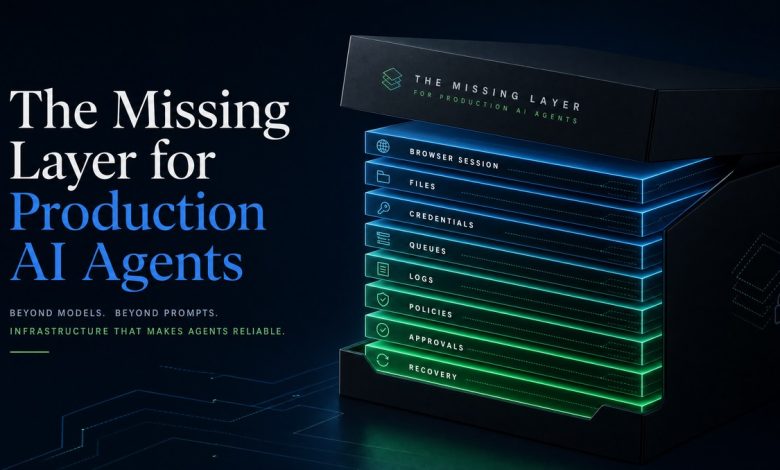
Autonomous agents also need an operating layer around them: persistent workspaces, recoverable state, browser and tool access, identity, observability, policy controls, human handoff and fleet management. Without that layer, a capable prototype can become fragile the moment it is expected to run real work.
For teams evaluating this operating layer, Molted is building a managed environment for OpenClaw & Hermes-based autonomous agent fleets. It is designed to help teams deploy, operate and scale agents with versioned workspaces, browser automation, 1,000+ managed integrations, recovery workflows, per-agent communication channels and fleet controls, without turning the product team into an infrastructure team.
The next phase of AI agent adoption will not be defined only by which model can reason best or which framework can define the cleanest graph. It will also be defined by which teams can keep agents operational, inspectable and recoverable after deployment.
That is the practical line between a demo and a production system.
References:
- NIST AI Risk Management Framework: https://www.nist.gov/itl/ai-risk-management-framework
- OWASP Top 10 for Large Language Model Applications: https://owasp.org/www-project-top-10-for-large-language-model-applications/
- Cloud Native Computing Foundation, Kubernetes probes documentation: https://kubernetes.io/docs/tasks/configure-pod-container/configure-liveness-readiness-startup-probes/