A lab can prove that something works. That does not mean anyone knows what to do with it next. Dr. Shruti Sharma has spent much of her career in that uncomfortable gap, where a discovery has promise on paper but still needs a customer, a partner, a pilot site, a funding path, and a clear reason to move forward.
That is the part of science most people never see. It is slower than the breakthrough moment. It is less tidy than the research paper. It is where technical teams start asking questions that do not always come naturally in a lab.
Who will use this?
Why would they switch from what they already have?
What has to be proven before anyone takes the risk?
Sharma came to those questions through science itself. She studied at the Indian Institute of Technology Bombay, one of India’s leading engineering institutions, then moved to the United States for graduate school. She became the first-generation woman in her family to earn a Ph.D. in materials science and engineering in the U.S.
Materials science gave her a front-row view of how much the world depends on things most people never think about. Energy systems, electronics, infrastructure, manufacturing, and deep technology all come down, at some point, to what materials can withstand and what they make possible.
She loved that materials science was so fundamental. She was looking at the building blocks behind many of the systems people use every day. She also became interested in what happens after the science is done. A discovery can be strong and still never reach the people who might need it.
That question stayed with her during graduate school. A lab-to-market technology commercialization workshop gave it a sharper shape. Until then, Sharma had mostly looked at research through an academic lens. The workshop pulled her into a different world, one with intellectual property, market validation, customer discovery, investors, and adoption barriers.
It was not a rejection of science. It was a wider view of what science has to survive if it is going to be used.
Sharma realized that the research itself is only one part of the story. There is a whole other set of decisions that determines whether a technology moves forward or stays inside the lab.
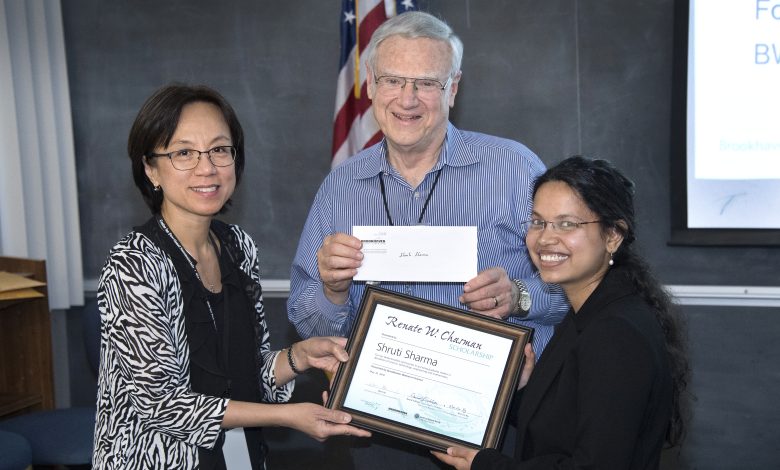
After training at Brookhaven National Laboratory, Sharma moved into roles that connected applied research, startup development, and commercialization programs. She began working with technologies that were not raw ideas anymore, but were also not ready for the market. They sat in the middle, which is often where things become complicated.
A founder may have strong data but no defined customer. A research team may know the technical advantage but not the use case. A deep tech startup may need a pilot partner before investors take it seriously. Another team may need to hear that the technology is not ready yet.
Sharma’s work often starts with that kind of honesty.
“I ask very simple questions, but they are not small questions,” she says. “Who is the end user? What problem is urgent enough that someone would act on it? What alternatives already exist? What would make this worth adopting now?”
At the Long Island High Technology Incubator, Sharma helped design and launch venture development programs that evaluated and supported emerging technologies. Within the first few months of one program, more than two dozen technologies and startups were reviewed. The work included commercialization strategy, market positioning, readiness assessment, and support for new startup formation.
Sharma has supported and mentored more than 100 deep tech startups and founders across energy, life sciences, engineering, advanced materials, and AI-enabled technologies. Her work has included customer discovery, pilot planning, grant strategy, market readiness review, and technical feasibility assessment.
The technical side still matters to her. She is not listening only for a polished pitch. She is listening for the strength of the underlying science. She wants to know what has been proven, what is still uncertain, and what might happen when a technology moves from a controlled setting into the real world.
Her scientific training is still central to how she evaluates things. She wanted to understand whether the technical claims hold up. Timing, infrastructure, policy, cost, scale, and adoption all matter.
That larger context has shaped her work with federally supported technology commercialization initiatives, including Department of Energy funded programs focused on energy innovation and technology transfer. Sharma has contributed to proposal development, partnership-building, program design, and evaluation metrics for programs meant to help research-based technologies move closer to deployment.
Deep Tech is a demanding area for this kind of work. The technologies can be expensive to test. Timelines can stretch for years. Adoption may depend on utilities, public agencies, industry partners, investors, or regulatory conditions. A good idea alone is not enough.
Commercialization is not just asking, ‘Can this work?’ It is also asking, ‘What has to line up for this to work outside the lab?’ Sometimes that is the harder question.
Her expertise has also been recognized through national innovation programs. Sharma has served as a mentor and instructor- for NSF I-Corps teams and has contributed as a reviewer or judge for initiatives connected to NSF, DOE, ASME, and AAAS. Those roles have allowed her to work with research teams at early decision points, before assumptions become too fixed.
“Not every technology needs the same path,” Sharma says. “Sometimes the right move is a startup. Sometimes it is a partnership, a license, a pilot, or more development. The important thing is helping the team make a clear-eyed decision.”
Her interest in access runs beyond commercialization. Sharma has mentored women and underrepresented students through university, nonprofit, and national laboratory outreach programs. She has worked with the Women in Science and Engineering Honors Program at Stony Brook University and participated in student outreach through Brookhaven National Laboratory.
She also co-founded Vigyanshaala, a grassroots STEM outreach initiative in India that became a registered nonprofit and has reached thousands of students. That work came from the same place as much of her career: noticing a gap and helping build something useful inside it.
“Mentorship changed what I could see for myself,” Sharma says. “That is why I care about creating access for others. A conversation, an introduction, or a little guidance at the right time can change the direction of someone’s path.”
Sharma plans to continue working as an independent expert and innovation leader, helping startups and commercialization programs grow through incubation and acceleration ecosystems in the United States and internationally. Her focus remains on deep tech commercialization, sustainability, economic growth, and the partnerships needed to move serious technologies toward use.
She still thinks like a scientist. She just does not stop at the lab door.
“Discovery matters,” Sharma says. “But the next stage matters too. I want to help stronger ideas make it through that stage instead of getting lost there.”