

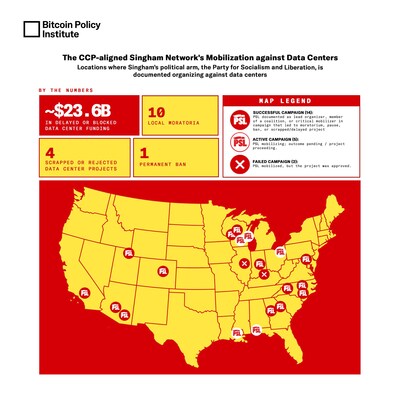
New Bitcoin Policy Institute report documents 21 campaigns in 14 states by the Party for Socialism and Liberation (PSL), a Marxist-Leninist group tied to Shanghai-based Neville Singham, with virtually no public record of who funds the organization’s activism.
WASHINGTON, June 30, 2026 /PRNewswire/ — The Bitcoin Policy Institute (BPI) today released the second installment of its investigation into foreign influence in the campaign against American artificial intelligence, uncovering how a Marxist-Leninist organization with documented ties to China has been a decisive organizer in campaigns that have delayed, blocked, or scaled back approximately $23.6 billion in proposed U.S. AI data center investment.
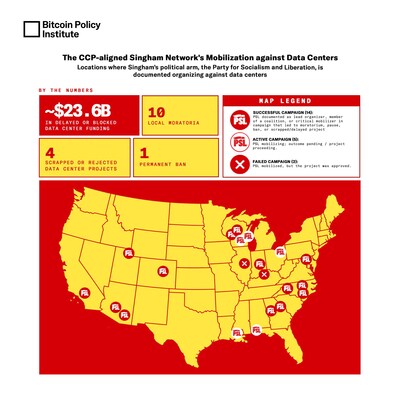
The report, “Foreign Influence in the Campaign against American AI, Part II: The Singham Ground Game,” by BPI Head of Research Sam Lyman, tracks 21 campaigns by the Party for Socialism and Liberation (PSL) across 14 states that contributed to 10 data center moratoria, one permanent data center ban, and four rejected or scrapped projects. The PSL’s role in each of these campaigns ranged from lead organizer to one member of a broader coalition. Its victories include halting construction permitting for a $5 billion data center project in Prince George’s County, Md.; the blocking of a $12 billion Blackstone-backed hyperscale campus in DeForest, Wis.; and a permanent data center ban in Monterey Park, Calif.
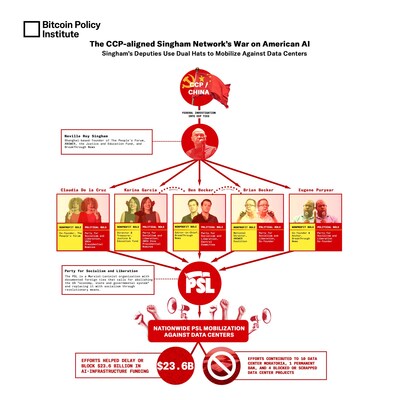
At the center of Part II’s findings is the PSL’s documented leadership overlap with the nonprofit network of Neville Roy Singham, a Shanghai-based U.S. expatriate under federal scrutiny for his ties to the Chinese Communist Party. The same individuals who have run Singham’s nonprofits — The People’s Forum, BreakThrough News, the Justice and Education Fund, and the ANSWER Coalition — hold top leadership positions in the PSL and drive its agenda.
BPI’s research further reveals that the PSL’s funding is almost entirely opaque. The party files no Form 990 and is not required under federal campaign-finance law to disclose donors for its year-round issue advocacy. As a result, the public record cannot establish who funds the bulk of PSL’s non-election activism, who its largest non-campaign donors are, or whether its operating money comes only from the sources it names. Nor can it rule out funding from Singham or from foreign sources.
“Data centers are a flashpoint in US politics,” said Lyman. “Americans have genuine concerns about how data centers may affect their electricity prices or strain local water resources. These concerns are authentic and need to be heard. The purpose of this report is not to cast doubt on the earnestness or even the veracity of claims made by Americans who oppose data centers. Indeed, most of the mobilizing taking place across the country is, on its surface, normal civic life in America functioning as it was designed to. Concerned citizens are organizing and affecting the political process.”
“But running parallel to this domestic, democratic movement is a foreign influence campaign that has worked to amplify public division and opposition to American AI infrastructure. At the center of this network is a Shanghai-based Marxist, one of the largest private funders of left-wing political organizing, and the subject of multiple congressional inquiries with documented ties to the Chinese Communist Party: Neville Roy Singham. This report adds to the mounting evidence that China and its surrogates are committed to stopping America’s data center buildout so that Beijing can gain the advantage in the AI race.”
BPI’s Part II release comes as the Singham network faces intensifying federal scrutiny. Sen. Tom Cotton recently urged the Department of Justice to investigate Singham by name, and the House Energy and Commerce Committee requested that the FBI investigate foreign efforts to block the U.S. data center buildout, citing BPI’s Part I research. A federal grand jury in the Southern District of New York is separately investigating Singham for alleged financial crimes. OpenAI also recently confirmed it had identified a likely Chinese influence operation — codenamed “Data Center Bandwagon” — using ChatGPT to generate content stoking opposition to U.S. AI data centers.
BPI’s report calls for greater transparency into the inner workings and finances of the Singham network.
The full report is available at: https://www.btcpolicy.org/articles/foreign-influence-campaign-against-american-ai-part-ii-singham-ground-game
About the Bitcoin Policy Institute: The Bitcoin Policy Institute (BPI) is a nonpartisan, nonprofit research organization dedicated to advancing sound policy on Bitcoin and emerging technology through rigorous research, education, and policy analysis. BPI informs policymakers, regulators, and the public about the future of money and Bitcoin‘s role in the financial system.
 View original content to download multimedia:https://www.prnewswire.com/news-releases/new-report-china-aligned-ground-game-stalled-or-blocked-23-6-billion-in-american-ai-infrastructure-302814464.html
SOURCE Bitcoin Policy Institute

