

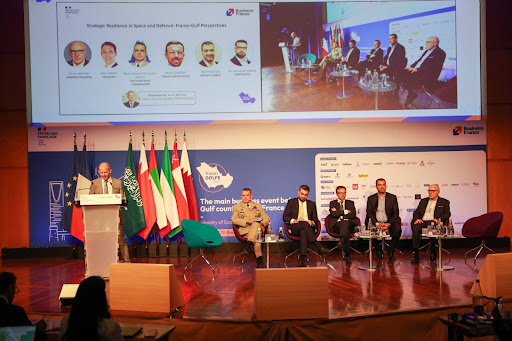
A France-Gulf exchange moderated by Karrier One at the Ministry of Economy and Finance, joined by a NATO Major General, on sovereignty, resilience, and the contest over critical infrastructure.
Paris, 27th June 2026 — Karrier One, the decentralized telecom operator building sovereign, resilient connectivity on a secure path-aware network architecture, participated in Vision Golfe, the France-Gulf economic forum held at the Ministry of Economy and Finance in Paris under the patronage of President Emmanuel Macron. Oscar Wendel, Karrier One’s representative for the Middle East, opened and moderated a panel on strategic resilience in space and defense, convening senior voices from across the defense, space, and diplomatic communities.
On stage at Vision Golfe, Ministry of Economy and Finance, Paris. From left: Oscar Wendel (Karrier One), Major General Christophe Hintzy (NATO) Dr. Hamdullah Mohib (Orbitworks), Olivier Guilbert (Thales Alenia Space), Adel Haddoud (Infinite Orbits) Olivier Badard (Armada Holding)
The themes of the session sit at the centre of Karrier One’s own mission. As the panel made clear, the infrastructure on which modern security depends, from telecommunications and navigation to financial systems and emergency services, has become both indispensable and increasingly exposed. Resilience, sovereignty, and the elimination of single points of failure are the principles Karrier One was built to advance, and they framed the discussion in Paris.
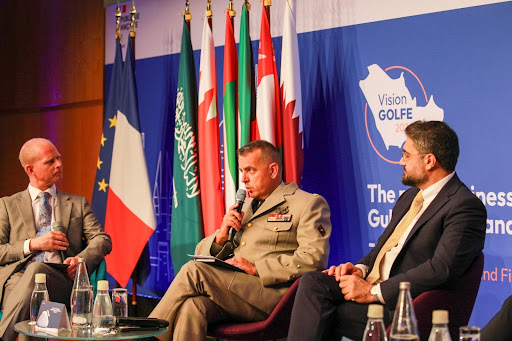
On strategic resilience, the conversation began on the ground. Major General Christophe Hintzy, fresh from leading the NATO Mission in Iraq, at Vision Golfe in Paris.
Opening the session, Wendel argued that defense cooperation has never been about equipment alone; it rests on diplomacy, trust, and shared sovereignty, which allow nations to protect their strategic interests without surrendering them. Space, he noted, has moved from a domain of exploration to the foundation layer of modern security, and France and the Gulf are entering a new phase of partnership anchored in co-development rather than exports.
The panel brought together Major General Christophe Hintzy, recently returned from leading the NATO Mission in Iraq; Olivier Guilbert, Export Sales Vice President at Thales Alenia Space; Adel Haddoud, Chief Executive of Infinite Orbits; Dr. Hamdullah Mohib, Acting Chief Executive of Orbitworks; and Olivier Badard of Armada Holding.
The discussion converged on a single thread: resilience depends on sovereignty, and sovereignty depends on the deliberate avoidance of dependence on any single provider. Guilbert recalled that Starlink’s decision to suspend connectivity over Ukraine demonstrated that no nation can rest its security on a private actor capable of withdrawing service overnight, and stressed that resilience derives from diversity of orbits and suppliers rather than any single system. Hintzy observed that recent conflict had exposed the limits of a nation’s sovereignty not only over its territory but over its airspace. Haddoud described a domain in which satellites once considered untouchable can now be approached, moved, or blinded, making sovereign reach a form of deterrence. Mohib, while making the strongest case for collaboration across the Gulf and Europe, agreed that full sovereignty is realistic for only a handful of states and that the rest must secure it through a partnership built deliberately.
Badard traced a fifty-year arc from the founding of a shared Arab satellite organisation toward today’s national programmes across the Gulf, arguing that the ability to cooperate depends first on the ability to be sovereign, since only a party that arrives with genuine capability can negotiate a balanced partnership rather than a dependency. He cautioned that owning sovereign assets in space is expensive and frequently not commercially sustainable, surviving on political will and allocated capital, and summarised the underlying principle that the more a nation pays, the more it expects to own.
The panel closed on the future of France-Gulf cooperation, recognising France for its technical mastery, training, universities, and independent launch capability through Ariane, alongside an acknowledgement that it will need to diversify the sources financing its ambitions, and positioning the Gulf’s capitalised, sovereign-minded operators as partners rather than customers.
For Karrier One, the conversation underscored a conviction that runs through its own infrastructure: in an era of contested networks and geopolitical fragmentation, secure, sovereign, and resilient connectivity is no longer optional. The same logic the panel applied to orbits and airspace applies to the networks that carry the world’s voice, data, and value.
About Karrier One
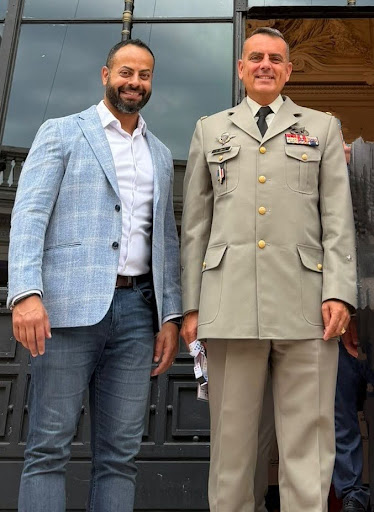
Conversations continued beyond the panel: Samer Bishay, CEO and Co-Founder of Karrier One, with Major General Christophe Hintzy at the Vision Golfe reception, Palais Galliera.
Karrier One is a decentralized telecom operator pioneering secure, sovereign, and resilient connectivity. Built on the Sui blockchain and integrating the SCION secure Internet architecture developed at ETH Zurich, Karrier One delivers cryptographically authenticated, path-aware networking designed to eliminate single points of failure and protect against modern cyber threats. Through a decentralized physical infrastructure network model, Karrier One empowers local operators and connects underserved communities across multiple continents, advancing a more inclusive and interconnected digital future. For more information, visit https://karrier.one.