Ask ChatGPT to write an announcement about a new workplace policy, and you’ll probably get something clear, structured, and grammatically flawless.
Yet send that same message to fifty employees, and you’ll likely get fifty different reactions.
Some will appreciate the directness.
Some will want more details.
Others will wonder why nobody consulted them beforehand.
The interesting part isn’t the AI. It’s the people.
As organizations rush to integrate AI into communication, leadership, and learning, many assume personalization begins and ends with better prompts. But communication has never been only about the message. It’s equally about how the receiver interprets it.
That’s why understanding behavioural preferences is becoming even more valuable in an AI-driven workplace.
AI can personalize content—but not relationships
Generative AI is remarkably good at adapting tone. It can write a formal email, a friendly Slack update, or a detailed project brief within seconds.
What it cannot know is how the individual reading that message naturally approaches work.
Someone who values speed and decisive action might appreciate a concise summary with clear next steps.
Another person may immediately ask, “What’s the reasoning behind this decision?”
Someone else might focus less on the task itself and more on how the change affects colleagues.
These differences aren’t random. They’re often reflections of behavioural preferences.
Frameworks such as Everything DiSC® help explain these patterns by describing how people tend to communicate, make decisions, and respond to change. Rather than placing people into rigid personality boxes, DiSC provides a practical language for adapting communication to different individuals and teams. A good overview of the model can be found in this Complete Guide to DiSC Personality Styles.
The hidden risk of AI communication
One of AI’s greatest strengths is consistency.
Ironically, consistency can also become its biggest weakness.
Many organizations now use AI to draft announcements, onboarding materials, manager communications, and performance feedback. While the quality is often impressive, the output tends to reflect a single communication style unless someone consciously adapts it.
The result?
Employees receive accurate information but don’t necessarily connect with it.
The challenge isn’t whether AI wrote the message. It’s whether the message feels relevant to the person receiving it.
Great communicators have always adjusted their approach depending on the audience. AI doesn’t replace that skill—it makes it even more important.
AI works best when people understand people
Forward-thinking organizations are beginning to combine AI with behavioural insight rather than treating them as separate capabilities.
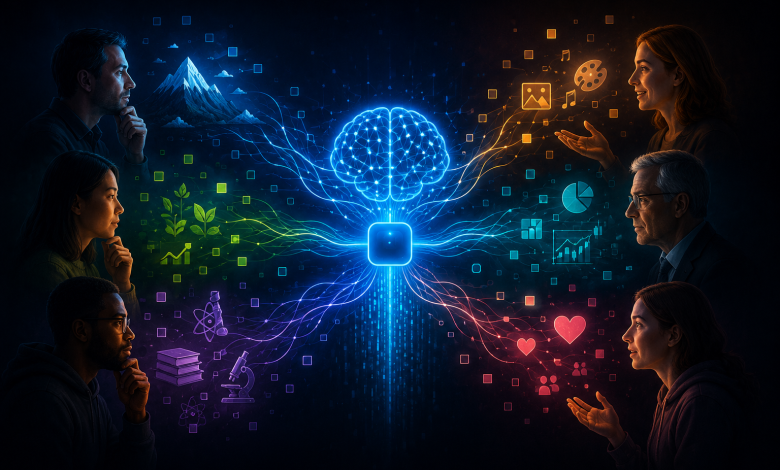
Imagine a manager preparing for four different one-on-one conversations.
AI can help organize talking points, summarize project updates, and suggest coaching questions.
Behavioural insight helps the manager decide how to have each conversation.
One employee may appreciate jumping straight into solutions.
Another may need context before discussing next steps.
A third may value time to reflect before making a decision.
The conversation changes, even if the facts don’t.
That’s where AI becomes an amplifier rather than a replacement for leadership.
The future isn’t AI versus personality assessments
Some people assume AI will eventually replace behavioural assessments.
The opposite may be happening.
As AI makes it easier than ever to generate content, the differentiator is shifting from what we communicate to how effectively we connect with different people.
This is one reason platforms like Everything DiSC® on Catalyst™ are attracting attention. Instead of treating behavioural insights as a one-time workshop, Catalyst gives employees ongoing, personalized guidance for collaborating with colleagues in everyday work, helping turn self-awareness into lasting behavioural change. Learn more about the Everything DiSC Catalyst learning platform.
AI can help us write faster.
It can summarize meetings.
It can draft strategies.
But it still can’t build trust, earn commitment, or understand the subtle dynamics of a team without human judgment.
Perhaps that’s the biggest lesson of all.
The future of work won’t belong to organizations that simply use AI better.
It will belong to those that combine artificial intelligence with a deeper understanding of human intelligence.