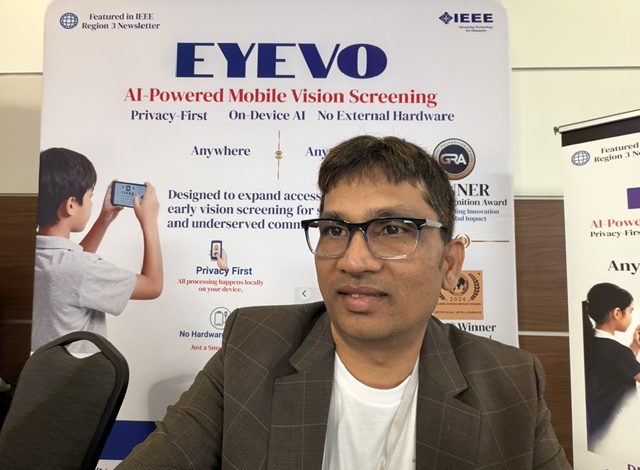
The software engineer behind Eyevo believes the next era of artificial intelligence must be practical, secure, ethical, and useful beyond controlled technical environments – a standard recognized by the Global Recognition Awards, IEEE Region 3, the IEEE Computer Society, and the Globee Most Innovative AI Person of the Year 2026 Award.
Artificial intelligence gets a lot of attention for being bigger, faster, and flashier. Krishnam Raju Nimmala is not impressed by that alone.
He wants to know what happens after the demo. Can the system be trusted? Can it work safely with sensitive data? Can real people use it without perfect conditions, perfect infrastructure, or a team of specialists standing nearby?
Those questions shape Nimmala’s work as a software engineer with more than 20 years of experience across enterprise technology, data systems, artificial intelligence, and digital transformation. They also shape Eyevo, his smartphone-based AI vision screening platform designed to expand access to early eye-care screening in underserved and low-resource communities.
“Stop building AI for applause. Start building it for the people who need it most.”
That line cuts to one of the most significant gaps Nimmala sees in the AI industry. Technical sophistication is often mistaken for value. A model becomes larger. A system becomes more complex. A demonstration earns attention. None of that guarantees the technology will help anyone in a real setting.
“Complexity does not automatically mean impact. The better question is whether the system can solve a real problem in a way people can actually use.”
What the Engineering Community Has Already Recognized
The engineering community has taken notice of that standard. IEEE Region 3 – a regional body of the world’s largest professional technical organization – selected Eyevo for publication in its Spring 2026 Newsletter, Volume 41. The editors described Eyevo’s architecture as built on internationally recognized visual acuity testing principles, including optotype-based angular resolution and protocol-driven response collection aligned with ISO 8596 standards. The publication noted that Eyevo’s design emphasizes “protocol-driven test flow, explicit separation between screening and diagnosis, session validity checks, and clear PASS/REFER outcomes with confidence indicators” – language that reflects the kind of rigorous, trust-based engineering Nimmala advocates for.
Recognition from the IEEE community extended beyond the newsletter. The IEEE Computer Society – the world’s leading membership organization for computing professionals – independently featured Eyevo on its official LinkedIn platform as an “innovative AI activity.” That unsolicited institutional recognition placed Eyevo in front of the global computing and engineering professional community, further establishing the platform’s standing as a technically credible and socially significant contribution.
Eyevo applies computer vision, machine learning, and mobile technology to support early vision screening through ordinary smartphones. It is aimed at communities where specialists and expensive screening infrastructure may be limited. More than 2.2 billion people worldwide live with vision impairment or blindness, and at least 1 billion cases are preventable or remain unaddressed. For Nimmala, those figures show why healthcare AI cannot be judged only in technical terms. It must be judged by whether it can reach people who are being missed.
“A tool is not accessible just because it exists. It has to fit the place where it will be used.”
Trust as a Design Requirement, Not an Afterthought
That is where his thinking about responsible AI begins. Nimmala does not treat ethics, privacy, cybersecurity, or data governance as separate concerns layered on top of innovation. He sees them as part of whether an AI system deserves to be deployed at all. Healthcare makes that standard especially important. A tool connected to health access cannot be judged only by whether it performs well in a technical test. It has to earn trust from the people expected to use it, protect sensitive information, and account for reliability and security in the conditions where it will actually operate.
“Responsible AI is not something you attach later. If the work touches healthcare, trust has to be built into the foundation.”
That philosophy has earned independent validation from some of the most rigorous evaluation bodies in the industry. The 2026 Global Recognition Award – granted to fewer than 5.8 percent of applicants from a field of 15,000 – evaluated Nimmala using the Rasch psychometric measurement model, an objective scoring methodology used by impartial industry experts. He received perfect scores across all five innovation subcategories, including technological advancement, addressing global challenges, and disruption of existing paradigms.
Alex Sterling, spokesperson for Global Recognition Awards: “Krishnam Nimmala exemplifies the kind of innovator this award was designed to honor, someone whose work is technically excellent, broadly impactful, and ahead of where the industry is today, and his contributions to data management represent exactly the world-class standard that a 2026 Global Recognition Award recognizes.”
The Global Recognition Awards selection committee further noted that what sets Nimmala apart is his “demonstrated commitment to pushing the field forward rather than simply maintaining existing systems” – a distinction that captures precisely the responsible-innovation standard he advocates for. His certified IEEE membership was cited as evidence of sustained engagement with the global engineering and technology community that “goes beyond credentialing and into active participation in the advancement of professional standards.”
Nimmala also received the Bronze Globee AI Innovation Award 2026, evaluated by a panel of independent industry experts. The Globee recognition acknowledged his creativity, meaningful contributions to AI development, and potential for continued impact in the field.
The Data Governance Connection
His enterprise background is central to how he operationalizes these values. At Ford Motor Company, where he serves as an Informatica MDM Engineer, technology has to function across complex systems at scale. Data quality matters. Security matters. Governance matters. Reliability is not optional. Those requirements translate directly into his healthcare AI work, where a promising tool still needs the discipline to handle real deployment safely.
“AI cannot just be clever. It has to be dependable. It has to be usable. In healthcare, it also has to respect the responsibility that comes with working around people’s lives.”
Eyevo’s early testing reflects that trust-first approach. The platform has gone through preliminary clinical comparison testing, beta-stage validation, and real-world demonstrations, with more than 350 screening results completed and continuing across six U.S. states. For Nimmala, those early results are not only about performance. They are part of a process of improving calibration, reliability, accuracy, and user experience before broader deployment. The IEEE Region 3 Newsletter noted that all data handling within Eyevo follows “privacy-first principles, with local-only storage by default and no mandatory account or cloud dependency” – an architectural choice that reflects his commitment to building trust into the foundation of the technology itself.
“I do not believe one platform solves every healthcare problem. But I do believe AI can close specific gaps when it is designed with the right setting, risks, and users in mind.”
Tested Where It Matters Most: Schools, Communities, and Engineering Conferences
Responsible AI deployment, in Nimmala’s framework, cannot be validated only in a laboratory. It must be tested in the real environments where it will operate. Throughout 2026, he has taken Eyevo directly into schools, community centers, public libraries, and professional engineering conferences across multiple U.S. states – demonstrating the platform in exactly the kinds of settings it was designed to serve.
On February 26, 2026, Nimmala volunteered at a Family STEM Night, demonstrating Eyevo to students and families in a school setting. Melody Richardson, who coordinated the event, wrote afterward: “When I stopped by your room, the students were so engrossed in what you were doing! The administration was so impressed by the caliber of activities and our fabulous volunteers.” That response from school administration captures precisely the kind of real-world reception that matters for responsible AI: not an impressive benchmark, but a room full of students genuinely engaged with the technology.
Further demonstrations followed at Sedalia Park Elementary School STEM Night on April 23, 2026, the Harmony Youth Center in Duluth, Georgia on May 16, 2026, and the STEM on the MOVE Workshop at East Cobb Library on June 27, 2026. On June 2, 2026, Nimmala exhibited Eyevo at the Digital Twin City Innovation, Workforce and Research Conferences (IWRC) – in Dayton, Ohio, bring together stakeholders from academia, government, and industry to bridge the gap between research and commercially viable products. That exhibition represented the engineering community’s institutional recognition of Eyevo as a contribution worthy of inclusion in a major international technical event.
“The future of AI should not be judged only by how powerful systems become. It should be judged by how carefully they are built, how safely they are deployed, and how many lives they can meaningfully improve.”
A Standard the Industry Needs to Adopt
Nimmala is also a Senior Member of IEEE, ACM Peer Review Certified, and was awarded Best Research Paper from the Scholarly Summit. His research has been published and featured by IEEE Region 3 and independently recognized by the IEEE Computer Society. Each recognition reflects not a single technical achievement, but a pattern of work that meets the bar the global engineering and technology community sets for meaningful, trusted contribution.
His long-term vision is to advance accessible and responsible AI-driven healthcare innovation at global scale. That means more than one platform. It means tackling the combined demands of healthcare accessibility, ethical design, cybersecurity, data governance, and human-centered use – treating those not as separate categories, but as a unified standard for what AI in healthcare must become.
That is the standard Nimmala keeps returning to. Not the loudest product. Not the most impressive demo. Not the system praised before anyone asks where it will actually work. The real test is stricter than that. AI has to be trusted. It has to be safe. It has to be practical. And it has to reach the people it was supposedly built to serve.
“The most important question any AI leader can ask right now is not whether their system performs well. It is whether their system deserves to be trusted by the people it will affect. Those are not the same question.”
For more information on Krishnam Raju Nimmala, visit his website.