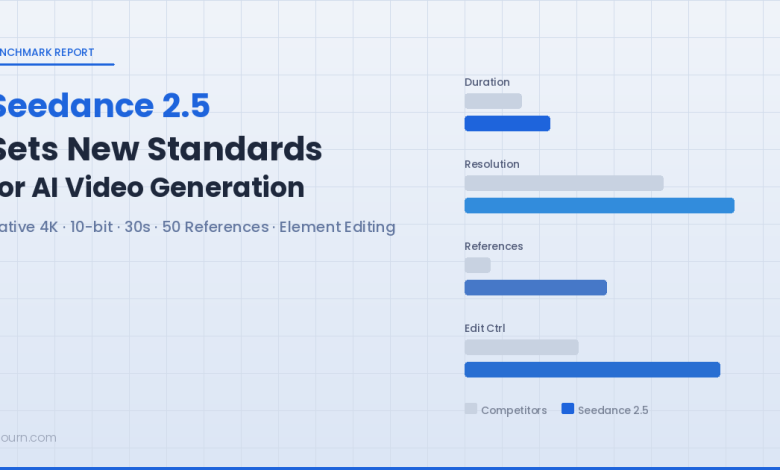
The competitive landscape of AI video generation has been defined by a handful of persistent technical constraints: limited generation duration, resolution achieved through post-processing rather than native rendering, narrow reference handling, and destructive regeneration cycles that make iterative editing impractical. ByteDance’s latest model release addresses all four simultaneously.
Seedance 2.5 , unveiled at the Volcano Engine FORCE conference in June 2026, extends single-generation output to 30 seconds at native 4K resolution with 10-bit colour depth — a combination no competing model currently matches. The release builds on the foundation of Seedance 2.0, which launched in February 2025 as the first Chinese-developed model to achieve global state-of-the-art performance in video generation and was the first to cross what the industry terms the “production quality threshold,” the point at which AI-generated output becomes viable for commercial deployment rather than purely experimental use.
Duration: Breaking the 15-Second Ceiling
Most leading video generation models remain constrained to 15 to 20 seconds per generation pass. While adequate for short-form social content, this ceiling has been a significant barrier to adoption in advertising, corporate video, education, and narrative content — all sectors where 30-second units represent a production standard. Seedance 2.5 is the first model to break through this barrier, generating 30 seconds of temporally coherent video in a single pass.
The implications extend beyond simple convenience. Longer single-generation output eliminates the need for multi-clip assembly, which has been the primary source of visual inconsistency in AI video production pipelines. Character identity, lighting conditions, and physics behaviour remain stable across the full generation length — a requirement that multi-clip workflows struggle to maintain.
Native 4K With 10-Bit Colour Depth
The distinction between native 4K and upscaled 4K is becoming increasingly relevant as AI video moves into professional production environments. Upscaling algorithms applied after generation can increase pixel count but cannot recover detail that was never rendered. High-frequency visual information — textile weaves, individual hair strands, embroidery patterns, metallic reflections — degrades predictably under upscaling.
Seedance 2.5 generates at 4K resolution from the diffusion stage, preserving high-density detail throughout the rendering process. The addition of 10-bit colour depth increases the available colour palette from approximately 16.7 million values (8-bit) to over one billion, providing significantly greater dynamic range and gradient precision. For post-production workflows that rely on colour grading, this additional headroom reduces banding artefacts and allows more aggressive adjustments without visible degradation.
Multi-Reference Input at Scale
The model accepts up to 50 multimodal reference assets — images, video clips, audio files, and 3D models — in a single generation request, the highest reference count of any publicly announced video generation model. This capability shifts the interaction paradigm from text-only prompting to asset-driven direction.
During the FORCE conference demonstration, the team simultaneously inputted reference images of over ten characters and allowed the model to autonomously handle casting and scene choreography. This represents a qualitative shift in the level of creative control available to users without requiring manual compositing or post-production intervention.
Non-Destructive Element-Level Editing
One of the most operationally significant features is localised editing — the ability to modify individual elements within a generated video without triggering full regeneration. Users can swap products, adjust backgrounds, or replace characters whilst maintaining the integrity of all surrounding elements.
For advertising production, where multiple variants of a single creative are frequently required for A/B testing, product line variations, or regional adaptation, this capability reduces per-variant production cost from near-full regeneration to targeted element replacement. The conference demonstration showcased a cosmetics advertisement in which lipstick shade variants were substituted in real time without affecting the model, lighting, or camera movement.
Industrial Applications
Beyond content creation, Seedance 2.5’s extended generation length and structural consistency open industrial use cases. The model can generate multilingual product video documentation automatically, synthesise training data for autonomous driving systems covering rare edge cases and extreme weather conditions, and produce architectural or engineering visualisations where dimensional accuracy across time is critical.
Availability
Seedance 2.5 is currently in final-stage internal testing with public availability expected in early July 2026. In a market where the competitive boundary has shifted from whether AI can generate video to whether it can generate video that integrates into professional production workflows, the model’s combination of duration, resolution, reference handling, and editing precision positions it as a notable advancement in the field.