




Laser hair removal has been available for decades, but the technology doing the work in 2026 looks very different from what clinics were running ten years ago.
The combination of more precise laser hardware and AI-driven skincare treatments and systems has changed what’s achievable, who treatments work for, and how long results last – often dramatically. That shift is most visible in larger treatment areas – and leg hair removal is where the practical gains are hardest to ignore.
What’s Actually Changed in the Technology
Full leg laser hair removal has historically been one of the more time-intensive treatments available, partly because of the surface area involved and partly because earlier laser systems required slower passes and more conservative settings to manage heat safely across the full treatment zone. Both of those constraints have loosened considerably in recent years.
Modern laser systems now operate with cooling mechanisms integrated directly into the handpiece, which allows faster delivery of energy with less discomfort and shorter recovery windows between sessions.
Treatment times for full legs that once ran an hour or more can now be completed in considerably less time without compromising efficacy.
The more significant development, however, is on the AI side. Machine learning systems are now being applied at several distinct points in the treatment process:
- Skin tone and hair type analysis – AI-assisted imaging tools assess melanin levels in both skin and hair at the start of treatment, generating parameter recommendations that reduce the trial-and-error involved in manual calibration
- Real-time adjustment during treatment – some systems adjust energy delivery mid-session based on sensor feedback, responding to variations in skin condition across different areas of the leg
- Treatment mapping – AI can generate coverage maps for larger areas, reducing the risk of missed zones or overlapping passes that cause uneven results
- Outcome prediction – predictive models trained on treatment histories help practitioners give more accurate timelines for reduction and estimate the likely number of sessions needed
Why Leg Treatments Specifically Benefit
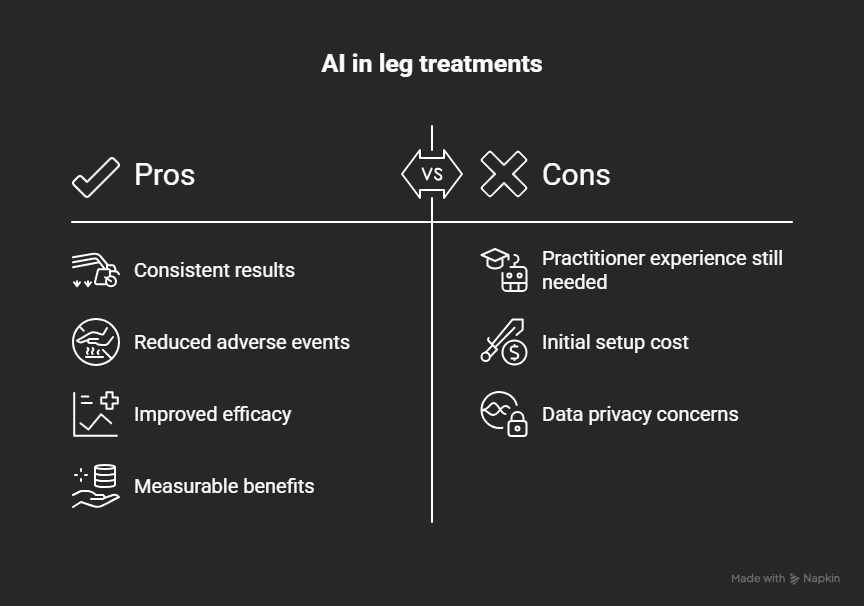
The leg presents a specific and well-documented set of challenges that make AI assistance particularly valuable. It’s not a uniform surface – skin thickness, hair density, and hair color can vary considerably between the upper thigh, the knee, the shin, and the ankle.
A setting calibrated for the thigh may be too aggressive or too conservative for the shin.
Earlier approaches managed this through practitioner experience and manual adjustment. Skilled technicians learned to adapt as they moved through each treatment area. That still matters – technique remains important – but AI-assisted systems add a layer of consistency that reduces variation across sessions and between different practitioners treating the same patient.
Research published in peer-reviewed dermatology literature has examined AI-guided parameter selection on outcomes across skin phototypes.
The consistent finding is that targeted calibration reduces adverse events – primarily burns and hyperpigmentation – while maintaining or improving efficacy compared to fixed-parameter protocols. For larger surface areas like the full leg, the cumulative benefit of better per-zone calibration is both measurable and meaningful.
The Skin Tone Question
One longstanding limitation of laser hair removal has been reduced effectiveness and higher risk for darker skin tones. Laser systems targeting melanin in the hair follicle also affect melanin in surrounding skin tissue – for darker skin, that creates higher risk of burns and pigmentation changes.
AI-assisted melanin analysis and improved laser wavelengths have narrowed this gap noticeably. The Nd:YAG wavelength, which penetrates deeper and interacts less with surface melanin, has long been the preferred option for darker skin tones.
Combined with AI calibration that accounts for individual variation, treatments are reaching patient populations that earlier technology largely excluded.
This isn’t a solved problem – patients with very dark skin tones still require careful assessment and genuinely experienced practitioners – but the clinical picture in 2026 is considerably better than five years ago.
What This Means for People Considering Treatment
Session times are shorter than they used to be. The number of sessions required to reach significant reduction has come down for many patients due to better energy delivery and targeting. And the risk profile – particularly for patients whose skin tone previously made them poor or marginal candidates – has improved considerably.
What patients should still look for:
- Practitioner experience with the specific system – AI assistance doesn’t replace clinical judgment, and results still depend on who operates the equipment
- Pre-treatment assessment – a thorough consultation using the imaging and analysis tools available should happen before any package is agreed
- Realistic expectations about timelines – full leg reduction requires multiple sessions across several months; the technology improves the outcome, not the timeline
The direction of travel is increasingly and unmistakably clear. More precise targeting, faster treatment, broader patient eligibility, and better outcome prediction.
For full leg treatments specifically, those improvements add up to a meaningfully different clinical experience than the same category of treatment offered a decade ago.