AI has not removed the SEO specialist from the workflow. It has changed where specialists spend their time. In 2026, AI handles the first pass on clustering, brief creation, audit grouping, content gap detection, and prospect research. SEOs still choose the page strategy, validate facts, edit copy, judge link relevance, and protect the brand from scaled mistakes.
The useful question is no longer: “Can AI do SEO?” The useful question is: “Which SEO decisions can a team safely delegate to software, and where must a specialist approve the result?”
Executive Summary
By 2026, SEO teams have moved from manual task execution to supervised AI workflows. The best teams do not ask AI to “do SEO.” They feed AI with search data, crawl data, backlink exports, SERP snapshots, and internal performance metrics. Then they use AI to group, score, summarize, and draft. Humans approve the decisions that affect positioning, trust, and revenue.
The attached research shows the clearest automation gains in five areas: keyword clustering, search intent classification, content brief generation, on-page optimization, and link prospecting. It also shows that technical SEO has shifted from long audit exports to issue grouping and impact-based triage. AI helps teams detect patterns across templates, logs, duplicate content, JavaScript rendering, Core Web Vitals, and internal linking.
The search environment also changed. Google AI Overviews and other generative answer interfaces reduce the value of rank tracking as a standalone metric. The research cites an Ahrefs finding that the presence of an AI Overview correlated with a 58% lower average click-through rate for the top-ranking page. It also notes seoClarity data showing that AI Overviews appeared for 30% of U.S. desktop keywords in its dataset, with more than 99% of those instances sourced from top-10 web results. SEO teams now track rankings, citations, brand mentions, and visibility inside AI answers.
The core risk has also changed. AI can make the wrong action cheaper and faster. A team can now publish more weak pages, send more irrelevant outreach, create more duplicated briefs, and trust more false recommendations. This means AI governance is now part of SEO operations: every AI-assisted workflow needs inputs, reviewer rules, approval gates, and quality metrics.
What Changed in SEO Workflows by 2026
Before AI entered daily SEO work, teams spent much of their time moving data between tools. They exported keywords, grouped them in spreadsheets, opened SERPs one by one, wrote briefs manually, checked competitor headings, built prospect lists, filtered low-quality domains, and converted audit exports into tickets.
AI reduces the first-pass labor. It does not remove the need for judgment. It changes the sequence:
- Specialists define the goal and the input dataset.
- AI groups, labels, summarizes, scores, or drafts the first output.
- A specialist reviews the output against intent, business value, brand risk, and factual accuracy.
- The team executes the approved change and measures impact.
This pattern works because many SEO tasks have clear inputs and repeatable outputs. Keyword clustering, content briefs, internal link suggestions, audit issue grouping, and prospect scoring fit that pattern. Creative positioning, final editorial decisions, link relationship building, and risk calls do not.
In practice, the strongest workflows use AI as a speed layer, not a strategy layer. A keyword clustering tool can group 10,000 terms. It cannot decide whether a company should create one product-led guide, three comparison pages, or no page at all. A link prospecting tool can score domains. It cannot judge whether the publication fits the brand, whether the relationship matters, or whether the pitch deserves a link.
AI in Content Optimization
Content optimization has seen the fastest adoption because the workflow already depends on structured inputs: keywords, SERPs, competitor URLs, headings, entity coverage, Google Search Console data, and existing drafts.
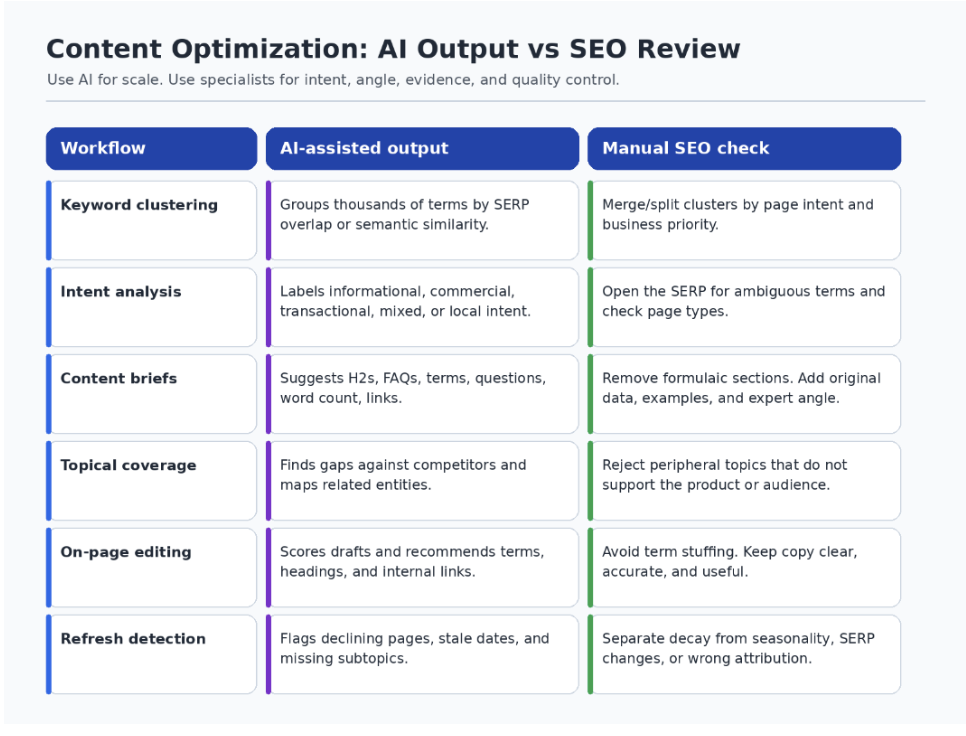
Keyword clustering
Keyword clustering used to be a spreadsheet task. SEOs grouped keywords by modifier, search volume, and intuition. That workflow broke down when a site had thousands of related terms and mixed intent across the same modifier set.
AI-assisted clustering now uses semantic similarity, SERP overlap, or both. The research highlights SERP-driven tools such as Keyword Insights and Keyword Cupid. These tools compare ranking URLs across queries and group terms when Google returns similar results. This helps SEOs avoid building separate pages for keywords that Google treats as the same intent.
AI can automate the first grouping, but the SEO specialist still needs to review edge cases. A tool may put two terms in one cluster because the SERP overlaps today, while the business needs two distinct landing pages. A tool may also split a synonym set because one query has a stronger commercial result mix. The reviewer must decide which cluster deserves a page, which cluster supports an existing page, and which cluster should not enter the content plan.
Search intent analysis
Search intent analysis shifted from manual SERP inspection to large-scale classification. Tools can label queries as informational, commercial, transactional, local, or mixed. They can also show which page types dominate the results: blog posts, product pages, category pages, directories, forums, videos, or comparison pages.
This helps teams avoid a common error: writing an informational article for a query where users want a tool, a service page, a marketplace, or a comparison. AI can label 5,000 keywords faster than a specialist can inspect them. But the labels still need sampling. Mixed-intent queries need manual review because they often decide the page format.
Content brief generation
AI can now build a content brief from SERP data in minutes. Frase, MarketMuse, Surfer, Clearscope, and similar platforms can extract common headings, related questions, topical terms, competitor patterns, internal link ideas, and suggested structure. The research notes that Frase and MarketMuse can create briefs from SERP and site data, while Surfer can combine SERP analysis, content scoring, topical maps, and internal link suggestions.
The old workflow asked an SEO specialist to inspect competitors, copy heading patterns, collect People Also Ask questions, and write a brief manually. The AI workflow starts with the same data but compresses the research phase. The editor then rewrites the brief into a real angle.
The risk is sameness. If five competitors use the same optimization tool and accept the same suggestions, the output converges. The article may cover the same sections, use the same terms, and answer the same questions without adding insight. A useful AI brief needs a human layer: original examples, first-party data, expert quotes, product context, and a clear reason to exist.
Entity and topical coverage
Topical coverage work also changed. Instead of mapping entities and content gaps by hand, teams can use topical maps and content inventories. These systems compare a domain against competitor coverage and show missing topics, weak clusters, and pages that need consolidation.
The practical value is prioritization. A SaaS SEO team can see whether it lacks a core comparison page, a glossary definition, a workflow guide, or a use-case page. An ecommerce SEO team can see missing buying guides, model comparisons, and support content. The reviewer must reject irrelevant suggestions. A tool may identify a competitor topic that drives search traffic but does not fit the product, audience, or revenue model.
On-page optimization
On-page optimization platforms compare a draft against the current SERP and recommend terms, headings, questions, media, and internal links. The research notes reported 30-50% improvements in content performance scores for teams using content optimization AI. That number should be treated as a tool-side benchmark, not a universal traffic promise. A higher content score does not guarantee ranking growth.
The strongest use case is controlled editing. Use the tool to find missing concepts, weak headings, unanswered questions, and internal link gaps. Do not turn the recommendation list into a stuffing checklist. A page that mentions every suggested term can still fail if it lacks proof, clarity, or search intent fit.
Internal linking and content refresh
AI-assisted internal linking is useful because it connects two datasets: the target page and the site inventory. Ahrefs Site Audit, Surfer, and other tools can find pages that mention a relevant phrase and should link to a refreshed URL. The research also highlights content decay workflows that connect Google Search Console data to pages losing traffic or missing subtopics.
Freshness matters in AI search. The research cites Ahrefs analysis showing AI-cited content was 25.7% fresher than traditional organic Google results. That does not mean every page needs a new date. It means teams should refresh pages where the facts, tools, SERPs, screenshots, or recommendations have changed.
AI in Technical SEO
Technical SEO used to produce too many issues and too little prioritization. Crawlers could find broken links, missing titles, redirect chains, canonicals, duplicate pages, orphan URLs, and Core Web Vitals problems. The harder task was deciding what mattered first.
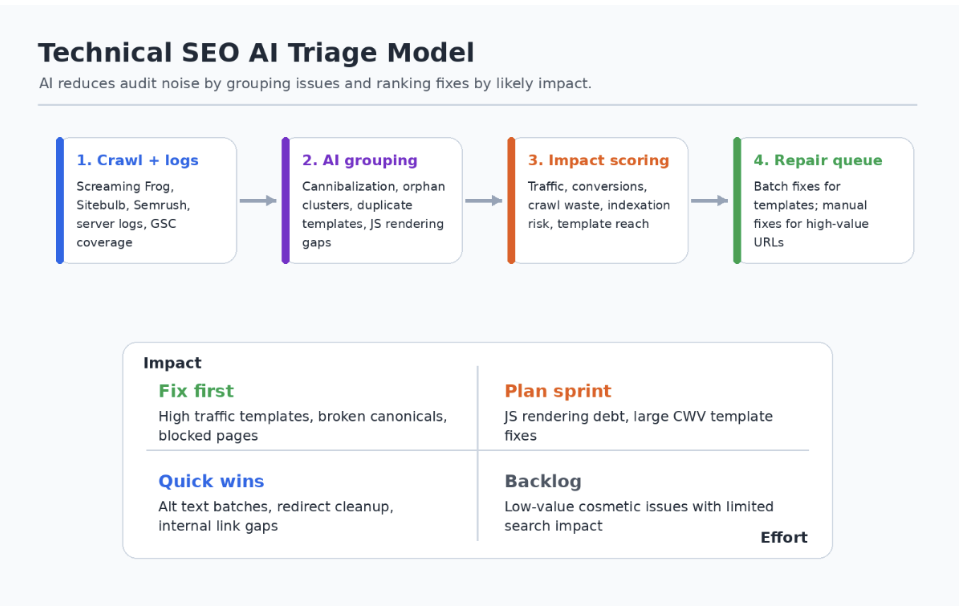
AI changes the audit workflow in three ways. First, it groups similar problems. Ten thousand missing alt attributes become one template-level issue. Hundreds of thin pages become a content cluster problem. Multiple JavaScript rendering failures become one engineering ticket for a template or component.
Second, AI can connect issues to impact signals: organic clicks, conversions, crawl depth, indexation state, template reach, and business value. A broken canonical on a high-value landing page should outrank a cosmetic metadata issue on a low-traffic archive URL.
Third, AI can summarize patterns that would take hours to see manually. It can identify crawl-budget waste, pages with similar content, internal linking holes, orphan clusters, and JavaScript content that key crawlers may not see. The specialist must still confirm the root cause. AI can point to a problem pattern; engineering and SEO teams must verify the fix path.
Crawling, logs, and AI crawlers
The research notes a BrightEdge-related claim that AI agents account for roughly 33% of organic search activity. Treat that as a directional industry signal, not a universal site benchmark. The practical takeaway is still clear: technical SEO now needs to consider traditional search crawlers and AI-assisted retrieval systems.
Clean HTML, accessible content, fast templates, structured data, and crawlable internal links matter because AI systems need to extract, summarize, and cite page content. JavaScript-heavy sites need extra checks. Teams should test whether important content appears in raw HTML, rendered HTML, and crawler simulations.
Structured data and indexation diagnostics
Structured data no longer sits at the edge of SEO work. The research ties structured data, entity clarity, and AI interpretation together. Product, FAQ, HowTo, Organization, Person, Article, Breadcrumb, and Review markup can help machines understand a page. That does not mean schema can compensate for weak content. It means schema should match visible content and support entity clarity.
AI can suggest missing schema and detect malformed JSON-LD, but humans need to approve markup. Incorrect schema can mislead crawlers, create rich result errors, or describe content the user cannot see. A safe workflow validates markup through testing tools and keeps schema in sync with page templates.
Core Web Vitals and JavaScript SEO
AI can group Core Web Vitals problems by template or component. This matters because site speed work often fails when teams fix individual URLs instead of the pattern that causes the problem. If every product page has poor LCP because of the same image carousel, the fix belongs to the template, not one page.
The same logic applies to JavaScript SEO. AI-assisted tools can compare how different crawlers see a page, flag hidden content, and find client-side rendering problems. The SEO decision remains manual: choose pre-rendering, server-side rendering, hydration fixes, or content fallback based on the site stack and business priority.
AI in Link Prospecting and Digital PR
Link prospecting has moved from manual list building to assisted qualification. A link builder can still export competitor backlinks from Ahrefs, Semrush, Majestic, or Moz. The AI layer now helps classify, enrich, score, and personalize that raw list.
The old workflow relied on broad searches, backlink exports, and manual filtering. The new workflow starts with the same raw sources but adds machine scoring: topical relevance, domain quality, recent coverage, page context, spam risk, outreach likelihood, and contact quality.
This does not make link building automatic. It makes the first pass faster. A tool may rate a site highly because it has strong metrics and related keywords. A human must still inspect whether the page attracts real users, whether the topic matches the campaign, whether the publication sells links at scale, and whether the pitch offers value.
Prospect discovery and domain qualification
AI helps find prospects that simple competitor-link exports miss. It can identify publications that recently covered a related subject, resource pages with broken external links, unlinked brand mentions, niche newsletters, industry blogs, and domains that link to similar resources.
The reviewer should apply a domain qualification checklist: topical fit, traffic quality, language, country, editorial standards, outbound link patterns, author pages, content freshness, and spam signals. High authority metrics do not make a domain relevant. A weaker but highly relevant publication can beat a stronger general site for campaign fit.
Unlinked mentions, broken links, and competitor gaps
AI also helps prioritize opportunity types. Unlinked brand mentions often require the lowest pitch effort because the site already mentioned the brand. Broken link opportunities require better context matching. Competitor backlink gaps require campaign judgment: copy the tactic only when the placement type, audience, and content asset make sense.
For teams comparing software options, a practical list of link building tools can help separate prospect discovery, backlink analysis, outreach automation, and marketplace features before a team commits to a workflow.
Outreach personalization and follow-up
AI can draft outreach emails from prospect data: recent articles, author bio, topical fit, and the asset being pitched. The research cites claims that AI-powered personalization can improve response rates two to three times compared with template-based outreach. Treat that as a benchmark to test, not a guarantee.
The safe workflow is simple: AI drafts the first version, a link builder reviews every message, and the campaign lead monitors reply quality, unsubscribe risk, bounce rate, and placements. At scale, one bad personalization rule can damage the domain, the brand, and the relationship with publishers.
Search Changes Caused by AI
AI search changes the way SEO teams measure success. Traditional organic rankings still matter because AI answers often cite or draw from high-ranking pages. But rank alone no longer explains visibility, demand, or revenue.
The attached research highlights four practical shifts.
- AI Overviews can reduce clicks even when a page keeps its organic position. Ahrefs found a 58% lower average click-through rate for the top-ranking page when an AI Overview appeared.
- Zero-click search increases pressure on brand recognition, citations, and SERP ownership. The research cites reports that 65-69% of searches ended without a click in 2025, with higher mobile rates.
- AI answers reward clear entities, structured content, and source trust. Brand mentions, author credibility, original data, and external citations matter more than generic keyword coverage.
- PR and digital authority now feed AI visibility. The research cites BrightEdge data suggesting around 34% of AI citations came from PR-driven coverage, with another 10% from social channels.
The SEO response is not to “write for bots.” The response is to make pages easier to understand, cite, and trust. That means concise answer sections, named authors, visible sources, schema that matches the page, fresh facts, and content that adds information the SERP does not already repeat.
AI Tools and Platforms: Choose by Workflow
The tool market is noisy. The useful way to evaluate tools is not by the number of AI features. It is by the decision the tool helps a team make. A tool that gives one reliable recommendation at the right point in the workflow beats a broad tool that creates more unchecked output.
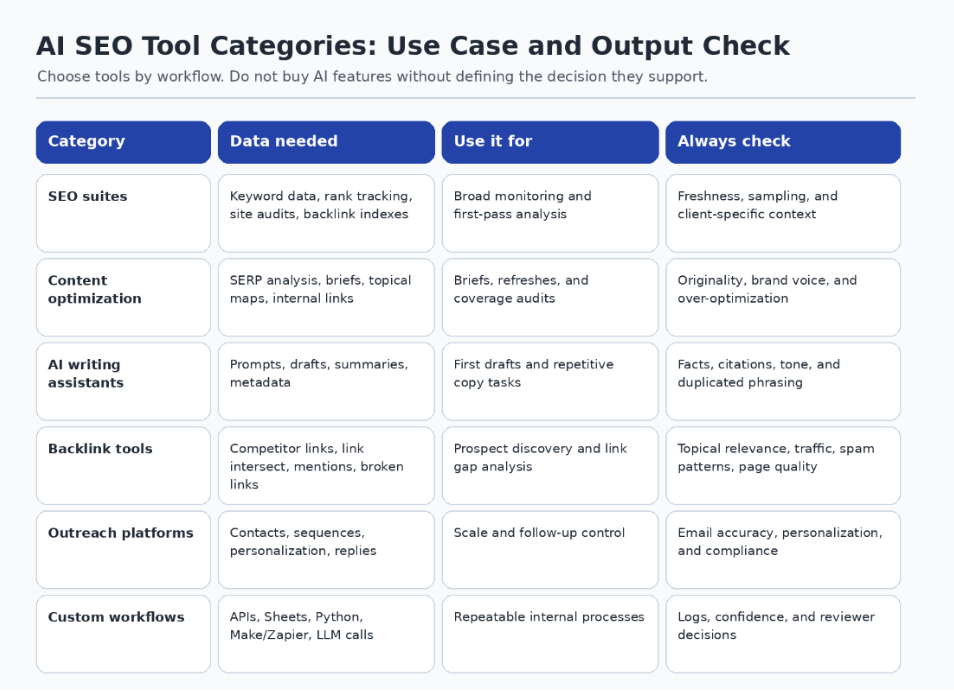
All-in-one SEO suites help teams monitor keywords, links, rankings, audits, and competitors in one place. Content optimization platforms help editors build briefs, refresh pages, and compare drafts against SERPs. AI writing assistants help with outlines, summaries, metadata, and transformations. Backlink tools help find link gaps, prospects, mentions, and broken links. Outreach platforms help manage contacts, personalization, follow-ups, and reporting. Custom workflows connect APIs, Sheets, Python, Zapier, Make, and LLM calls around a team’s own data.
Each category has a failure mode. SEO suites can hide sampling limits. Content tools can push teams into copycat pages. AI writers can invent facts. Backlink tools can return irrelevant or stale links. Outreach platforms can scale weak pitches. Custom workflows can break quietly if the input format changes. Every AI tool needs a reviewer and a log of decisions.
Practical AI SEO Workflows
Update an old blog post
Start with Google Search Console and analytics data. Identify a page with declining clicks, shrinking keyword coverage, or outdated facts. Use AI to summarize the current SERP, extract missing questions, and compare the page against competitor coverage. Then edit the page manually. Add current examples, remove outdated claims, update screenshots, add or correct schema, and strengthen internal links. After publishing, measure clicks, impressions, top queries, assisted conversions, and AI citations where tracking is available.
Build a content brief from SERP data
Start with a keyword cluster, not a single keyword. Use a content optimization tool or SERP API to extract top-ranking page types, common headings, questions, and entities. Ask AI to turn that data into a draft brief. Then rewrite the brief for the business goal: target reader, search intent, product angle, required proof, examples, sources, and internal links. The output should guide a writer, not replace thinking.
Find and filter 100 link prospects
Start with competitor backlinks, relevant resource pages, unlinked mentions, broken link targets, and niche publications. Enrich the list with traffic, authority metrics, language, country, topical category, contact data, and last publish date. Use AI to score fit and remove obvious mismatches. Then manually review the top prospects. A final prospect list should include URL, contact, page context, pitch angle, quality notes, risk flags, and target asset.
Prioritize technical SEO fixes
Start with a crawl and connect it to GSC, analytics, and template data. Use AI to group issues by pattern: template, URL type, canonical problem, internal linking problem, JS rendering problem, duplicate cluster, or CWV component. Score each group by affected pages, traffic, conversions, indexation risk, and repair effort. Turn the highest-impact groups into engineering tickets with examples and expected outcome.
Metrics and Benchmarks
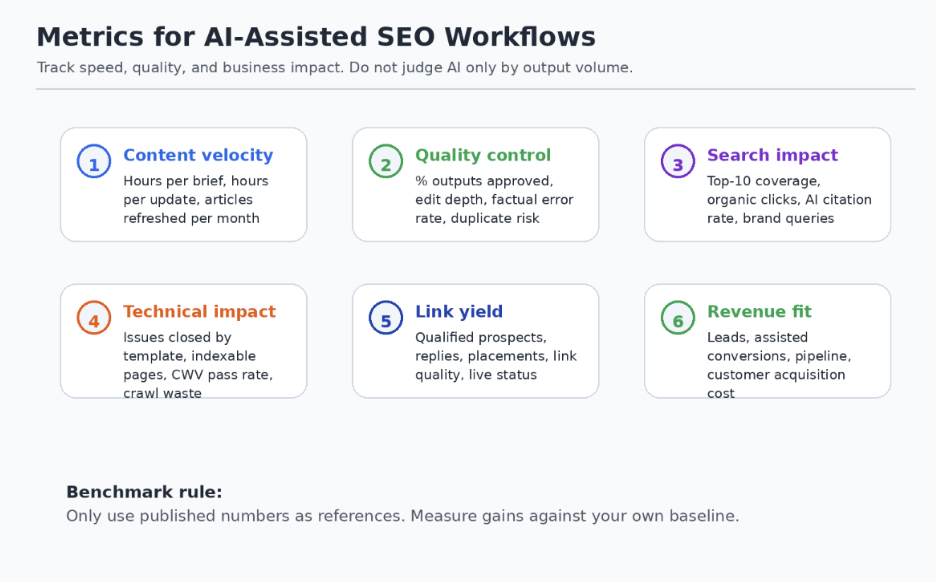
AI should improve a workflow, not only increase output. Teams need baseline metrics before they automate. For content, track hours per brief, hours per refresh, edit depth, approval rate, factual error rate, and performance after publication. For technical SEO, track issues closed by template, indexable pages, Core Web Vitals pass rate, and crawl waste reduction. For link building, track qualified prospects, reply rate, placement rate, live link status, topical relevance, and link quality.
The research cites one concrete case study: Helium SEO reduced time per 1,500-word article from 4.5 hours to 1.5 hours with an AI-driven content platform, a reported 79% reduction. It also cites an 84% increase in annual output while staff hours stayed flat. Use such numbers as references, not promises. Each team needs its own baseline because niche, review standards, subject complexity, and legal risk change the result.
AI citation tracking also belongs in the measurement set. Teams should track where the brand appears in Google AI Overviews, ChatGPT, Perplexity, Gemini, and other answer systems where relevant. Useful metrics include AI presence rate, citation share, sentiment of brand mentions, query coverage, and downstream conversions from branded search or direct visits.
Risks and Limitations
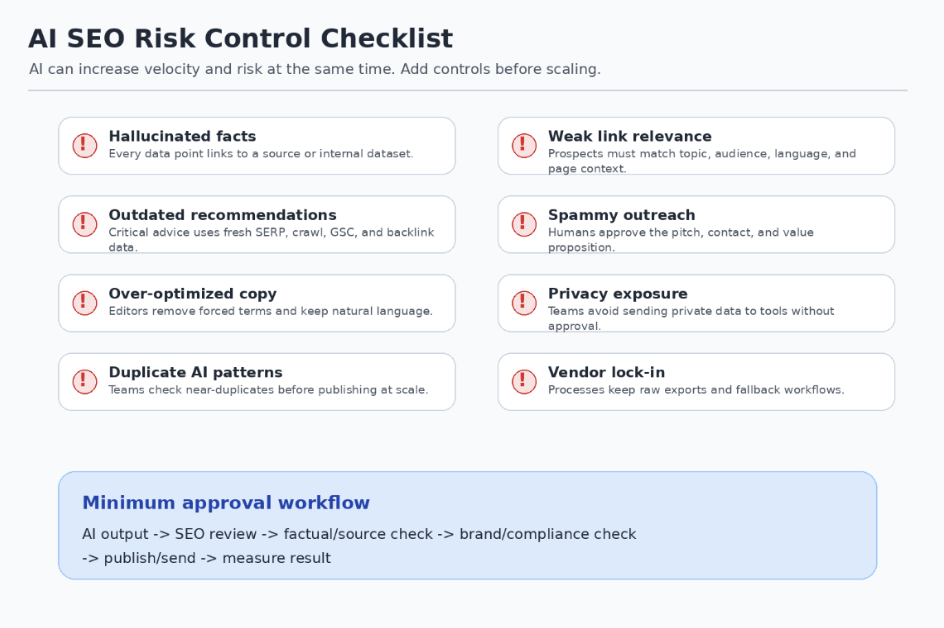
AI introduces operational risk because it lowers the cost of scale. A team can create more drafts, more briefs, more tickets, and more outreach. That helps only when the quality gate improves at the same time.
Hallucinated facts remain the most obvious risk. Any factual claim, statistic, source, quote, product feature, price, legal statement, or technical recommendation needs verification. Outdated recommendations are the second risk. A model may summarize old search behavior while the SERP changed last week. Teams should feed AI with current SERP, crawl, GSC, and backlink data when the decision depends on freshness.
Over-optimized content is another risk. Content optimization tools can make pages more complete, but they can also make them more similar to every other page using the same recommendations. Editors should remove forced terms, rewrite generic sections, and add proof that competitors do not have.
Link building adds a separate risk layer. AI can score prospects and draft emails, but it can also recommend irrelevant sites, misread context, or personalize from stale data. Teams should never allow automated outreach to run without review. The reviewer must check the domain, page, contact, pitch, anchor, and risk profile.
Privacy and compliance also matter. SEO teams often work with unpublished content plans, customer data, revenue reports, CRM exports, and proprietary performance data. Do not send sensitive data to AI platforms unless the company has approved the tool, contract, data handling, and retention policy.
Recommendations for SEO Teams
Solo specialists
Start with workflows that have clear inputs and outputs: keyword clustering, content brief drafts, SERP summaries, metadata variants, and simple internal link discovery. Keep the final page plan manual. Use the time saved for strategy, analysis, and editing.
Small SEO teams
Standardize one content workflow and one technical workflow before adding more tools. For example: monthly content decay scan, weekly brief generation, quarterly technical triage, and one link prospecting sprint per month. Define review rules before scaling output.
Agencies
Build reusable operating procedures. Each AI workflow should have required inputs, prompt or tool settings, reviewer role, approval criteria, and client-facing notes. Agencies should track edit depth and error rate, not only output volume. For link building, centralize prospect quality rules so teams do not scale weak placements across clients.
In-house SEO departments
Connect AI workflows to first-party data. In-house teams can use GSC, GA4, CRM, product data, conversion data, support tickets, sales calls, and content inventory. This makes AI recommendations more useful than generic SERP summaries. In-house teams should also align with legal, security, brand, engineering, and PR before using AI at scale.
Link-building teams
Use AI to enrich and score prospects, not to replace editorial judgment. The best link builders still understand the site, topic, writer, audience, and reason for the link. Train the system with successful placements and rejected prospects. Review outputs weekly and refine the scoring rules.
Conclusion
AI changes SEO work by moving repetitive analysis into supervised systems. It helps teams cluster keywords, build briefs, detect content gaps, group technical issues, find prospects, and personalize outreach faster. It also raises the cost of weak judgment because bad decisions now scale quickly.
The winning workflow in 2026 is not AI-only. It is AI-assisted and human-approved. SEO specialists who define strong inputs, set review rules, and measure outcomes will move faster without losing quality. Teams that use AI as a publishing or outreach shortcut will create more noise, more risk, and less trust.
Source Notes
This article was prepared from the attached research document. The research references Ahrefs, seoClarity, Yoast, Search Engine Journal / BrightEdge, Keyword Insights, SlateHQ, Noble Content Lab, Lily Ray, PikaSEO, and related SEO tooling sources.
Selected facts preserved from the research: Ahrefs reported a 58% lower average click-through rate for the top-ranking page when an AI Overview appears; Ahrefs also reported AI-cited content as 25.7% fresher than traditional organic results; seoClarity reported AI Overviews for 30% of U.S. desktop keywords in its dataset and more than 99% sourced from top-10 results; Noble Content Lab / Helium SEO reported a reduction from 4.5 to 1.5 hours per 1,500-word article; the research cites a BrightEdge-related claim that about 34% of AI citations come from PR-driven coverage.