- Pfizer Canada, Migraine Canada, and Migraine Québec continue partnership to educate Canadians on the impact of migraine.
- Increasing Return-to-Office mandates across professional sectors in Canada present challenges to those who struggle with migraine to manage their symptoms in the workplace due to misunderstanding or lack of support.
- New Migraine Canada and Migraine Québec survey data confirms significant support gaps remain in workplaces, highlighting the ongoing need for migraine care and resources.
KIRKLAND, QC, June 8, 2026 /CNW/ – In recognition of Migraine Awareness Month in June, Pfizer Canada, in partnership with Migraine Canada and Migraine Québec, announce the return of the Out of Office for Migraine Awareness campaign for its third consecutive year. This national initiative unites Canadians to challenge the invisible burden of migraine, particularly as it impacts workplace environments and productivity. This debilitating neurological disease takes a profound toll on the mental health, careers, and daily lives of over five million people across the country.1
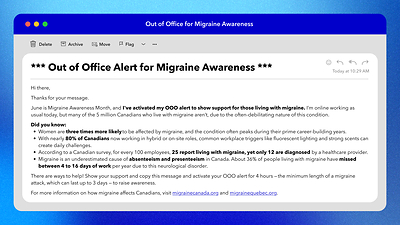
During Migraine Awareness Month, Canadians are encouraged to turn on their Out of Office (OOO) Alert for 4 hours — the minimum length of a migraine attack, which can last up to 3 days – to raise awareness and show solidarity with colleagues living with migraine (example below).2,3
“People living with migraine spend a lot of energy trying to manage and mask symptoms in the workplace, and that can be isolating because many people misunderstand or aren’t aware of the impact”, says Susan Cape, a patient advocate with Migraine Canada. “The simple act of reaching out and saying, ‘I sense you’re struggling, and do you need some support,’ can be all someone needs. It’s a small step, but it can make an incredible difference in making you feel seen, heard, and less alone at work.”
A 2026 survey commissioned by Migraine Canada and Migraine Québec underscores that need, revealing that significant support gaps remain in our workplaces, highlighting the ongoing need for awareness and education.
Evolving Workplaces and the Disproportionate Burden on Women
As the modern hybrid workplace evolves, new challenges are emerging for employees with migraine. With nearly 80% of Canadian workers now in on-site or hybrid roles,4 many are losing the controlled, low-trigger environments that remote work provided.5
“The return to shared workspaces means renewed exposure to common triggers. For someone living with migraine, this isn’t a matter of preference – it’s a clinical issue,” shares Dr. William Kingston, Assistant Professor of Neurology at University of Toronto and Neurologist, Sunnybrook Hospital, Toronto. “Exposure to environmental factors like fluorescent lighting and strong scents can lower the threshold for an attack. Employers and workplaces working with someone to adjust to a more favourable work environment can prove to be a huge benefit to a person with migraine.”
While migraine affects all genders, its disproportionate impact is a critical issue, as women are three times more likely to be affected,6 and the condition often peaks during their prime working years.7
“I had to leave my career as a nurse because the demanding environment became impossible to manage with chronic migraine,” comments Tiffany Eichhorst, a passionate patient advocate from British Columbia. “This isn’t just about debilitating pain and many other invisible symptoms that affect daily life; it’s about careers being impacted and people having to make difficult choices between their health and their profession.”
A Call for Greater Understanding and Support
“Now in its third year, this campaign is more important than ever. We’re hearing from our community that the return to offices has created new anxieties and we’ve confirmed this through recent 2026 survey data,” says Wendy Gerhart, Executive Director, Migraine Canada. “The OOO Alert remains a simple but powerful tool to spark dialogue even three years later. Our collective goal is to turn that dialogue into meaningful action. Proactive accommodations and flexible arrangements are not just perks – they are essential tools for retaining talented employees and enabling them to work to their full potential.”
A significant number of people in their peak earning years are affected by migraine, which has a substantial impact on the workforce.7,8 Migraine management resources such as Migraine Canada’s Duty To Accommodate in the Workplace resource equips organizations to help their employees better understand absenteeism and presenteeism (i.e. when employees are not fully functioning in the workplace because of an illness) and support those who experience it.9
Pfizer Canada is taking action to support its own colleagues, recently conducting an internal survey to better understand the ongoing need for migraine support within the company. This year, Pfizer calls on other Canadian organizations to do the same and provide support where it is needed.
“At Pfizer Canada, our commitment extends beyond medicine to fostering communities of support for patients,” said Frédéric Lavoie, Specialty Care and Internal Medicine Business Lead at Pfizer Canada. “This campaign offers a vital opportunity to shed light on the profound, often unseen consequences of migraine, and we are proud to continue helping Canadians foster conversations that could lead to meaningful change.”
Additional Quotes
“The true, debilitating nature of migraine is so often misunderstood and stigmatized, leaving people to struggle in silence both at work and at home,” adds Véronique Clément, Executive Director, Migraine Québec. “Our approach is to bridge that gap in understanding by equipping people living with migraine, their families, and their employers with the knowledge they need–from treatment options to effective workplace accommodations. The OOO alert remains a simple but powerful action for the migraine community.”
“I’m proud to be a part of this campaign for a third year,” said Dr. Heather Pim, neurologist and director of the University of Montreal Hospital Center’s Headache Clinic. “While migraine can develop into a chronic condition10, its power can be significantly diminished through proactive management. The primary barrier for many is a lack of education and access to resources, which directly impacts their health. This initiative is so vital because it empowers both employees and employers to create a healthier, more inclusive workplace, and I am thrilled to be a part of that positive change.”
“As a person living with migraine, it’s incredibly empowering to see the momentum of this campaign continue into its third year,” says Marie-France Lemire, Vice-President and Spokesperson for Migraine Québec. “It shows a growing commitment to understanding our reality and helps turn silent struggles in the workplace into supportive conversations.”
About Migraine in the Workplace
More than five million Canadians live with migraine.1 While migraine affects all demographics, its prevalence peaks for people in their 30s and 40s, when most individuals are likely employed.7 Despite this, migraine remains highly misunderstood and stigmatized in the workplace as being directly related to one’s ability to work. 11
The OOO Alert message can provide key migraine information, statistics, and resources to show allyship for colleagues impacted by migraine while encouraging their professional network to learn more.
For more information on migraine, please visit migrainecanada.org or migrainequebec.org.
About Migraine Canada
Migraine Canada is a nationally-registered charity organization dedicated to improving the lives of all Canadians living with migraine and other headache disorders. Our vision is to see that all Canadians living with migraine and headache disorders are diagnosed, treated and supported so their quality of life is optimized. Visit migrainecanada.org.
About Migraine Québec
Migraine Québec is a charity organization founded in 2014. Its mission is to enhance the quality of life of people living with migraine throughout Québec. Their vision is to help build a society where people living with migraine can thrive, without limitations or stigmatization. Visit migrainequebec.org.
About Pfizer Canada
Pfizer Canada ULC is the Canadian operation of Pfizer Inc., one of the world’s leading biopharmaceutical companies. At Pfizer, we apply science and our global resources to bring therapies to people that help extend and improve their lives. We strive to set the standard for quality, safety, and value in the discovery, development, and manufacture of health care products. Every day, Pfizer colleagues work to advance wellness, prevention, treatments, and cures that challenge the most feared diseases of our time. To learn more about Pfizer Canada, visit pfizer.ca or follow us on LinkedIn, Facebook, Instagram or YouTube.
References:
1 Migraine Canada. Access to Care and Treatment for Migraine in Canada Report Card. Accessed May 2026: Migraine in Canada: Report Card on Access to Care and Treatment – Migraine Canada
2 Migraine Canada. Migraine Diagnosis & Categorization. Accessed April 2026 at https://migrainecanada.org/understanding-migraine/what-is-migraine/migraine-categories/
3 Cleveland Clinic. Migraine Headaches. Accessed April 2026 https://my.clevelandclinic.org/health/diseases/5005-migraine-headaches
4 Statistics Canada. Percentage of workforce anticipated to work on-site or remotely over the next three months, fourth quarter of 2025. Accessed April 2026 at https://www150.statcan.gc.ca/t1/tbl1/en/tv.action?pid=3310109301
5 Migraine Canada. What your Employer Should Know about Migraine. Accessed April 2026 at https://migrainecanada.org/what-your-employer-should-know-about-migraine/
6 Migraine Canada. Women, Hormones and Migraine: An Overview. Accessed April 2026 https://migrainecanada.org/women-hormones-and-migraine-an-overview/
7 Ramage-Morin PL, Gilmour H. Prevalence of migraine in the Canadian household population. Health Rep. 2014 Jun;25(6):10-6. PMID: 24941316. Accessed April 2026 https://pubmed.ncbi.nlm.nih.gov/24941316/
8 Graves EB, Gerber BR, Berrigan PS, Shaw E, Cowling TM, Ladouceur MP, Bougie JK. Epidemiology and treatment utilization for Canadian patients with migraine: a literature review. J Int Med Res. 2022 Sep;50(9):3000605221126380. doi: 10.1177/03000605221126380. PMID: 36173008; PMCID: PMC9528037. https://pmc.ncbi.nlm.nih.gov/articles/PMC9528037/
9 Migrane Canada. Duty to Accommodate Workers Rights Accessed April 2026 at https://migrainecanada.org/duty-to-accommodate-workers-rights/
10 NIH Medline Plus. When migraine turns chronic. Accessed May 2026 at https://magazine.medlineplus.gov/article/when-migraine-turns-chronic#:~:text=Chronic%20migraine%20is%20defined%20as,fluctuates%20from%20month%20to%20month).
11 Young, W. B., Park, J. E., Tian, I. X., & Kempner, J. (2013). The stigma of migraine. PloS one, 8(1). DOI: https://journals.plos.org/plosone/article?id=10.1371/journal.pone.0054074

SOURCE Pfizer Canada Inc.