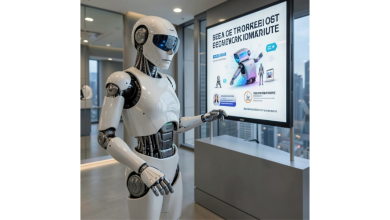
Artificial intelligence is already changing how agencies think about wildfire response. Detection systems can scan for smoke, predictive models can help estimate risk, and connected platforms can give command teams a clearer view of fast-moving incidents. Most of that progress depends on one assumption: the data can move when and where it needs to.
For remote fire crews, that assumption does not always hold. Wildland firefighters often work in steep terrain, heavy smoke, rural landscapes, and fast-changing conditions where network access can be limited or unavailable. That is why the question of how offline AI could support remote fire crews is becoming more than a technical curiosity. It is a practical challenge for the next generation of emergency-response technology.
Closing the Gap Between AI Insight and Field Use
AI is already helping public safety organizations think differently about operational data. The broader fire service is moving toward real-time fireground intelligence, where information from equipment, vehicles, sensors, and response systems can be connected to improve visibility for teams and command staff.
That connected model has obvious value. Better data can support faster decisions and stronger situational awareness. But wildland firefighting introduces a harder problem. A crew working miles from a command post may not have the same access to cloud systems and continuous data streams.
In other words, better intelligence is only useful if it can reach the people who need it. Offline AI offers one possible way to close that gap by moving certain decision-support functions closer to the crew.
Designing for the No-Connectivity Problem
In many industries, AI deployment is built around relatively stable infrastructure. Enterprise users often assume access to cloud environments and reliable power. Remote fire operations rarely offer that kind of predictability.
The terrain can block signals. Smoke can reduce visibility and limit the usefulness of certain sensors. The weather can shift quickly. Battery life can become a serious constraint. GPS data may be imperfect in some landscapes. Crews may also need to keep communication channels focused on critical updates rather than routine data exchange.
These constraints do not make AI irrelevant. They simply change what good AI design looks like.
A tool that works well in a control room may not be useful on the fireline if it depends on constant connectivity and large data transfers. For AI to support crews in remote environments, it needs to be built around real field conditions.
That means offline functionality should not be treated as a backup feature. In some settings, it may be the feature that determines whether the technology can be used at all.
Applying Offline AI to Field Decisions
Offline AI does not need to replace large-scale wildfire intelligence systems. Its value may come from handling narrower, more immediate tasks at the edge.
A field device could process local environmental inputs and provide basic hazard prompts without waiting for cloud analysis. A crew-facing tool might help interpret temperature, wind, smoke, or location data and flag when conditions begin trending in a riskier direction. Rugged handheld systems could store maps, incident notes, evacuation references, or safety checklists and adjust what they display based on local conditions.
Computer vision could also have limited offline applications. A local model might help analyze images or thermal inputs in specific situations, such as identifying visibility changes, terrain hazards, or equipment concerns. These systems would need careful testing, but the potential is clear: when data cannot reliably travel to the cloud, more processing may need to happen where the data is created.
The most practical tools will likely be focused rather than broad. Fire crews do not need a general-purpose AI assistant in the middle of a demanding assignment. They need systems that support specific decisions and work under pressure.
Keeping Humans in the Loop
Any AI system used in emergency response must be designed around human judgment. That is especially true in wildland firefighting, where conditions are dynamic and decisions can carry serious consequences.
Offline AI should not override incident command, crew leadership, or established safety protocols. It should function as a decision-support layer. That means clear recommendations and interfaces that are easy to understand in stressful conditions.
A vague warning is not enough. Field users need to know what the system is responding to, how urgent the signal is, and what action, if any, should be considered. If the system is uncertain, that uncertainty should be obvious.
Designers also need to avoid alert fatigue. Crews working in difficult environments cannot afford tools that create noise. A useful AI system should reduce cognitive load, not add another stream of information that has to be managed manually.
This is why offline AI for fire crews should be built with operators, not simply for them. Input from firefighters, crew bosses, dispatchers, and incident commanders can help determine which use cases are genuinely useful and which ones sound better in theory than they work in practice.
Connecting Digital Tools to Physical Readiness
It is easy to discuss AI as if better intelligence automatically creates better outcomes. In reality, the insights still have to be converted into actions.
If an offline AI tool identifies a safer route, flags a change in conditions, or helps prioritize a field decision, the crew still needs to be able to respond effectively. That depends on training, leadership, physical readiness, and the organization of essential gear.
Offline intelligence can shorten the gap between insight and action, but crews still need reliable field habits and organized fireline packing systems to make those decisions workable in real conditions.
This is an important part of the last-mile problem in emergency technology. AI may improve awareness, but awareness alone is not the same as readiness. For remote crews, digital systems and physical systems have to support each other.
The same principle applies across other high-risk industries. Edge technology is most valuable when it fits into the environment where people actually work. A model that performs well in testing still needs to survive heat, movement, dust, limited power, and human attention limits. In wildfire response, operational usefulness is the standard that matters most.
Preparing for the Next Phase of Wildfire Technology
The future of wildfire AI will likely include both centralized and decentralized systems. Large-scale models can help agencies analyze risk, improve planning, and coordinate resources across regions. At the same time, offline AI could support remote fire crews by bringing smaller pieces of intelligence closer to the people working beyond stable networks.
That combination may become increasingly important as climate conditions and land-use changes continue to make wildfire response more complex. Faster detection and better forecasting are valuable, but they are only part of the challenge. The next phase is making sure useful intelligence can reach the people who need it, even in the least connected environments.
For technology providers, that means designing AI tools with field constraints in mind from the beginning. For agencies, it means evaluating not only what a system can do in ideal conditions, but how well it performs when infrastructure is limited. For fire crews, it means future tools may become more supportive without becoming more intrusive.
Offline AI is not a replacement for experience or command structure. Its promise is more practical than that. It could help remote crews access relevant intelligence when conventional systems are harder to reach.
In emergency response, the most valuable technology is not always the most advanced on paper. It is the technology that remains useful when conditions are at their worst.