AI translation tools have changed how global businesses create multilingual content. Many companies now use large language models for speed and cost savings. The challenge appears when translations are used for B2B content. Marketing pages, SaaS documents, and technical material require accuracy and consistent tone.
A full comparison of leading LLMs shows clear differences in translation quality. Models from OpenAI, Anthropic, and Google perform differently depending on content type. Some models work well for casual text, while others handle structured business language better. Performance gaps become more visible in long-form and technical translations.
This analysis explains what actually works in real B2B translation tasks. It covers testing methods, model performance, and enterprise use cases. It also highlights key failures and practical workflows. The goal is to help businesses choose reliable AI translation systems for scalable global content.
Why LLM Translation Matters for B2B
B2B companies depend on clear communication across multiple languages. Poor translation leads to confusion, lost trust, and reduced conversions. Traditional translation methods are slow and expensive. LLMs offer a faster alternative for scaling global content.
Modern AI models such as GPT-4o and Claude allow real-time translation of complex business content. These models understand context better than older machine translation systems. This helps improve readability and fluency in target languages.
However, translation quality still varies. Some models struggle with industry-specific language. Others fail to maintain a consistent tone across documents. For B2B use, this inconsistency creates risk in branding and messaging.
Despite these challenges, LLMs are now central to global content strategies. They support localisation, documentation, customer support, and marketing translation. Businesses use them to reduce turnaround time and scale multilingual operations. The key lies in selecting the right model and workflow for the task.
Testing Methodology
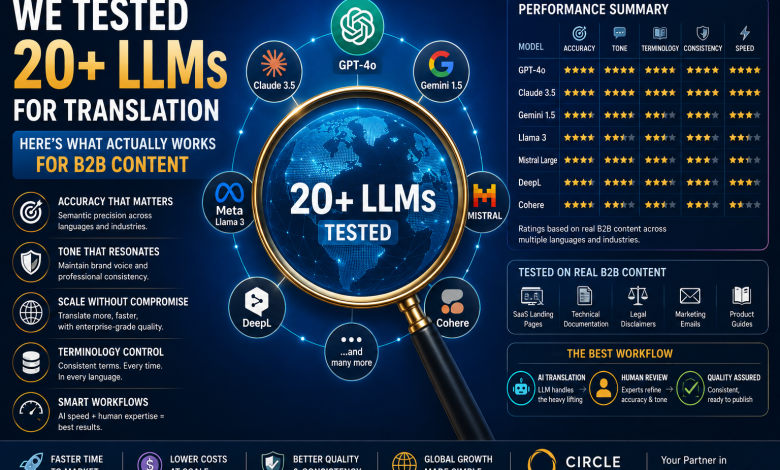
A structured testing approach is required to evaluate translation quality across LLMs. The testing process focuses on real-world B2B content instead of simple sentences. Inputs include SaaS landing pages, product documentation, legal disclaimers, and marketing emails.
Each model is tested under identical conditions. The same source text is translated into multiple languages. Outputs are compared for accuracy, tone, and consistency. Special attention is given to technical vocabulary and brand language.
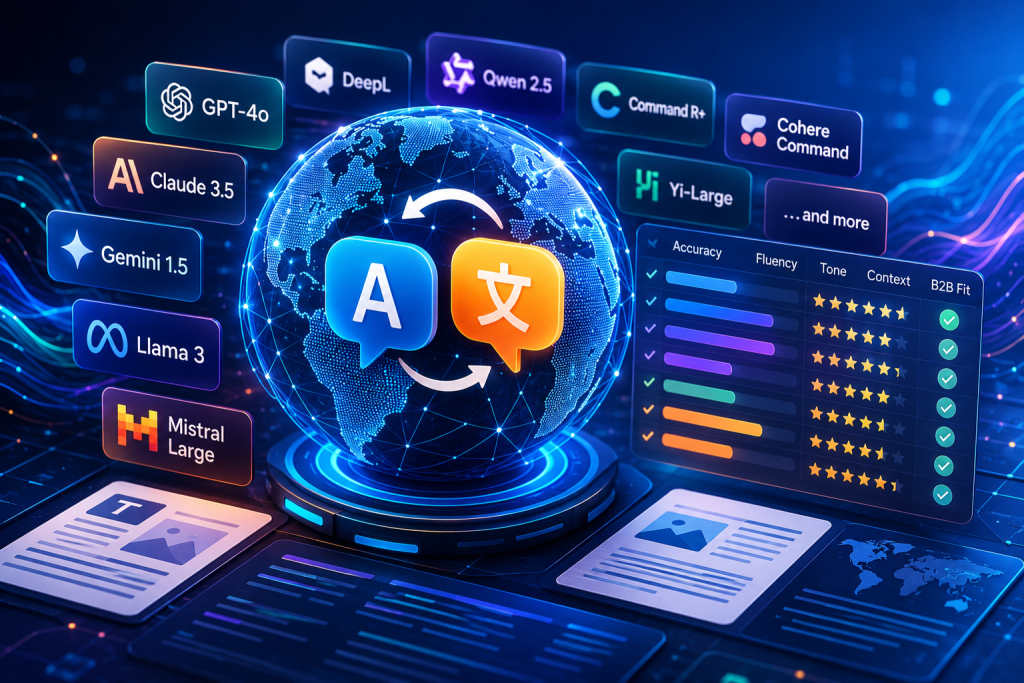
Models tested include GPT-4o, Claude, Gemini, and Llama from Meta. Open and proprietary models are both included for comparison.
Scoring is based on human review and structured benchmarks. Each translation is rated for meaning retention, fluency, and terminology accuracy. Edge cases such as idioms, regional expressions, and technical jargon are also included. This ensures results reflect real business use cases rather than controlled lab conditions.
Evaluation Criteria for Translation Quality
Translation quality in B2B use depends on more than language accuracy. Several factors determine if an LLM is suitable for enterprise content. The first factor is semantic accuracy. The meaning of the original text must remain unchanged.
The second factor is tone consistency. Business content requires a formal and stable voice. A shift in tone can damage brand perception. The third factor is terminology control. Industry-specific terms must remain consistent across documents.
Models like Google systems and OpenAI models show strong general performance. However, differences appear in specialised vocabulary handling.
Another key factor is contextual awareness. Long documents require memory of earlier sections. Without this, translation becomes fragmented. Readability is also important. The output must sound natural in the target language.
Final evaluation includes scalability. Enterprises require systems that can handle large volumes without quality loss. These criteria define real-world performance for AI translation tools.
GPT Model Performance in Translation
OpenAI models show strong performance in B2B translation tasks. GPT-4o produces highly fluent translations with strong contextual understanding. It performs well in marketing content and general business communication.
The model handles tone adaptation effectively. It can shift from formal to conversational styles without losing meaning. This makes it suitable for SaaS content and customer-facing material. However, it sometimes over-edits content. This can slightly change the original intent.
Technical documents show mixed results. GPT models occasionally simplify complex terminology. This can reduce precision in legal or engineering content. Terminology consistency improves when guided with structured prompts.
Overall, GPT-based systems offer balanced performance. They are strong in fluency and usability. They are less reliable for strict technical accuracy without additional controls. For most B2B workflows, they remain a leading choice due to versatility and speed.
Claude Model Performance
Anthropic models, especially Claude, show strong strengths in structured and precise translation. The model performs well in long-form business documents. It maintains context across long sections more consistently than many alternatives.
Claude delivers stable tone control. It preserves formal language better in corporate communication. This makes it suitable for legal documents, policy text, and enterprise reports. Terminology consistency is also strong in controlled environments.
However, creativity is limited. Marketing content sometimes feels less engaging compared to other models. This reduces effectiveness in brand storytelling. In some cases, translations feel overly literal.
Claude performs best in documentation-heavy environments. It is widely used in enterprise workflows where accuracy matters more than creativity. For regulated industries, it offers reliable output with reduced risk of hallucination or meaning drift.
Gemini Model Performance
Google developed Gemini, which performs well in multilingual translation tasks. It shows strong capabilities in structured data and multilingual understanding. It also benefits from large-scale training across diverse datasets.
Gemini handles short-form content effectively. Marketing headlines and UI strings translate cleanly. It also performs well in multilingual SEO content where keyword alignment matters.
However, long-form consistency can vary. In extended documents, tone shifts occasionally appear. This affects brand consistency in enterprise use. Technical terminology handling is strong but not always stable across languages.
Gemini is particularly effective when integrated into Google-based ecosystems. It supports scalable translation workflows for content-heavy organisations. Its strength lies in speed, multilingual coverage, and integration flexibility.
For B2B use, Gemini is suitable for content scaling but may require human review for precision-critical material.
Mistral and Open Model Performance
Open models such as Mistral AI and Llama offer flexibility for enterprise translation workflows. These models are often used in custom deployment environments.
Llama from Meta provides strong baseline translation quality. It performs well in controlled environments with fine-tuning. Mistral models offer fast inference and efficient processing.
However, out-of-the-box translation quality is less consistent compared to closed models. These systems require prompt engineering or fine-tuning for best results. Without optimisation, terminology and tone may vary.
The main advantage is control. Enterprises can customise translation pipelines based on industry needs. This includes domain-specific vocabulary and brand tone rules.
These models are ideal for organisations that require data privacy and infrastructure control. They are not always the best choice for plug-and-play translation, but excel in customised enterprise systems.
Industry-Specific Translation Challenges
Different industries require different translation standards. SaaS content focuses on clarity and user experience. Legal content requires precision and strict wording. Medical and technical industries demand accuracy above fluency.
LLMs often struggle with domain-specific vocabulary. A general model may translate terms too loosely. This creates risk in regulated environments. Marketing content is easier, but still requires tone control.
Technical industries require structured terminology databases. Without these, AI models may change slightly in meaning. This affects trust and compliance.
B2B translation also involves localisation, not just language conversion. Cultural adaptation plays a major role. Different regions expect different phrasing and tone.
The best results come from combining AI translation with human review. This ensures both accuracy and relevance across industries.
Brand Voice Preservation
Brand voice is critical in B2B communication. Translation must maintain tone, style, and personality across languages. Many LLMs struggle to preserve a consistent brand identity.
GPT-4o performs well in adaptive tone control. It can mimic brand style with clear instructions. Claude maintains formal consistency better in structured documents.
However, without guidelines, models often drift in tone. This creates inconsistency across multilingual content. Brand messaging becomes weaker in global markets.
The solution is structured prompting and style guides. These help models maintain tone across all translations. Enterprises often define tone rules for each language.
Consistency is more important than creativity in B2B translation. Strong brand voice improves trust and recognition across regions.
Terminology Consistency Systems
Terminology consistency is a key requirement for enterprise translation. Inconsistent terms create confusion in product documentation and marketing.
LLMs handle terminology differently. Some models maintain consistency within a single document. Others fail across multiple files. Controlled vocabulary systems improve performance significantly.
Glossaries and translation memory systems help reduce variation. These systems guide models to use approved terms. This is especially important for SaaS and technical industries.
OpenAI and Anthropic models respond well to structured prompts. When given term rules, output quality improves significantly.
Consistency is a major factor in enterprise adoption. Without it, scaling multilingual content becomes unreliable.
Multilingual SEO Impact
AI translation directly affects multilingual SEO performance. Poor translation reduces keyword relevance and search visibility. High-quality translation improves ranking in global search engines.
LLMs help generate SEO-friendly content at scale. They can adapt keywords for different languages. However, literal translation often fails in SEO contexts.
Search intent varies across regions. Direct translation does not always match local search behavior. This requires semantic adaptation rather than word-for-word translation.
Properly tuned models improve metadata, headings, and content structure. This supports international SEO strategies. Businesses targeting global markets benefit significantly from AI translation systems.
Common AI Translation Failures
AI translation systems still show predictable failures. One common issue is hallucinated meaning. Models sometimes add information not present in the source text.
Another issue is tone mismatch. Formal content may become too casual. Technical accuracy also breaks in complex sentences. Long paragraphs increase error rates.
Context loss is another problem. Earlier sections of a document may not be remembered correctly. This leads to inconsistent translations.
Terminology drift is also frequent. Key terms change across sections. These issues reduce trust in AI-generated translations.
Human review remains important in critical workflows. AI alone is not sufficient for high-risk content.
Best Workflows for Enterprises
The most effective enterprise workflow combines AI and human expertise. LLMs handle first-pass translation. Human editors refine accuracy and tone.
A hybrid system improves both speed and quality. Glossaries and style guides are integrated into AI prompts. This ensures consistency across documents.
GPT-4o and Claude are often used together in enterprise pipelines. One focuses on fluency, the other on precision.
Automation tools manage large-scale content translation. Quality assurance layers check terminology and tone. This reduces manual workload.
This workflow supports scalable multilingual content operations.
Final Recommendations and Decision Framework
Choosing the right LLM for translation depends on business needs. No single model performs best in all scenarios. GPT models excel in fluency. Claude excels in structure. Gemini excels in integration. Open models excel in customisation.
OpenAI, Anthropic, and Google each provide strong options for different use cases.
Enterprises should evaluate models based on content type. Marketing, legal, and technical content require different strategies. A hybrid approach delivers the best results.
Testing remains essential before full adoption. Real-world content should be used for benchmarking. This ensures accurate performance evaluation.
AI translation is powerful but not perfect. Proper systems and workflows unlock its full potential for global B2B growth.
FAQs
1. Which LLM is best for B2B translation?
GPT-4o and Claude are strong choices. GPT-4o is best for fluency. Claude is best for structured accuracy.
2. Can AI replace human translators?
No. AI supports translation but human review is still needed for accuracy and tone control.
3. What is the biggest issue in AI translation?
Terminology inconsistency and context loss are the most common problems.
4. How does AI help SEO translation?
AI helps scale multilingual content and adapt keywords for different languages and regions.
5. Are open-source models good for translation?
Yes, but they require fine-tuning and custom workflows for reliable performance.