The legal world is moving away from the “invisible injury” dilemma. Historically, if a standard MRI or CT scan came back normal, defense teams routinely claimed the plaintiff was exaggerating. Today, advanced tools like Diffusion Tensor Imaging (DTI) map actual nerve fiber damage, while blood-based biomarkers provide immediate biological proof of cellular trauma at the scene.
This data also dismantles the classic “pre-existing condition” defense. Instead of allowing insurance companies to blame cognitive decline on aging or depression, attorneys use machine learning to analyze years of pre-accident digital health metrics. This creates an undeniable “before and after” baseline that isolates the exact impact of the accident.
Furthermore, future damages are no longer based on guesswork or speculative math that judges easily slash. Predictive AI models now analyze thousands of similar patient profiles to calculate highly defensible lifetime care costs. They can even forecast the precise statistical risk of future complications, like post-traumatic epilepsy.
As a result, the courtroom battleground has shifted to the technology itself. Under strict legal evidentiary standards, lawyers are no longer just questioning a doctor’s clinical opinion. Instead, they are launching Daubert challenges to cross-examine the reliability, error rates, and algorithmic biases of the software processing the data.
Brain Injury Accidents: The Hidden Data Behind the Claim
Brain injury accidents are no longer just about “feeling off” after a fall, crash, or hard hit.
In entertainment, construction, transportation, and everyday life, the real injury often shows up slowly in memory, focus, mood, and daily performance long after the accident itself. In the United States, traumatic brain injury (TBI) affects about 1.7 million people each year, with thousands of new cases tied to workplace accidents, sports‑style impacts, and transportation events that initially look like “minor” incidents.
Traditionally, these injuries were hard to prove legally because they did not always show up clearly on a standard scan. Now, advanced imaging, AI‑assisted diagnostics, and digital health records are turning invisible symptoms into measurable evidence changing how brain‑injury accidents are valued in personal‑injury and workers’ compensation claims.
For the injured person, this is good news:
better tools can support real symptoms that once risked being dismissed.
For insurers and legal teams, it is a new challenge:
claims will increasingly hinge on whose data tells the more accurate story—doctors’ advanced tests, AI‑generated predictions, or the insurer’s internal models.
In this environment, a brain‑injury accident is no longer just a moment on the road, a set, or a stage.
It is the starting point for a data‑rich claim that can stretch for years, touching head trauma, long‑term recovery, lost income, and legal battles over how the numbers add up to compensation.
The Next Fight Will Be About Recovery
Once a brain injury is diagnosed, the next question becomes even more important: what will the future look like?
That question matters because the value of a serious injury claim is not based only on what happened on the day of the accident. It also depends on what the injury does to the person’s future.
Will the person return to work? Will they need long-term care? Will they recover fully, partially, or very slowly? Will memory problems continue? Will their ability to earn income change? Will their family life be affected?
Traditionally, medical experts would answer these questions through reports and testimony. A neurologist might describe the likely recovery path. A neuropsychologist might explain cognitive changes. A life-care planner might estimate future treatment costs.
Now, predictive AI models are beginning to enter this conversation.
These tools can compare a patient’s condition with large groups of past cases and produce possible recovery patterns. They may estimate how someone with a similar injury could
In legal terms, recovery is not just a medical question. It directly affects compensation. If a brain injury limits a person’s ability to work, increases future care needs, or causes lasting cognitive problems, those future losses become part of the claim. Predictive AI may help estimate those losses, but it also opens a new legal fight over reliability, data quality, and whether the model’s forecast should be trusted by insurers, courts, or juries.
Insurance Companies Are Also Using AI
AI is not only changing medical evidence. It is also changing how insurance companies handle claims.
Many insurers already use automated systems to review claims, estimate risk, detect fraud, assign severity scores, and decide which files need more attention. In simple cases, this can speed things up. A minor vehicle damage claim, for example, may be processed faster with automation.
Brain injury claims are different.
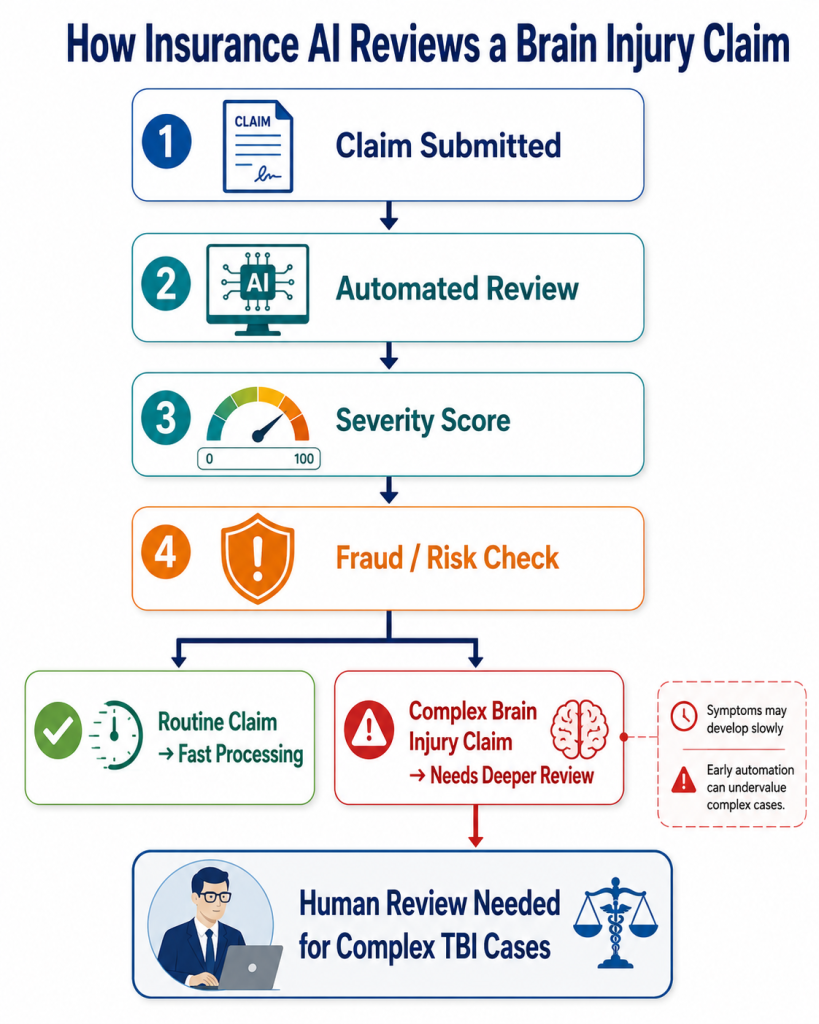
They are rarely simple. Symptoms may appear slowly. Medical records may develop over months. The injured person may look fine but struggle with focus, memory, headaches, fatigue, or mood changes. The true impact may not be clear in the first week or even the first month.
This creates a risk.
If an insurer’s AI system is trained to move claims quickly, it may undervalue cases that need more time and deeper review. A serious brain injury claim may be treated too early as a routine accident claim. The system may miss the long-term impact because the evidence is still developing.
That does not mean AI should be removed from claims processing. It means AI should not be allowed to make important decisions without proper human review, especially in complex injury cases.
Speed is helpful only when it does not come at the cost of fairness.
Lawyers Will Need to Understand the Technology
Personal injury law has always required translation.
Medical findings must be translated into legal arguments. Treatment records must be translated into damages. Symptoms must be explained in a way that insurers, judges, or juries can understand.
AI adds a new layer to that work.
A legal team handling a serious brain injury claim may need to understand what a biomarker test shows, what an AI-assisted scan means, how a predictive model was built, and where the model may be unreliable. They may also need to challenge an insurance company’s automated claim review if it leads to an unfair offer or denial.
This is where experience matters.
A general injury claim and a serious brain injury claim are not the same. Brain injury cases may involve advanced medical evidence, long-term recovery questions, expert testimony, and insurance models that are not always transparent.
For claimants, working with a California Brain Injury Lawyer can be important when the case involves traumatic brain injury, disputed symptoms, complex medical records, or long-term damages. These cases require more than basic claim handling. They require someone who can connect the medical evidence, legal strategy, and future impact of the injury into one clear case.
As AI becomes more common in medical and insurance systems, that kind of technical understanding will become even more important.
AI Can Help, but It Cannot Tell the Whole Story
The rise of AI in brain injury claims is not automatically good or bad. It depends on how the tools are used.
Used well, AI can help doctors detect injuries earlier. It can help identify patterns in medical records. It can help lawyers organize complex evidence. It can help insurers process information faster. It can help courts understand technical issues more clearly.
Used poorly, AI can create new problems.
It can make weak assumptions look scientific. It can undervalue unusual cases. It can rely on biased or incomplete data. It can turn a deeply personal injury into a score, estimate, or probability curve without enough human judgment.
That is the biggest issue.
Brain injuries affect real people in ways that are difficult to reduce to numbers. A model may estimate recovery, but it cannot fully capture the frustration of forgetting simple things. A scan may show changes in the brain, but it cannot fully describe the emotional toll of losing independence. A claim score may predict cost, but it cannot understand how an injury changes someone’s work, family, confidence, and daily routine.
Technology can improve the evidence. It cannot replace the human story behind the claim.
The Future Will Be Uneven
One important detail is often overlooked: this future will not arrive everywhere at the same time.
Some hospitals will use advanced tools earlier than others. Some doctors will have access to better imaging and testing. Some insurers will rely heavily on AI. Others will move more slowly. Some legal teams will understand the technology. Others may treat it as too complicated or ignore it completely.
That unevenness will affect real cases.
Two people with similar brain injuries may have very different claim outcomes depending on where they receive care, what insurance systems review their case, which experts become involved, and how early the right legal help is brought in.
This is already happening in smaller ways. Some claims include advanced imaging and detailed neurological testing. Others rely only on basic scans and short medical notes. Some insurers use sophisticated claim review tools. Others still depend mostly on traditional adjuster judgment.
The result is a transition period where the quality of evidence may vary widely from case to case.
A More Data-Driven Claim Still Needs Human Judgment
The future of brain injury claims will likely be more data-driven, but it should not become data-only.
Better scans, biomarkers, AI models, and digital records can all help create a clearer picture. They can reduce doubt, support real symptoms, and improve the way long-term damages are understood. They may also make it harder for serious injuries to be dismissed simply because they are not visible in a traditional scan.
But these tools still need interpretation.
Doctors must explain what the evidence means medically. Lawyers must explain what it means legally. Experts must clarify where the science is strong and where uncertainty remains. Courts and insurers must avoid treating AI results as final answers.
The strongest brain injury claims of the future will not be the ones that rely blindly on technology. They will be the ones that use technology to support a complete, human-centered case.
Final Take
Brain injury claims are entering a new stage.
For a long time, many cases were shaped by a difficult gap between what the injured person felt and what the available evidence could prove. AI and advanced medical technology are beginning to close that gap. They can make injuries easier to detect, easier to document, and easier to explain.
But they also create new questions.
Which model should be trusted? Which data matters most? Did the insurer’s system understand the complexity of the injury? Did the medical evidence get interpreted correctly? Did the legal team know how to use the technology without letting it overshadow the person?
That is where the future of these claims will be decided.
AI may bring more clarity to brain injury cases, but clarity is not the same as justice. The real value of technology will depend on whether it helps people tell the full truth of what happened to them.
Because a brain injury claim is not only about scans, scores, or predictions.
It is about a person trying to rebuild a life after an injury that may not always be visible, but can change everything.