
By the close of 2025, artificial intelligence had moved from a legal-tech experiment to a working part of major law-firm infrastructure. The Am Law 100 generated roughly $158.3 billion in gross revenue, with reported profit growth of about 13%, while AI platforms such as Harvey gained rapid adoption among large firms. This shows that AI is not arriving in a struggling profession; it is entering a highly profitable industry now under pressure to deliver faster, more efficient, and more transparent legal services.
The legal impact is not limited to productivity. AI now touches core professional duties such as competence, confidentiality, supervision, candor to the court, billing fairness, and client communication. The ABA’s Formal Opinion 512 made clear that lawyers remain responsible for verifying AI-assisted work, protecting client data, and ensuring that fees remain reasonable even when generative AI helps with research, drafting, or document review.
Courts are also becoming more cautious. Some federal judges now require lawyers to certify whether AI was used in preparing filings, especially after multiple cases involving fabricated citations and hallucinated legal authorities. In one federal appeals matter, an attorney was fined $2,500 after a brief included AI-generated false citations and claims. That risk has turned AI use into a legal-compliance issue, not just an internal workflow choice.
The deeper challenge is economic. The billable-hour model rewards time spent, while AI rewards time saved. If a task that once took five hours can now be completed in one hour with proper human review, clients may increasingly question traditional billing. The future of AI in law will therefore depend not only on adoption, but on governance: secure use, human verification, ethical billing, and lawyer-led judgment. In legal practice, speed will matter, but trust and accountability will matter more.
The Economic Reordering Already Visible
Three trend lines define the financial picture, and each is rising sharply.
Technology Investment
Law firm spending on technology rose 9.7 percent in 2025, according to the 2026 Report on the State of the US Legal Market produced by Thomson Reuters and Georgetown Law’s Center on Ethics and the Legal Profession. Spending on knowledge management rose 10.5 percent. Both figures represent the fastest real growth the legal industry has ever recorded in those categories.
Platform Scale and Market Concentration
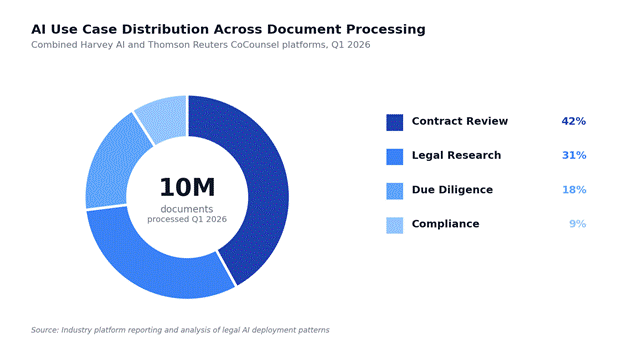
Harvey AI, the legal AI platform built in partnership with OpenAI, reached a $3 billion valuation after its December 2025 funding round. The combined platforms of Harvey and Thomson Reuters’ CoCounsel processed approximately ten million legal documents in the first quarter of 2026, a roughly twelvefold increase from the same quarter a year earlier. Contract review accounted for 42 percent of that volume, legal research for 31 percent, due diligence for 18 percent, and regulatory compliance for 9 percent.
Firm Financial Performance
Am Law 100 total revenue reached $158.3 billion in fiscal 2024, up 13.3 percent year over year. Revenue per lawyer climbed to $1.28 million, up 5.2 percent. Profits per equity partner reached $3.15 million, up 12.3 percent. Demand for legal services grew 3.9 percent year over year in the third quarter of 2025, the fourth-highest quarterly demand growth observed in the past two decades.
What these numbers describe collectively is a profession running two tracks simultaneously: aggressive investment in AI infrastructure alongside aggressive growth in traditional revenue. The two are not yet in obvious tension. The longer-term question is how long they remain compatible.
“What used to take a team of associates two weeks now takes 45 minutes. And the output isn’t just faster, it’s more consistent and more thorough than what humans produce under time pressure.”
Winston Weinberg, co-founder and CEO, Harvey AI
Where AI Has Earned Its Seat in Legal Work
Adoption has spread fastest where the work is most pattern-driven. Legal research, document review, due diligence, contract analysis, and e-discovery have absorbed most of the early integration, and the productivity figures in those categories are substantial. Studies conducted in 2025 found that AI-powered legal research reduced average task time by 62 percent. Ninety-three percent of law firms now report that AI has reduced time spent on non-billable administrative work.
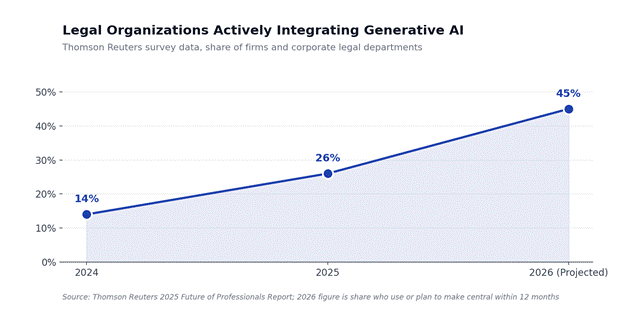
Adoption is much more cautious in areas that involve judgment, novel argument, or client-facing strategy. The Thomson Reuters survey that recorded 26 percent of legal organizations actively integrating GenAI in 2025, up from 14 percent in 2024, also found that even firms describing themselves as bullish remain, in their own words, hyper-cautious. That caution is rational. The cost of an AI error in a brief is now well documented across more than 600 reported sanctions in U.S. courts.
| Practice Area | Adoption Pace | Productivity Gain | Notable Risk |
| Legal research | High | 62% average time reduction | Hallucinated citations and fabricated authority |
| Document review | High | 75% faster on volume work | Confidentiality of uploaded materials |
| Contract review | High | 42% of all legal AI document volume | Missed clauses and inconsistent risk flagging |
| Due diligence | Moderate | Substantial on M&A document sets | Material omissions in deal documents |
| Regulatory compliance | Moderate | 9% of legal AI document volume | Jurisdictional drift in evolving rules |
| Brief drafting | Cautious | Variable, judgment-dependent | Rule 11 sanctions and judicial credibility loss |
| Trial strategy | Limited | Minimal at present | Loss of attorney work-product privilege |
Inside the Courthouse: Judges Set New Ground Rules
The court side of this transition is moving in parallel. Federal judges across multiple districts have issued standing orders requiring lawyers to disclose AI use in filings, certify that all citations have been verified, or, in some courts, prohibit unverified AI-generated content entirely. The Federal Rules of Evidence, last comprehensively updated for the digital era in 2017, are now under discussion at federal judicial conferences for amendments specific to AI-generated and AI-modified materials.
Judges have also become active enforcers. Public trackers documented more than 600 sanctioned cases of fabricated legal authority nationwide by late 2025, with the rate accelerating from roughly two cases per week in early 2025 to two to six new cases per day by December. Fines have grown from the $5,000 penalty in the original Mata v. Avianca matter to a $31,000 sanction imposed by a Los Angeles federal judge in August 2025, the largest single AI-hallucination penalty on record.
The Talent Pipeline Question
The most contested issue inside firms concerns the bottom of the career pyramid. Junior associates have historically performed the kind of high-volume, pattern-driven work that AI now handles in a fraction of the time. The implications are becoming visible. Clifford Chance announced AI-related job reductions in 2024. The 2026 Report on the State of the US Legal Market found that firms have reduced the pace of associate hiring and trimmed summer associate program sizes.
The labor picture is not yet a contraction story. Total lawyer FTE growth at U.S. firms reached 2.9 percent in 2025, the third consecutive year of historically strong hiring. The legal industry is not replicating the AI-related layoffs visible in software engineering or media. What is changing is the shape of entry-level work and the implicit contract that has long traded grueling associate years for eventual partnership.
Forty percent of law firm respondents in a 2025 Thomson Reuters survey now believe AI will lead to an increase in non-hourly billing methods. That projection, if it materializes, would represent the first structural change to legal services pricing since the spread of the billable hour in the 1950s.
A Practitioner’s Perspective from California
The states where AI adoption in legal practice is moving fastest are also the states where AI-related cases are reaching the courts most often. California sits at the center of both trends. The state has produced more AI-related personal injury filings than any other jurisdiction, more state bar guidance on AI use than nearly any other bar, and a disproportionate share of the published case law that other states are beginning to cite.
Plaintiff practitioners working in this environment have had to develop expertise that combines traditional product liability and personal injury doctrine with a working understanding of how machine-learning systems actually function. California trial lawyers handling catastrophic injury, vehicle technology, and complex product cases have been among the earliest observers of how AI-driven litigation actually proceeds, and what the practical evidentiary problems look like inside the courtroom rather than in academic literature. The work demands the same fundamentals that trial practice has always required, with new categories of expert testimony, new discovery obligations, and new strategic questions layered on top.
What Survives and What Does Not
Several elements of legal practice will survive any plausible version of the next decade. Adversarial argument, judgment under uncertainty, courtroom advocacy, client counsel on consequential decisions, and the strategic shaping of complex matters remain difficult to automate and may become more valuable as routine work disappears. Several other elements are visibly under pressure. The billable hour as the default pricing model. The traditional pyramid that depended on volumes of junior labor. The assumption that legal research and document review are inherently slow processes.
The picture is not one of replacement. It is one of redistribution. The work that survives will be more concentrated, more strategic, and more dependent on judgment that AI systems still cannot reliably replicate. The work that does not survive will be absorbed by software at a pace the profession has rarely experienced.
Looking Toward 2030
The reasonable forecast for the next five years includes several developments that already appear close to inevitable. Generative AI will become a routine layer in legal research platforms, contract management systems, and discovery tools. State bar guidance will continue to converge around the framework established by ABA Formal Opinion 512. Federal court rules will incorporate AI disclosure and authentication standards. Alternative fee arrangements will expand even if the billable hour does not disappear. AI-related product liability will become a recognized subspecialty of personal injury law. Legal education will adjust to produce graduates who treat AI fluency as table stakes rather than as a specialty.
What will not change is the fundamental nature of the profession. Law remains a discipline organized around human disputes, human consequences, and human accountability. The technology surrounding that work has changed dramatically. The work itself has not been replaced. It has been amplified, accelerated, and in some ways made more demanding.