



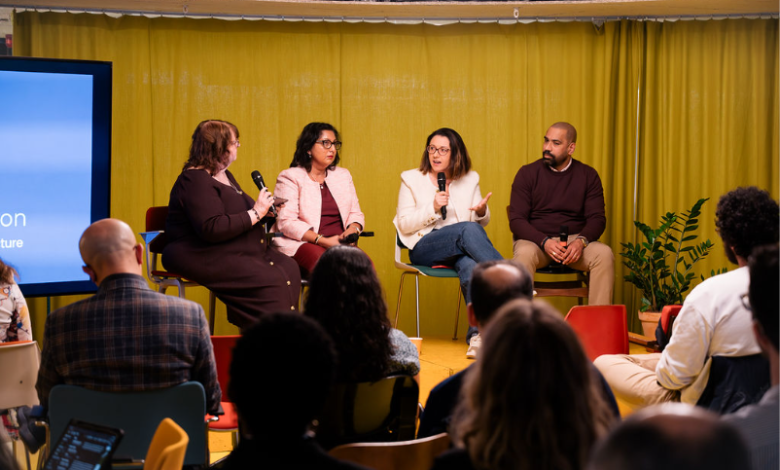
Drawing on five years of research, expert-led salons across the GCC and Europe, and its Impact Prism™ framework, Kaleidoscope has examined why the gap between AI ambition and AI resilience has become the defining challenge for organisations across two of the world’s most consequential markets.
— Kaleidoscope, a London-based advisory helping companies understand where sustainability, resilience, and commercial performance meet, has released findings from its research into AI governance across the GCC, UK, and Europe. Drawing on five years of research, expert-led salons including a closed-door Suhoor in Dubai and its London Salon series, and the advisory’s Impact Prism™ framework, the research examines why organisations that adopt AI without building the governance architecture to support it are creating fragility rather than advantage.
According to Kaleidoscope’s findings, responsible AI is about creating the architecture that allows AI to scale without creating fragility: governance, ownership, oversight, resilience, inclusion, and the ability to explain the systems being built.
The Question Boards Are Not Answering Clearly Enough
Across its convenings with executives, policymakers, and advisors on two continents, Kaleidoscope has examined whether organisations can scale AI and sustainability together rather than sequentially. According to Kaleidoscope’s findings, the gap between ambition and execution is widening faster than most boards have acknowledged. The organisations best positioned for the next decade are, according to Kaleidoscope’s research, those that treat AI adoption and sustainability governance as the same workstream rather than separate priorities.
The GCC: Capital, Ambition, and a Governance Question
At a recent closed-door Suhoor convened by Kaleidoscope at the One and Only Royal Mirage in Dubai, the advisory brought together executives, policymakers, and advisors to examine the intersection of AI and sustainability governance in the Gulf. Kaleidoscope’s findings from that convening identify AI without governance as carrying risks of exponential energy demand, water stress, labour displacement, and a dangerous concentration of digital power.
“The UAE is uniquely positioned. You have AI readiness, sovereign capital, and genuine sustainability ambition in the same room. The question we keep asking is whether governance is moving fast enough to make sure those three things compound in the right direction rather than cancel each other out,” said Sandhya Sabapathy, Founder and CEO of Kaleidoscope.
Mayank Patel, who joined the session as a Spotlight Voice, brought the corporate operational lens. According to Kaleidoscope’s findings from the convening, AI adoption is accelerating at a pace that the social infrastructure around it is not matching.
“The real question is not whether AI is augmenting human capital. It is whether we are building the social infrastructure quickly enough to absorb the displacement it is already creating,” Patel noted.
The advisory anticipates that the GCC represents a region with the capital, policy ambition, and regulatory momentum to address these questions before other markets are required to. Green data infrastructure, sovereign capital aligned to sustainable AI, and incentive structures for responsible deployment are, according to Kaleidoscope’s research, commercially achievable in this context.
UK and Europe: The Gap Between AI Ambition and AI Resilience
Across the UK and Europe, Kaleidoscope’s research identifies a different version of the same challenge. Senior leaders are no longer asking whether to adopt AI. According to Kaleidoscope’s findings, they are asking whether the way they are adopting it will hold under regulatory, reputational, and operational scrutiny.
According to Kaleidoscope’s findings, enterprise AI pilot failure rates remain high, board-level scrutiny of AI investment is intensifying, and regulation is tightening across multiple jurisdictions simultaneously. Through its London Salon series, the advisory has been convening academics, corporate leaders, and policy thinkers to move the conversation beyond ethics and into execution.
“What we are seeing is that the gap is not ambition, it is architecture. The organisations that are getting AI right are the ones who built sustainability, inclusion, and resilience into the foundation. Not bolted it on after the fact,” Sabapathy said.
Regulation as a Signal, Not a Constraint
Dr Jacqui Taylor, Expert Advisor to the European Commission and UK Government on AI and technology, and a Kaleidoscope advisor, frames the regulatory environment in terms that Kaleidoscope’s research supports.
“Regulation is always running two to three years behind the technology. The organisations who will be ahead are not the ones reacting to it. They are the ones treating it as a signal of where the world is going,” Dr Taylor observes.
That reframing is consequential. According to Kaleidoscope’s findings, organisations that use regulation as a planning tool rather than a compliance burden gain a structural advantage. They are building toward a state that others will be required to reach. By the time the requirement arrives, they are already there.
The Generational Dimension Boards Are Missing
Kaleidoscope’s research surfaces a generational dimension that most boardroom AI conversations have not yet absorbed. The workforce entering organisations over the next five years has a fundamentally different relationship with AI than the leaders governing those organisations.
Dhruva Bhat, Co-Founder of Lumiere Education Group and a panellist at the Kaleidoscope London Salon, addresses it directly.
“Gen Z and Gen Alpha are already AI natives. They are using these tools intuitively in ways institutions are scrambling to catch up with. If you want to understand where AI governance needs to go, start by watching how the youngest generation is already living with it,” Bhat says.
Responsible AI as Commercial Advantage
Kaleidoscope’s research finds that the organisations seeing measurable results from AI are not those attempting to scale everywhere at once. Sunil Bharadwaj, Senior Director of Sustainability at Capgemini, confirms this finding.
“Organisations that try to scale AI everywhere at once are stalling. The ones seeing results are going deep and narrow: one problem, one use case, use-case specific data. That is how you prove ROI and that is how responsible AI becomes a driver of innovation rather than a liability,” Bharadwaj says.
What Kaleidoscope’s Research Found Across Both Geographies
Across five years of research, expert-led salons, and its Impact Prism™ framework, Kaleidoscope’s findings across the GCC and UK and Europe are consistent. Commercial advantage, reputational integrity, and regulatory readiness are not separate workstreams. They are three levers of the same system. According to Kaleidoscope’s research, governance is not the brake on AI progress. It is the architecture that makes progress sustainable.

About Kaleidoscope
Kaleidoscope is a London-based advisory helping companies understand where sustainability, resilience, and commercial performance meet. Its work focuses on the practical questions facing leadership teams: how climate and nature risk, regulation, supply chains, reputation, capital, and customer expectations are changing the way a business is run, and what decisions need to change as a result. Founded by Sandhya Sabapathy, an ESG and sustainability leader whose experience spans global markets, FTSE 100, Fortune 500, and public-private partnership environments, Kaleidoscope combines five years of research, expert-led salons, and its Impact Prism™ framework to turn complex signals into clearer strategic and operational choices. For more information visit kaleidoscope.earth.
Contact Info:
Name: Gianmarco
Email: Send Email
Organization: Xraised
Website: http://xraised.com
Release ID: 89193673
If you detect any issues, problems, or errors in this press release content, kindly contact [email protected] to notify us (it is important to note that this email is the authorized channel for such matters, sending multiple emails to multiple addresses does not necessarily help expedite your request). We will respond and rectify the situation in the next 8 hours.