Patent drawings are often treated as the final production step before a filing, but they can strongly affect how clearly an invention is understood. A strong specification can still become harder to review when a flowchart is inconsistent, a product view omits an edge, or reference numerals change from one figure to the next. For patent attorneys, in-house IP teams, and technical founders, figure preparation is not just illustration work. It is part of the disclosure workflow.
The traditional process is familiar. An inventor sends photos, CAD exports, screenshots, sketches, or a rough system diagram. A patent professional turns that material into drawing instructions. A draftsperson redraws the figures as black-and-white line art. The team reviews each sheet, requests corrections, waits for another version, and repeats the cycle until the figures are clean enough for filing. That process can work, but it is slow and fragile when an application has many figures or when the product changes late in drafting.
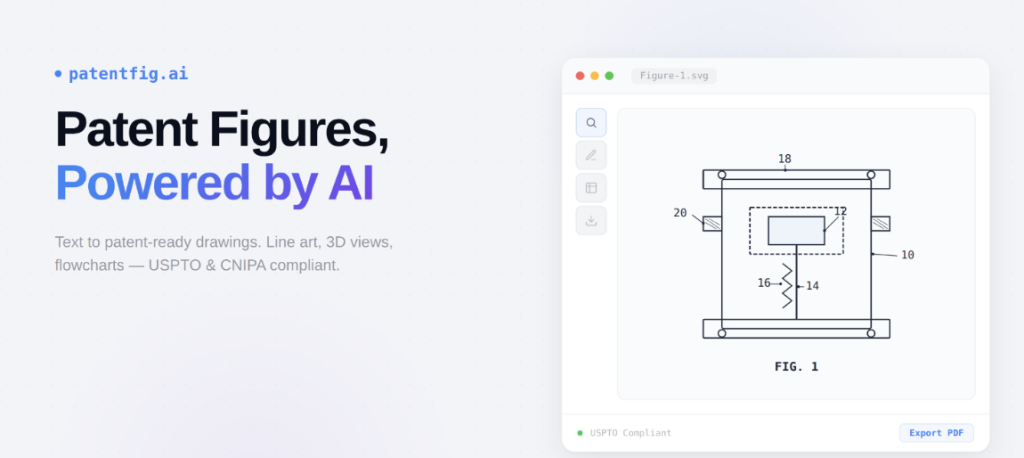
PatentFig AI positions patent figure creation as a workflow for line art, review, and export rather than a one off image generation task.
This is where AI is starting to change patent figure preparation. The goal is not simply to create a nicer image. The more useful shift is from manual redraws to reviewable figure systems: tools that can take a description, a product image, a sketch, a 3D reference, or a software architecture and produce a draft that can be checked, revised, labeled, and exported in filing-ready formats.
PatentFig AI is one example of this new category. It is built as an AI native patent drawing workspace for patent attorneys, patent agents, enterprise IP teams, and independent inventors who need utility patent figures, design patent views, flowcharts, block diagrams, and technical line art without starting every figure from a blank canvas. Instead of treating AI as a generic illustration engine, the product focuses on the constraints that make patent drawings different from ordinary graphics: black-and-white line work, reference numerals, view consistency, office-specific rules, and export formats that fit the filing process.
Why generic image generation is not enough
Generic AI image tools can produce impressive visuals, but patent drawings have a different standard of usefulness. A photorealistic product rendering may look polished while failing as a patent figure. It may include shading that is inappropriate for the filing context, blur important edges, hallucinate physical details, or change geometry between views. A patent team does not need an artistic interpretation of the invention. It needs a clean technical representation that can be reviewed, corrected, and tied back to the claim strategy.
PatentFig AI is designed around those use cases. Users can start from text, a sketch, a reference image, a product photo, or a 3D model, then generate a patent figure draft that can be refined through the workspace. For design patent workflows, the platform supports multiview sets such as front, rear, left, right, top, bottom, and perspective views. For utility filings, it supports flowcharts, system diagrams, mechanical views, electrical and circuit-style drawings, and AI or software architecture figures.
A patent-style line drawing needs clean outlines, numbered callouts, and repeatable visual logic, not decorative rendering.
Reviewability matters more than automation alone
The real productivity gain comes when AI output becomes easy to review. A first draft is useful only if the team can identify what changed, correct details, and bring the figure into the style required by the application. This is especially important in patent work because figure edits are often tied to legal and technical judgment. A draftsperson may know how to redraw an object, but the attorney or inventor knows which elements need to be emphasized, omitted, dashed, numbered, or described in the specification.
A reviewable workflow gives teams a middle path between doing everything manually and accepting an AI image as final. PatentFig AI includes tools for iterative editing, reference numeral consistency, line-art refinement, DPI enhancement, vectorization, and format conversion. The output can be exported in formats such as SVG, TIFF, PDF, and PNG, depending on how the team wants to preserve, edit, or file the drawing. SVG is useful for continued editing, while high-resolution TIFF or PDF output is useful for submission and review packages.
Compliance is another part of reviewability. Patent drawings must satisfy formal expectations that vary across jurisdictions. PatentFig AI is built with workflows for USPTO, CNIPA, EPO, JPO, KIPO, and PCT drawing requirements, including rules around line drawings, figure formatting, and submission-ready output. The platform does not replace the judgment of a qualified patent professional, but it can reduce repetitive figure production work before that professional review.
Where AI patent drawing workflows fit best
AI assisted figure preparation is most useful when the team already has a clear invention disclosure but needs to move faster from rough material to filing-ready visuals. A solo inventor may have a product photo and a written description but no illustrator. A startup may need provisional figures before a funding announcement or product launch. A law firm may need to standardize figure quality across many client drafts. An enterprise IP team may need consistent diagrams for related filings that share a product architecture.
For software and AI inventions, the workflow can start with architecture notes or a model pipeline. For mechanical inventions, it can start with product photos, CAD screenshots, or hand sketches. For design patents, the value is often in keeping multiple views consistent enough for review, especially when small geometry changes can create confusion across sheets.
This is why dedicated AI patent drawing software is becoming a practical alternative to the old redraw cycle. It does not remove the need for review, but it moves the first version of the figure closer to the format patent teams actually need. It also gives teams more chances to explore figure strategy earlier, before the final drafting deadline compresses every edit into a rush.
A better role for human experts
The strongest argument for AI in patent drawing is not that it eliminates professional skill. It is that it lets human experts spend more time on judgment. Patent professionals still decide what the figures should disclose, how reference numerals map to the specification, whether broken lines or shading are appropriate, and whether a figure supports the claim set. What changes is the amount of time spent converting rough inputs into a usable first draft.
As AI tools mature, patent drawing will likely become less about outsourcing every line and more about managing a reviewable visual record of the invention. PatentFig AI shows how that future may look: a workspace where technical descriptions, sketches, product images, and legal filing requirements meet in one figure-generation process. For teams that prepare patent applications regularly, that can mean fewer redraw cycles, more consistent figures, and a clearer path from invention disclosure to filing-ready drawings.