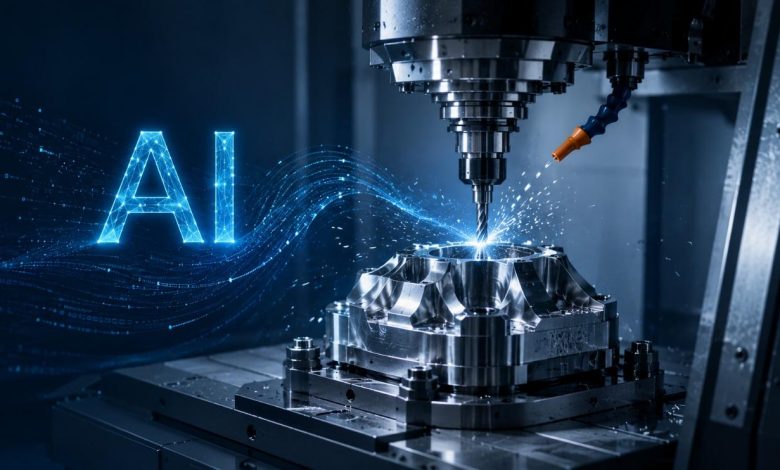
With the manufacturing industries moving towards digitalisation and intelligent production, artificial intelligence (AI) has been one of the key technologies to promote the transformation of CNC machining. Conventional CNC machining relies on manual programming, operator experience and fixed process parameters. But the use of AI technologies such as machine learning, computer vision, sensor analytics, and predictive algorithms is making CNC machining more adaptive, efficient, and intelligent.
AI isn’t just replacing operators. Rather, it enhances decision making, increases machining stability, reduces production waste and enables more autonomous manufacturing systems. From toolpath optimisation to predictive maintenance, AI is revolutionising almost every aspect of the CNC machining process.
AI-Aided Process Planning and CNC Programming
Intelligent process planning is one of the most important applications of AI in CNC machining. In conventional manufacturing, engineers manually select machining sequences, cutting parameters, tooling selection and fixture strategies based on experience. This process can be time consuming and heavily dependent on skilled personnel.
AI systems can look at historical machining data, material properties, part geometry and machine capabilities and automatically generate optimised machining strategies. Machine learning algorithms can suggest optimal spindle speeds, feed rates, cutting depths and tooling combinations for different materials and geometries.
CAM software can also benefit from AI by increasing the efficiency of CNC programming. It can automatically recognise machining features such as pockets, holes, slots and contours. This shortens programming time and reduces human errors in manufacturing complex parts.
In high mix and low volume production environments, such as aerospace prototyping or custom manufacturing, AI assisted programming dramatically reduces lead times and improves consistency.
Smart Toolpath Optimization
Another important area where AI enhances CNC machining performance is toolpath optimization. The traditional toolpaths are pre-determined based on mathematical strategies. However, these strategies may not fully consider the real-time cutting conditions, tool wear, machine vibration or thermal deformation.
The algorithms of the AI can dynamically optimize the cutting paths by analyzing the sensor feedback during machining. The system constantly monitors the spindle load, vibration, cutting force and temperature and makes real-time adjustments to the machining parameters.
This adaptive machining feature comes with several advantages:
- Reduce cycle time
- Better surface finish
- Lower tool wear
- Increased dimensional accuracy
- Minimized chatter and vibration
AI can also be used to optimize collision avoidance and tool orientation in multi-axis CNC machining, thus improving safety and efficiency of machining complex geometries.
Predictive Maintenance of CNC Machines

Unexpected machine downtime is one of the biggest challenges in manufacturing. This problem is tackled by AI-based predictive maintenance systems that continuously monitor the condition of machines and predict possible failures before they happen.
The collected data with the sensors installed on the CNC machines are the following:
- Vibration of the spindle
- Temperature of the bearing
- Current of motor
- Sound signals
- Lubricating conditions
These data sets are then processed by machine learning models to find abnormal patterns related to wear or mechanical failure. For example, a strange vibration of the spindle may be an indication that the bearing is degrading or that the tool is out of balance.
Manufacturers are not limited to a pre-determined maintenance schedule but can perform maintenance when it is needed. This approach reduces unplanned downtime, reduces maintenance costs and increases machine life. Predictive maintenance is especially valuable in automated production lines where a machine stoppage can stop the whole manufacturing process.
AI for Tool Wear Monitoring
The tool wear has a direct effect on machining accuracy, surface quality and production cost. In traditional machining, operators usually conduct manual tool inspections or replace tools according to estimated tool life. AI enables intelligent tool condition monitoring based on real-time machining signals. Deep learning algorithms can identify subtle changes in vibration, cutting sound, spindle load or surface finish, which are indicative of tool wear progression. Some sophisticated systems combine computer vision with AI to automatically inspect tool edges. Once abnormal wear is detected, the CNC system can compensate for the machining parameters or recommend tool replacement before catastrophic failure occurs. This reduces scrap rates, improves machining reliability and maximizes tool usage.
Automated Quality Inspection Using Computer Vision
Another major application of AI in CNC machining is quality control. Conventional inspection methods usually require manual measurements or offline coordinate measuring machines (CMMs), which might hinder production. AI-powered computer vision systems can automatically inspect machined parts during production or after. Cameras and vision sensors take pictures of part surfaces, and AI algorithms analyse dimensions, surface defects, burrs, cracks or machining inconsistencies.
Compared with traditional inspection methods, AI inspection systems provide:
- Inspection speed faster
- More consistency
- Decreased human error
- Instant feedback
- Automated Defect Categorisation
AI-based inspection in precision industries such as aerospace, medical devices and automotive manufacturing ensures stable product quality while reducing labour costs.
Smart CNC Automation and AI
AI is also playing a key role in fully automated machining systems. Today’s smart factories are a mix of CNC machines, industrial robots, automated material handling systems, IoT sensors, and centralized data platforms. AI orchestrates these systems to optimize the overall efficiency of production. For example, robots with vision recognition systems can automatically load and unload workpieces, detect part orientation and correct handling paths. AI scheduling systems can dynamically allocate machining tasks based on machine availability, tooling condition, and production priorities. This increases the utilisation of machines and reduces the lead times in production.
AI makes it possible to make autonomous decisions in unmanned machining environments, thereby ensuring the uninterrupted operation of production systems with minimal human intervention.
AI Use Cases in High Precision Machining
Extremely small tolerances and stable machining conditions are required in high-precision machining. AI improves precision machining by compensating for thermal expansion, machine deformation, and environmental variations. Machine learning models can analyse machining errors and automatically apply compensation strategies to maintain dimensional accuracy. AI can also be applied to optimise cutting conditions in ultra-precision applications for reducing surface roughness and keeping tolerances in the micron range. This skill is becoming ever more vital in industries such as semiconductor manufacturing, aerospace parts, optical systems and medical implants.
The Challenges of AI in CNC Machining
Despite the great benefits of AI, there are also some challenges in real applications.
Data Collection and Quality. AI systems need lots of good-quality machining data. Many factories still lack the data collection infrastructure to make AI work.
High Capital Investment. Deploying AI systems involves investment in sensors, software platforms, industrial networks and training. Financial barriers may affect small and medium-sized manufacturers.
Complexity of Integrating Systems. The integration of AI with existing CNC equipment and manufacturing systems can be technically challenging, especially in older factories with legacy machines.
Cybersecurity & Data Protection. As manufacturing systems get more connected, safeguarding industrial data and fending off cyber threats is more critical.
Trends of AI in CNC Machining
The future of CNC machining is intelligent, autonomous and data driven. There are a number of important trends evolving:
- AI-based autonomous machining
- Digital twins for machining simulation
- Adaptive machining in real time
- Cloud-based manufacturing analytics
- Human-robot cooperation
- CAM software with integrated AI
- Self-optimizing production systems
The evolution of AI technologies will see CNC machining progress past simple automation and into intelligent manufacturing systems that can learn, adapt and constantly improve production performance.
AI is changing the CNC machining process from traditional programmed manufacturing to intelligent adaptive production. AI can greatly enhance machining efficiency, product quality, and operational reliability by employing intelligent process planning, predictive maintenance, automated inspection, tool wear monitoring, and smart factory automation.
Challenges like data management, integration complexity, and the cost of implementation remain, but the long-term benefits of AI-driven manufacturing are substantial. As manufacturing industries continue to pursue higher precision, faster production and lower operational costs, AI will become an indispensable technology in the future of CNC machining.