Global climate finance now exceeds $2 trillion annually. Less than $65 billion, roughly three percent is directed toward adaptation. Developing countries need between $284 and $339 billion each year to stay resilient against the climate impacts already locked in. Of what does flow, nearly 98 percent comes from public actors. Private capital, despite growing institutional interest, remains largely on the sidelines.
The standard explanation tends to sound the same everywhere. There are not enough bankable projects. The risks are too high. The returns are too uncertain. The capital is hard to deploy.
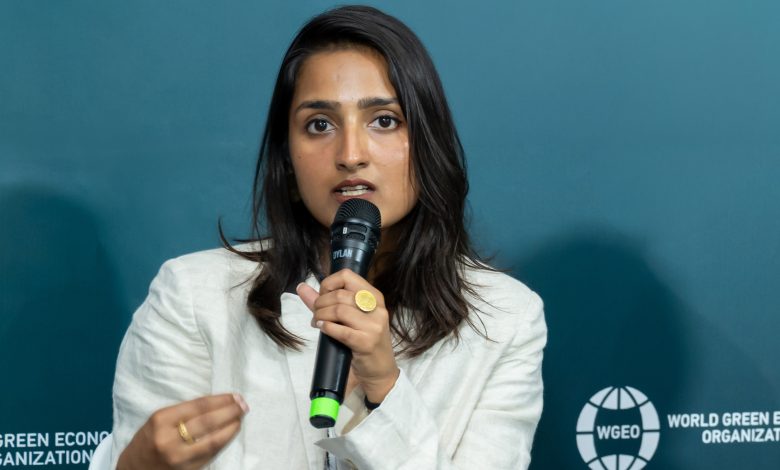
Shubhi Goyal does not dismiss that diagnosis. She has a more precise one: the bottleneck is not financial. It is a data infrastructure problem. The data exists. The financing architecture exists. The opportunities are real. What is missing is the system that connects them.
The Data Problem: What Accra and Kathmandu Revealed About Invisible Risk
Goyal has spent five years working on the translation problem from the ground up.
In Accra, her vulnerability assessments for the Accra Metropolitan Assembly identified three-quarters of the city’s land area as facing high exposure to coastal flooding, erosion, and storm surge, analysis that fed directly into Ghana’s national Coastal Land Management Plan and informed her MIT research evaluating a $200 million World Bank resilience project. In Kathmandu, working on the city’s Master Plan, she encountered the failure in a different form: not an absence of data, but an abundance of it, scattered across 70+ policies, plans, and technical reports dating back to 1950, held in separate agencies, formatted inconsistently, and functionally inaccessible to anyone trying to make an investment decision in real time.
The data existed. The financial intelligence did not.
What both cities revealed is a structural market gap. The risk is real. The need is politically recognized. The multilateral financing architecture is theoretically accessible. And yet capital is not landing at scale, because the systems that institutional investors rely on cannot read the formats that cities build for local use. This is not a developing world problem. It is a data infrastructure problem, and it sits at the entry point of what is estimated as a $212 billion annual adaptation investment needed in developing economies alone.
“The information existed,” Goyal says. “What did not exist was the infrastructure to make it readable to the institutions with the capital to act on it.”
Today, Goyal is working on that problem at the systems level, mapping where data infrastructure exists, where it breaks down, and which cities are positioned to translate local knowledge into decisions that funders and policymakers can act on. She says the next step is to build the translation infrastructure: common risk standards, interoperable platforms, shared assessment methodologies, that will not only enable investor deal flow but shape the architecture of a market that does not yet fully exist.
The Structuring Problem: What Hurricane Helene Revealed About Unfinanceable Plans
Goyal saw it in Western North Carolina after Hurricane Helene, where she led post-disaster recovery planning with more than two hundred frontline residents and local stakeholders. The work helped shape a countywide resilience hub network and early project pipelines aligned with $225 million in incoming federal funding.
“We engaged communities to identify needs and recovery priorities. Public funding was slowly moving. But the harder question was never about the money. It was about what happens between a community’s documented need and a structure that capital can actually attach to. The financial architecture gap is where most adaptation investments stall.”
That architecture can include blended finance structures, technical assistance facilities, local financial intermediaries, clear ownership models, maintenance plans, concessional capital layers, and risk allocation mechanisms. Without those pieces in place, even well-documented, politically supported adaptation work cannot cross the threshold into deployable deals.
“In my work with local municipalities in Accra and Kathmandu, I encountered the same structural ceiling repeatedly: documented risk, accessible financing architecture, and yet project pipelines that could not become investable ones, not because the underlying opportunities were weak, but because the institutional capacity to structure them had never been built.”
“The single biggest lever in adaptation finance is not more capital,” Goyal says. “It is the capacity to deploy it. Adaptation is closest to local public intermediaries, businesses, and civil society organizations. Until those institutions can structure deals, negotiate blended finance instruments, and manage the reporting that institutional investors require, the pipeline will remain thin regardless of how much money is available.”
The Verification Gap: What Nine Countries Revealed About Untracked Capital
The third problem comes after capital is committed.
The verification gap is not new to the field. Existing methodologies for coding and tracking adaptation finance have long been recognized as inadequate, failing to capture the full range of activities that build resilience on the ground, and shaped as much by political economy as by technical standards. What has been missing is not awareness of the problem but the ground-level data infrastructure to close it.
Goyal is building that infrastructure at the Huairou Commission, a global network of grassroots organizations operating across fifty countries. Working with member organizations across nine countries in Asia, Africa, and Latin America, she is developing tools and methodologies that allow grassroots organizations to independently track whether climate finance commitments translate into verifiable ground-level outcomes. The work connects to the World Bank’s Green Accountability Platform under the Global Partnership for Social Accountability.
The market implication is direct. If adaptation finance cannot prove what happened on the ground, it cannot build a track record. If it cannot build a track record, it cannot attract institutional capital at scale.
“You cannot price what you cannot measure,” Goyal says. “Right now, adaptation finance is asking investors to trust outcomes that the field itself cannot verify.”
This is where AI and machine learning enter as practical infrastructure tools. Machine learning models can scan disbursement records and flag where committed funds never arrived. Natural language processing can make decades of fragmented climate finance documents searchable and comparable across geographies. Remote sensing and satellite data can independently verify whether funded projects materialized on the ground. These are not hypothetical applications. They are the missing verification layer that would allow adaptation finance to build the track record institutional investors require to enter the market at scale.
The Gap Is Architectural
Goyal sees data infrastructure as the foundation of the solution. The standard climate finance conversation asks why capital is not landing. Goyal’s answer is more precise. Capital cannot find the opportunity because the data infrastructure is missing. It cannot move into the opportunity because the structuring capacity is missing. It cannot prove what happened afterward because the verification systems are missing. These are not three problems. They are one problem, repeating at every stage of the same broken pipeline.
None of this is abstract for her. Goyal grew up in Kathmandu through earthquakes, flooding, economic blockades, and years of rolling power cuts. She did not arrive at climate finance because it was an emerging field. She arrived by following the logic of repeated breakdown.
“Kathmandu was my first classroom,” she says. “I learned early that a crisis is never just about the event. It is about everything that was already failing before it arrived.”
“The capital exists. The need is documented. The opportunities are real. What is missing is the infrastructure that allows all three to find each other.”
The adaptation finance gap is not inevitable. It is architectural. And data infrastructure is how that architecture gets built.
For more on Shubhi Goyal, visit LinkedIn.