The “Silver Tsunami” is no longer a looming macroeconomic prediction, it is actively hitting the shores of Main Street. Over the next decade, an estimated 6 million baby boomer-owned small businesses are projected to change hands. It represents a staggering $5 trillion in generational wealth. Yet, the legacy brokerage ecosystem tasked with managing these transitions is notoriously fragmented, relying on archaic spreadsheets, manual valuations, and opaque networks.
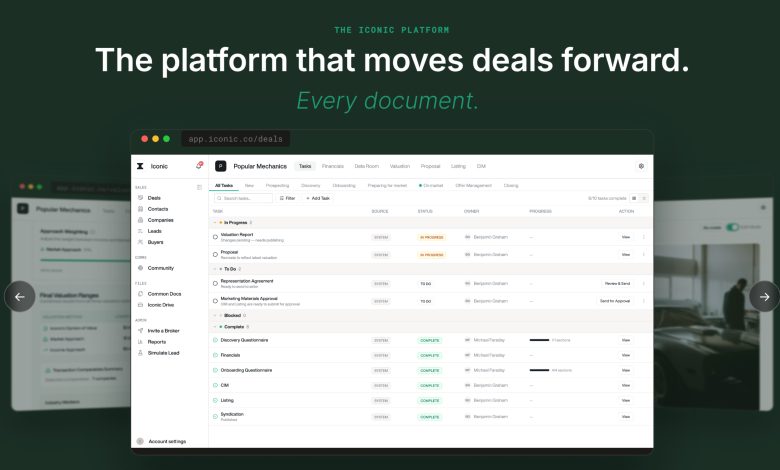
Enter Iconic: a tech-enabled M&A advisory firm wants to replace the broken plumbing of small-business acquisition with a purpose-built, AI-driven operating system.
Today the startup launched out of stealth with a $6 million seed round led by Expa (the startup studio founded by Uber co-founder Garrett Camp), Oceans Ventures, Fluent VC, and VSC Ventures. Joining them is an elite roster of strategic angels, including early Google investor and board member Ram Shriram, author and tech investor Tim Ferriss, and AngelList CEO Avlok Kohli.
The Broken Main Street M&A Machine
For a massive enterprise, selling a company involves an army of investment bankers, clean data rooms, and standardized valuation metrics. For a local manufacturing plant generating $4 million in revenue, the process looks entirely different.
Currently, the lower-middle market ($1M–$10M in business value) is dominated by local brokers operating as solo practitioners. These brokers spend the vast majority of their time drowning in administrative overhead: hunting down missing tax returns, manually drafting Confidential Information Memorandums (CIMs), and cold-calling potential buyers.
Because the process is so inefficient, a typical small-business sale can drag on for over a year. Worse, a shocking percentage of these businesses never sell at all, forcing retiring owners to simply liquidate or close their doors, wiping out decades of equity.
“Most business owners don’t have the tools to understand what their business is worth, what buyers are actually looking for, or what it takes to be truly ready to sell,” says Erik Salazar, Co-founder and CEO of Iconic. “Our platform changes that. It gives sellers the structure and visibility to prepare with confidence, run a credible process, and move toward a real outcome.”
Inside the AI Architecture: How Iconic Speeds Up the Deal
Iconic isn’t just throwing a ChatGPT wrapper over a standard CRM. The company has built a verticalized AI system designed to handle the messy, unstructured financial data typical of Main Street businesses.
The platform’s infrastructure is built across three core pillars:
- The Lead Engine: This layer uses predictive analytics to identify and qualify business owners who are statistically primed to exit, allowing brokers to stop chasing cold leads and focus on high-intent sellers.
- Automated Deal Materials: Instead of taking weeks to build a marketing package, Iconic’s AI ingests raw seller financials to instantly generate buyer-ready CIMs, teasers, and proposals. Critically, these documents update dynamically in real time as new financial quarters close.
- Intelligent Buyer Matching: The system matches listings against thousands of institutional and individual buyer data points, leveraging historical transaction analytics to optimize pricing and positioning from day one.
According to Iconic, the platform is already cutting traditional deal timelines by more than half.
“Before Iconic, I was spending nearly 80% of my time on administrative work and only 20% actually advising clients,” says David Malyar, an M&A advisor using the platform. “Iconic’s platform flipped that ratio. By automating the upfront work and qualifying sellers earlier, the technology frees up time for more client meetings.”
The Proprietary Moat: Private Market Data
The real long-term play for Iconic isn’t just workflow automation; it’s the data flywheel.
In public markets, data is ubiquitous. In the $1M–$10M private business sector, data is a black box. If a niche medical supply distributor in Ohio sells for 3.2x EBITDA, that transaction price typically remains a secret between the buyer, the seller, and the local broker.
Iconic tracks the entire transaction lifecycle, from the first touchpoint to the final signature. By capturing closed-loop data on what buyers are actually paying for specific asset classes, the platform’s valuation and matching algorithms grow exponentially smarter with every closed deal. If a buyer passes on ten healthcare businesses but aggressively bids on an eleventh, Iconic’s data layer maps that behavior to optimize future matchmaking.
Operator Pedigree Meets Marketplace Capital
Iconic’s leadership team has a distinct track record of building tech for the physical world. The founders and executive team include operators who built Reserve (the hospitality platform acquired by Resy/American Express), scaled local discovery engine Foursquare, and launched e-commerce builder Kit. They understand the friction of onboarding non-technical business owners onto digital platforms.
That operator empathy is exactly what drew in heavyweight backers like Expa and Tim Ferriss, who have spent decades investing in marketplace disruptors like Uber and Shopify.
By opening up its platform to independent brokers nationwide today, Iconic isn’t trying to eliminate the human element of M&A advisory. Instead, they are betting that by equipping local brokers with institutional-grade AI infrastructure, they can transform a highly fragmented, legacy cottage industry into a scalable asset class, and save a massive chunk of American wealth in the process.
Companies can learn more at https://iconic.co/.