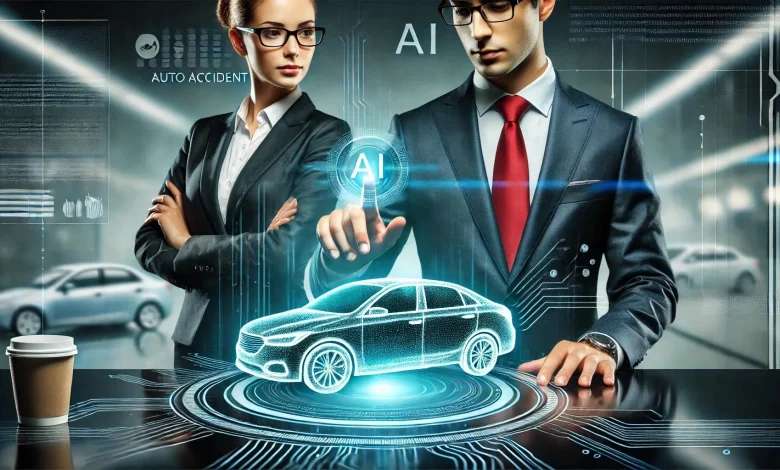
A friend of mine got rear-ended last spring at a stoplight just outside Tampa. The car that hit her was a 2024 SUV with all the latest driver-assist features. A few weeks later, when we sat down to talk through the insurance claim, she said something that has stayed with me ever since. “Apparently the car that hit me has video. From, like, multiple cameras. And nobody seems sure who’s allowed to look at it.”
That one sentence, more than any industry report I have read on the subject, captures what is happening to ordinary car accident claims right now. The technology in the vehicle has moved ahead of the paperwork around the vehicle. And most of us only find out about the gap when something goes wrong on the road.
The Family Car Quietly Became a Computer
If you bought a new vehicle in the last few years, you almost certainly bought several computers wrapped in sheet metal. The auto industry calls the bundle ADAS, which is short for Advanced Driver Assistance Systems. These are the features that help your car stay in its lane, brake before you do, slow down on the highway when traffic ahead tightens up, and beep at you when you back too close to something.
None of this is exotic anymore. After a 2016 voluntary commitment by twenty major automakers, automatic emergency braking is now standard on nearly all new passenger vehicles sold in the United States. Forward collision warning, lane departure assistance, adaptive cruise control, and driver-facing monitoring cameras have followed similar paths. This is not futuristic technology. It is what the average commuter drove home from work tonight.
Crash Evidence Looks Almost Nothing Like It Used To
Twenty years ago, the evidence in a typical car accident claim was relatively simple. Police report, a few photographs from the scene, statements from the people involved, maybe a medical report. If there was video, it was almost certainly from a gas station or stoplight camera nearby, and someone had to physically go ask for it before it got overwritten.
Modern crashes generate a different category of evidence entirely. Here is the comparison I find myself drawing for people who ask me about this:
| Element | Crash claim, circa 2005 | Crash claim, 2026 |
| Vehicle-generated data | Brief airbag module log (seconds of speed and brake pressure) | Continuous camera footage, radar tracks, steering input, ADAS state logs, mostly held in manufacturer cloud |
| Driver-side evidence | Statements and witness accounts | Phone activity logs, in-cabin cameras, voice commands to the car, vehicle app usage history |
| Roadway evidence | Police photos, skid marks | Connected infrastructure logs in some cities, third-party dashcam footage from passing vehicles, smart signal data |
| Insurance investigation | Adjuster visit and inspection | Photo-AI damage estimation, fraud-scoring algorithms, much of it before a human opens the file |
If you sketched the trend as a rough chart, the shape would not look gradual. It would look closer to this:
Vehicle data generated per crash (approximate scale)
2005 ▓
2015 ▓▓▓▓
2025 ▓▓▓▓▓▓▓▓▓▓▓▓▓▓▓▓▓▓▓▓▓▓▓▓
That sharp jump on the right is the entire reason this article exists. The amount of new evidence flowing into the average claim has changed how every party at the table behaves. Insurance companies have built AI systems that can resolve straightforward claims in minutes. One U.S. insurer has publicly said it handles around 40 percent of its claims instantly through machine systems. Plaintiff attorneys have started hiring forensic technologists. Manufacturers have built legal teams whose job is to control access to cloud-stored vehicle data.
The Question of Who Was Actually Driving Got Harder
Most of us were taught somewhere along the way that car accidents are about who was driving and what they were doing. The new generation of partial-automation features makes that question genuinely complicated.
The Society of Automotive Engineers has a six-level scale that describes how much a car is driving itself. It is worth knowing in plain language because it directly affects who carries responsibility when things go wrong:
| SAE Level | Description | Who is generally responsible |
| 0 | No automation, traditional car | Driver |
| 1 | Single-feature assistance like cruise control | Driver |
| 2 | Hands-on assistance (most modern lane-keep plus adaptive cruise) | Driver, but the question is getting harder |
| 3 | Conditional automation, the car drives itself in defined conditions | Depends on whether the human got a takeover warning |
| 4 | High automation, no human needed in defined conditions | Mostly the system and the operator |
| 5 | Full automation, anywhere a car can go | The system and the operator |
Almost every new car you can buy today sits at Level 2. That is the level where the human is technically responsible but the car is doing a meaningful chunk of the actual driving in real time. That gap, between technical responsibility and actual control, is where the biggest legal fights are now happening.
The clearest example of the stakes is the verdict that came out of Florida in 2025 and was upheld in early 2026. A federal jury in Miami found Tesla 33 percent liable for a fatal 2019 Key Largo crash in which the human driver was using Enhanced Autopilot when he dropped his phone, looked down, and his Model S accelerated through an intersection at roughly 62 miles per hour. The total damages came in at around $329 million. Tesla’s share after the apportionment landed at approximately $243 million, with $200 million of that as punitive damages. Judge Beth Bloom upheld the verdict in February 2026. One detail keeps surfacing in coverage of the case. The most damaging piece of technical evidence, a “collision snapshot” from the Autopilot computer, only came to light because an independent researcher was able to extract it after Tesla had told the plaintiffs the data did not exist.
That last sentence is the part that should make every claimant pay attention. Even when the data is there, getting to it is its own challenge.
Local Counsel Matters in Ways That Are Not Obvious

Here is where I usually say something that surprises people. The most important thing about the lawyer you hire after a modern crash is not just how good they are at trial. It is how fast they know where to send the preservation letter.
Manufacturer data retention windows vary widely. Some logs sit on cloud storage for years. Others get overwritten in weeks. If nobody contacts the right department at the manufacturer with the right legal language inside the right window, the evidence is simply gone. The crash that would have been provable becomes a crash where it is your word against the other driver’s word, except now the other driver also has a giant company quietly defending them.
This is also why jurisdiction matters more than it used to. Florida is a no-fault state. It has Personal Injury Protection requirements, statutory thresholds for stepping outside the no-fault system, and Florida-specific comparative fault rules. Those rules were drafted before any car could partially drive itself, and they still control most of what happens in a crash claim filed in Orlando, Tampa, or Miami. Working with an Orlando Car Accident attorney who has actually handled ADAS-related cases, knows the manufacturer discovery playbook, and has filed evidence preservation letters in this kind of matter before is a different experience from working with general counsel. The work that gets done in the first sixty days of the case usually decides the case.
That is not a marketing line. It is what people who do this work for a living quietly tell each other.
The Insurance Side Is Changing Just as Fast
Carriers are not standing still. The same AI tools that help them process claims faster also produce friction for any claim that does not look routine. If you have ever wondered why complicated injuries seem to take three times as long to resolve as simple ones, part of the answer is that the AI triage system flagged the claim as complex and shifted it to a slower queue. That makes sense from the carrier’s side. It is exhausting from the claimant’s side.
The 2024 UnitedHealth backlash, after an algorithm was alleged to have denied coverage to a patient who later died, is the cautionary tale that everyone in this corner of the industry is now watching. Auto insurance is not health insurance, but the same structural risk exists whenever machines are making first-pass decisions on serious claims. Regulators in several states have started asking carriers for explanations of how their AI claim-handling systems make decisions. That kind of oversight is going to get more intense over the next few years, not less.
The World Is Not Catching Up, But It Is Trying
The World Economic Forum projects that fully autonomous private vehicles will not become mainstream for at least another decade. That sounds like distant news until you remember that the cars with partial automation are already here in the millions, and they are already in crashes. The legal system, the insurance system, and the rest of us are adapting to a transition we are already inside of, not one that is about to arrive.
I keep thinking back to my friend at the stoplight in Tampa. Her claim eventually got sorted out. The other driver’s insurance paid. Nothing about her case looked unusual on the surface, except for the quiet unease that came from realizing how much information existed about her crash that she did not control and could not see. That unease, I think, is the everyday version of the much larger change happening to car accident claims right now. The data is here. The systems are here. The question of who gets to use them, and on whose behalf, is still being settled. Anyone driving a modern car, or sharing the road with one, has a stake in how that gets settled.
The friend I started with, by the way, has since traded in her car. The new one has even more cameras.