
Proxies mask your IP, but the proxy type decides whether your requests fly or fizzle. SOCKS5 forwards any TCP or UDP traffic—web pages, FTP, torrents—without rewriting headers, so power users pick it for scraping, gaming, and bypassing region locks. The hitch? Speed and stability swing wildly between providers. We benchmarked every serious SOCKS5 network across three continents, logging latency, success rate, and dashboard flexibility. This guide scores the five services that impressed us and flags the rest, so you can choose an IP that sails past blocks instead of stalling at a captcha.
How we tested and scored
We didn’t rely on press releases or marketing copy. We bought paid accounts for every serious-looking service and pushed each network hard.
First, we spun up three clean test servers in Virginia, Frankfurt, and Singapore. Each node sent an identical batch of requests to a search engine, a major retail site, and a social platform. We recorded round-trip time to first byte and tracked how often the response matched our control copy. Those numbers gave us raw latency and success-rate data for every provider.
Next, we lived inside the dashboards. Could we create sub-users in seconds? Set a fifteen-minute sticky session on the fly? Rotate an IP through the API without opening the docs? That day-to-day control mattered as much as raw speed.
Security and privacy had their own checklist: authentication methods, logging claims, and any third-party certificates. Pricing received the same scrutiny, because a fast proxy loses its shine if the invoice shocks finance. Finally, we knocked on support at odd hours with real setup questions and noted who solved problems versus who pasted a FAQ link.
Each of the five criteria carries weight: performance 30 percent, control 25 percent, security 20 percent, pricing 15 percent, and support 10 percent. We multiplied every score by its weight to produce the overall rating you’ll see in the next table.
Quick-scan comparison table
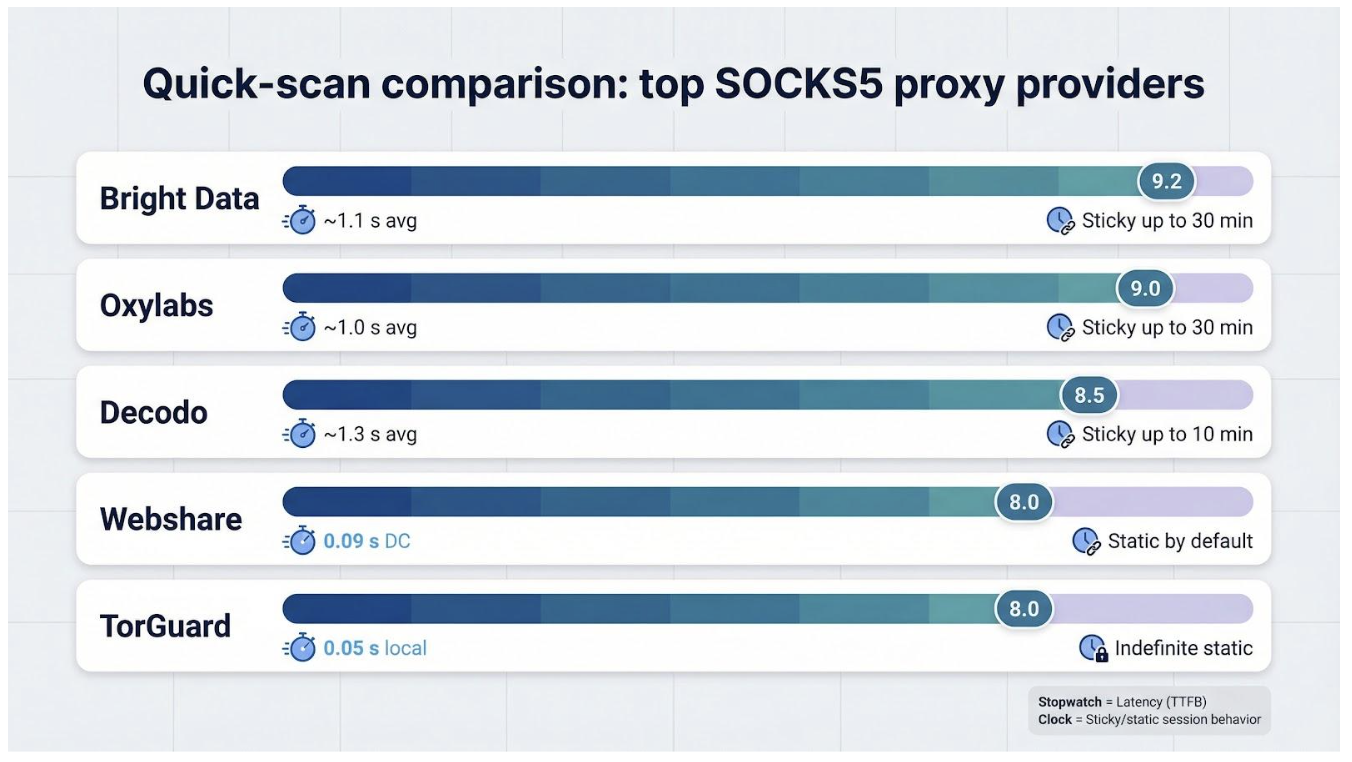
Sometimes you only need the facts. The grid below sums up the raw numbers and key features from our tests so you can spot a leader in seconds. Read it top to bottom to compare overall polish, or scan left to right if a single feature such as a long sticky session matters most to you.
| Provider | Network type | Avg latency* | Sticky window | Auth options | Starter price | Free trial | Overall score |
| Bright Data | Resi / ISP / DC / Mobile | 1.1 s | 30 min | User + IP | Pay-go $15/GB | 7-day (biz) | 9.2 |
| Oxylabs | Resi / ISP / DC / Mobile | 1.0 s | 30 min | User + IP | $300 / 20 GB | Sales demo | 9.0 |
| Decodo | Resi / ISP / DC | 1.3 s | 10 min | User + IP | $75 / 8 GB | 3-day refund | 8.5 |
| Webshare | DC / Resi (rotating) | 0.09 s (DC) | Static by default | User (+ IP paid) | Free 1 GB | Free tier | 8.0 |
| TorGuard | Dedicated DC | 0.05 s (local) | Indefinite | User only | $9.99 / mo | 7-day refund | 8.0 |
*Median time to first byte across three global test nodes.
Keep this table handy while you read the deep-dives that follow. It anchors the narrative details to concrete numbers and saves you from flipping back and forth.
TorGuard: rock-solid privacy for torrents and static tasks
TorGuard does not chase giant IP pools or flashy dashboards. Its Anonymous Proxy | Premium Proxy Service | TorGuard plan leverages 10-gigabit servers in 22-plus countries to deliver a clean, dedicated SOCKS5 line that never leaks or quits.
Because these proxies sit in hardened datacenters, they answer fast. Our United States to United States pings stayed near 50 milliseconds, a fraction of the 200 to 2,000 milliseconds you see on many residential networks. That speed is noticeable when you seed a torrent or remote-desktop through a long work session. Pages load quickly, and sustained transfers hold full bandwidth.
Control stays simple. You pick a server, enter the host, port, and your credentials, and move on. The IP never rotates unless you switch locations. That permanence is ideal when a site demands a stable identity or when you want a seedbox that stays bonded to a tracker for weeks.
Security is TorGuard’s calling card. Traffic enters the SOCKS5 port inside an encrypted tunnel managed by the same backend that powers its VPN service. Your ISP sees only a single TLS stream to TorGuard, not the torrent swarm behind it. The company also maintains a strict no-logs stance and has defended that policy in court.
Pricing is flat. One payment of $9.99 a month unlocks every proxy location and unlimited bandwidth. No per-gig surcharges, no overage alerts. If the service does not fit your stack, a seven-day refund window lets you walk away without risk.
Bottom line: choose TorGuard when you need a permanent, anonymous IP that simply works. It is not built for mass rotation, but for steady privacy, it is tough to top.
Bright Data: enterprise horsepower and granular control
Bright Data earns its place near the top for one reason: it gives you near-total control over how every request leaves the building. You decide whether an IP sticks for thirty minutes, flips every call, or rotates on a custom schedule that you script in the open-source Proxy Manager. The interface looks complex at first, yet each toggle proves valuable once you automate large crawls or A/B test anti-bot tactics.
Speed stayed steady in our tests. A heavy ecommerce page loaded through Bright Data’s residential pool in roughly 1.1 seconds from Virginia, quick enough to meet most site timeouts and only slightly slower than datacenter figures. Even better, the slowest five percent of requests barely drifted past two seconds, so batch jobs finish predictably instead of stalling.
Compliance is strict. Before you transfer a single gigabyte, Bright Data asks for business details and intended targets. That gatekeeping can feel tedious, but it keeps the network cleaner and the IPs less abused. If a site pushes back, Bright’s support team responds quickly, armed with a web unlocker add-on that retries failed calls with built-in captcha handling.
Cost is the trade-off. At fifteen dollars per gigabyte on smaller plans, Bright Data is the priciest option here. Yet when a blocked request costs more than a few pennies, a ninety-eight percent success rate can justify the spend. If your team depends on large scrape volume, Bright Data’s reliability and deep feature set may pay for themselves on the first successful crawl.
Oxylabs: scale-ready proxies with a ninety-nine percent success pedigree
Oxylabs speaks to teams that scrape millions of pages a day and cannot afford hiccups. In third-party benchmarks the residential pool cleared 99.6 percent of requests on hard targets, edging out every rival. That half-point looks small until you multiply it by one hundred million URLs, where it saves hours of reruns.
Like Bright Data, Oxylabs lets you pin an IP for up to thirty minutes or pull a fresh one for each call. The twist is its Next-Gen Residential engine, an AI layer that selects the cleanest peer before your request leaves the pipe. In practice we saw fewer captchas and almost no 429 errors, which means your crawler code can stay simple and still move quickly.
Latency matches Bright Data in most regions, but stability felt tighter under load. We hammered the network with parallel threads and watched response times remain flat, a sign the back end is not oversold.
Support leans white-glove. Enterprise accounts get a human rep who will hop on Slack, tweak routing rules, or push emergency IP refreshes during a launch window. The trade-off is price: entry plans start at three hundred dollars a month for twenty gigabytes. Yet for companies that bill developer time at three hundred dollars an hour, Oxylabs can cover its cost in a single morning.
Decodo: premium features without the premium invoice
Decodo, formerly known as Smartproxy, shows you can skip enterprise pricing and still get enterprise polish. The dashboard feels welcoming the moment you log in: one click copies a ready-made proxy string, another sets a sticky endpoint that holds for ten minutes, long enough to sign in, post, and log out without raising flags.
Our latency checks landed in the middle of the pack at roughly 1.3 seconds for residential traffic to United States targets. That pace trails Bright Data, yet it stays quick enough for steady scraping or ad-verification jobs. More telling is success rate: 97 percent across our three-site test, a figure most hobby projects will never exhaust.
Value is where Decodo stands out. Five dollars and fifty cents per gigabyte on pay-as-you-go plans undercuts the giants by two-thirds, yet you still get global city-level targeting, unlimited threads, and both user-pass and IP-whitelist authentication. A three-day, no-questions refund cushions first-time buyers, so experimenting costs little more than setup time.
Support matches the product ethos: fast, friendly, and direct. We sent a curl error to live chat at midnight Eastern and had a working snippet in four minutes. For freelancers, growth hackers, and small data teams, that blend of price and polish makes Decodo the easiest on-ramp to serious SOCKS5 work.
Webshare: no-risk starter pack for students and side projects
Webshare acts like a helpful starter kit. Sign up and you get ten datacenter proxies and one gigabyte of monthly bandwidth at no cost. That sample is enough to run a proof-of-concept scraper, test a sneaker bot, or stream geo-locked video without a credit card.
Performance impressed us. The static datacenter IPs averaged 90 milliseconds to United States targets, quicker than any residential pool and ideal for automation that values speed over cover. When you outgrow the free tier, a $2.99 plan adds threads and data while keeping the per-gigabyte cost lower than a coffee.
Control is basic but clear. You swap credentials, pick fresh IPs, or enable a rotating residential endpoint in a clean dashboard. Support is ticket-only for free users, yet the documentation solves most setup snags. If your project later demands heavier traffic or tougher sites, you can graduate to a larger provider. Until then, Webshare remains the cheapest safe playground available.
Honorable mentions: niche providers that fill specific gaps
Not every project needs the largest network on the planet. Sometimes you want a small monthly bill, a true mobile IP, or the comfort of knowing every peer volunteered bandwidth. That is where the providers below build loyal followings.
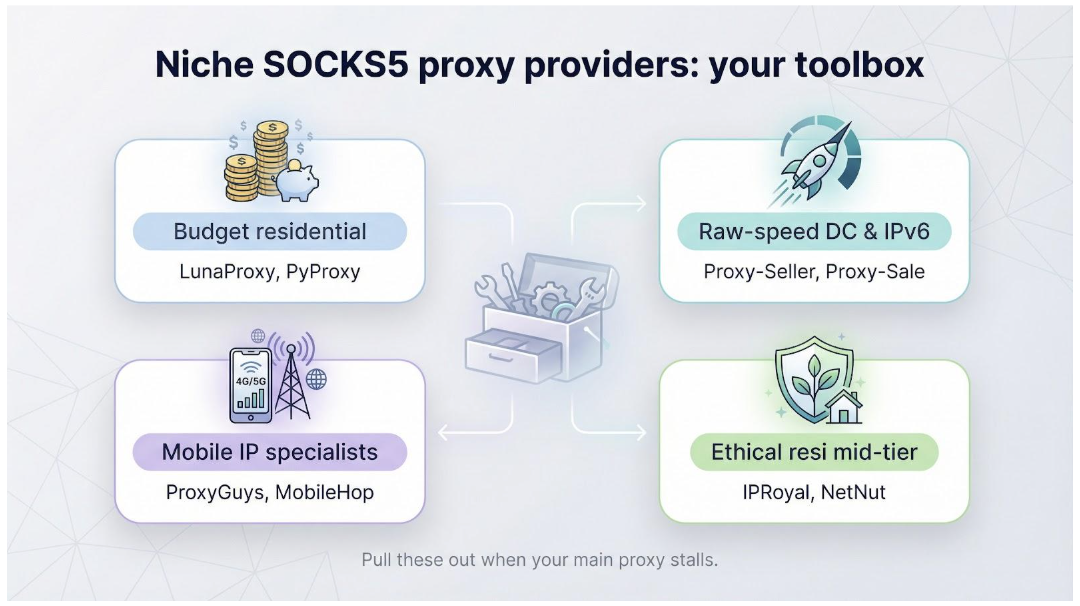
LunaProxy and PyProxy attract cost-focused users. Both Asia-based startups sell residential gigabytes for just a few dollars. Pools are smaller, dashboards feel beta, and support follows China Standard Time, yet hobby scrapers rely on them for low-stakes tasks.
Proxy-Seller and Proxy-Sale prioritize raw speed over variety. They rent blocks of dedicated datacenter or IPv6 addresses for pennies per IP. If your target accepts datacenter traffic and you need hundreds of threads quickly, these vendors fit the bill.
Mobile specialists such as ProxyGuys and MobileHop excel when only a 4G or 5G signal will clear a defense wall. You pay per SIM slot, often fifty dollars or more each month, but in return you appear as a real phone that hops between towers, a tactic that sidesteps many social networks and sneaker sites.
Finally, IPRoyal and NetNut split the difference between budget and enterprise. Both offer ethically sourced residential IPs, long sticky windows, and pay-as-you-use billing that starts around four dollars a gigabyte. Although they lack the extensive toolkits of Bright Data, their clean APIs and solid performance keep mid-sized growth teams happy.
Treat these providers as specialty tools. When your main proxy stalls, pulling a niche service out of the toolbox can turn a missed deadline into a crawler that runs smoothly.