AI in education means using artificial intelligence tools to support teaching, learning, grading, and school operations. You’re already close to it, even if you haven’t thought of it that way: a chatbot explaining algebra at 10:14 p.m., a writing tool suggesting clearer sentences, a platform adjusting practice questions after you miss two in a row. The upside is real. So is the catch, and that’s what you need to understand before treating AI like either a miracle or a menace.
What AI in Education Actually Means
AI in education is the use of software that can analyze patterns, generate language, make predictions, or adapt content in ways that help schools and learners work better. In plain English, it means tools that can respond to what you need instead of delivering the exact same thing to everyone at the exact same time.
That can include machine learning systems that notice which math problems trip you up, generative AI that drafts explanations or study materials, chatbots that answer routine questions, and analytics tools that help schools spot attendance or performance trends. It can also show up in less visible ways, like scheduling support, email drafting, or systems that flag when a student may need extra help.
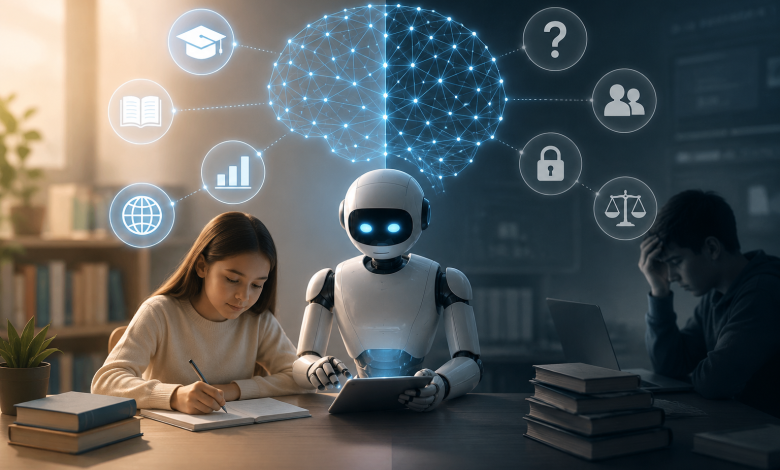
Here’s the balanced version: AI can save time, widen access, and make learning feel more personal. But if you hand it too much control, it can also spread mistakes, mishandle sensitive data, and weaken the very thinking skills education is supposed to build.

The Short Version: What Counts as AI in a School or College Setting
Most of the AI you’ll run into in education fits into a few familiar buckets. There are AI tutors that walk you through problems step by step. There are writing assistants that help with grammar, structure, summaries, or brainstorming. There are automated feedback tools that score quizzes or give instant comments on short responses. There are plagiarism and authorship detection systems, though those are far from perfect. There are predictive analytics tools that look at patterns in grades, logins, and attendance. And there are administrative tools that help with scheduling, communication, note summaries, and repetitive office work.
If that sounds broad, that’s because it is. “AI in education” does not mean one product or one classroom robot. It means a growing pile of tools doing different jobs, some visible to you, some working in the background.
Why This Topic Feels Suddenly Urgent
The speed is the story. Adoption moved fast, policy did not.
During the 2024 to 2025 school year, 85% of teachers and 86% of students used AI for school-related purposes. In higher education, usage is even more intense. One 2026 survey found only 20% of universities had a formal AI policy, while more than half of students and educators felt their institution was not ready to manage it well.
That gap matters. When people use powerful tools before schools set clear rules, confusion fills the space. Is using AI to brainstorm okay? What about fixing grammar? What about drafting a full essay? How is student data stored? Who checks if an AI recommendation is biased or just plain wrong? Those questions stopped being theoretical the moment AI became routine.
Where You’re Most Likely to See AI in Education Today
AI in education does not mostly look like a futuristic classroom with holograms. It looks ordinary. A student opens a chatbot after dinner for help with chemistry. A teacher uses AI before first period to turn yesterday’s lesson into a five-question quiz. A college advisor gets an automated summary of which students missed deadlines last week.
That’s why the topic feels bigger than it first appears. AI is not arriving as one dramatic change. It is slipping into dozens of small moments.
In the Classroom
Inside the classroom, AI often starts with planning and differentiation. A teacher can ask a tool to generate reading questions at three difficulty levels, rewrite a passage for English learners, or create extra examples for students who need more practice. Instead of building every version by hand, the teacher gets a draft in seconds and then edits it.
Some tools also work directly with students during class. Adaptive platforms can adjust the next question based on your answer, which makes the experience feel less like marching through a workbook and more like using a GPS that reroutes when you miss a turn. Classroom assistants can also support translation, captions, or text simplification, which helps more students stay in the lesson.
The trick is that good classroom use still depends on human judgment. AI can generate options fast. It cannot know, on its own, why one student is suddenly quiet or why a joke landed badly in third period.
In Homework and Studying
This is where most people notice AI first. You’re stuck on a concept, so you ask a chatbot for an explanation. You paste in class notes and ask for a summary. You turn vocabulary into flashcards, request practice problems, or ask for a simpler explanation of a dense reading.
That kind of support can be genuinely useful. Nearly 90% of students who use AI at least monthly say understanding complex material is a major reason for using it. That tracks with real life. If you’re staring at a confusing economics graph at 11:20 p.m., an instant explanation feels better than waiting until office hours.
Used well, AI can reduce friction. Used poorly, it can become a shortcut that gets the task done without building much understanding. That difference matters more than the tool itself. If you want a wider view of how these tools show up beyond school, it helps to understand how AI fits into everyday routines.
Behind the Scenes
A lot of AI in education happens where you don’t see it. Schools and colleges use it to draft emails, organize schedules, summarize meetings, sort support tickets, and analyze large sets of performance data. Staff can spend less time on repetitive work and more time on direct support.
That productivity angle is a big reason AI is spreading so quickly. In one higher education survey, automating repetitive processes and offloading administrative burden ranked among the top perceived opportunities. The point is simple: schools run on an enormous amount of routine work, and AI is very good at routine work.
The Biggest Advantages of AI in Education
The strongest case for AI in education is not that it replaces teaching. It’s that it can make teaching and learning more responsive, faster, and easier to access.
More Personalized Learning
Personalization is the headline benefit for a reason. Traditional classrooms ask one teacher to meet a wide range of needs at once, which is hard even on a great day. AI can help by adjusting pace, difficulty, examples, and feedback based on your performance.
If you miss a concept, the system can offer easier practice or a different explanation. If you master something quickly, it can move you ahead instead of forcing you to wait. That’s useful because real learning rarely happens at one uniform speed.
This is one place where AI actually fits the promise. Across the research, personalization keeps showing up as the biggest upside. And the market is growing around that demand, with the AI in education market projected to expand sharply over the next decade. Schools want tools that can meet learners where they are, because the one-size-fits-all model has obvious limits.
Faster Feedback
Fast feedback changes how you learn. If you wait a week to find out why you misunderstood fractions, that mistake has time to settle in. If you get a targeted hint right away, you can correct course while the idea is still fresh.
AI can return quiz results instantly, suggest writing improvements, point out repeated errors, and offer step-by-step guidance while you work. That matters because learning is often less about getting one final grade and more about the correction loop. Try, check, fix, try again.
Done right, AI shortens that loop. You spend less time wondering what went wrong and more time improving it.
More Time for Teaching and Support
One of the least glamorous benefits is also one of the most convincing. AI can save teachers time.
Teachers using AI weekly save an average of 5.9 hours per week. That adds up to about six weeks over a school year. Those hours come from things like drafting worksheets, summarizing meetings, generating practice material, supporting grading, and writing parent communications.
That matters because time is a real constraint in education. If repetitive tasks shrink, more time opens up for feedback, small-group support, lesson adjustment, and actual human interaction. You can see a similar pattern in other fields where repetitive digital work gets handed off to smart systems. Education is not unique there, but the payoff may matter more because the time gets redirected toward people.
Better Access and Inclusion
AI can make learning more accessible in practical ways. Translation tools can help if you’re learning in a second language. Text-to-speech can support reading access. Speech-to-text can help if writing by hand or typing is difficult. Captioning helps with video content. Reading support tools can simplify dense text without removing the core idea.
None of that solves every barrier. But it can lower several at once.
For students with disabilities or language barriers, small changes in access can make a lesson usable instead of frustrating. That’s not a side benefit. It’s one of the best arguments for careful AI adoption.
Smarter Use of Data
Schools collect more information than most people realize: attendance, assignment completion, quiz results, course activity, and patterns over time. AI can help make sense of that data faster.
For example, a system might notice that students who miss two early assignments in a course often struggle later, so advisors can step in sooner. Or it might flag that a group is doing poorly on one standard, which helps a teacher reteach that concept before moving on.
The practical point is early support. Instead of waiting for a report card to confirm a problem, schools can notice warning signs earlier and respond while there’s still time to help.
How AI Can Help Students Learn Better When It’s Used Well
The best use of AI in education is support, not substitution. That distinction sounds small, but it changes everything.

On-Demand Tutoring and Practice
AI tutors can explain a concept in multiple ways, generate extra examples, and keep going without impatience. If you need the same idea explained three times, that’s not a problem for the tool. If you want one more practice set before a test, it can produce it immediately.
That can translate into real gains. A randomized controlled trial found students using an AI tutor scored meaningfully higher than students in traditional classes, with strong effect sizes and shorter time on task. That’s impressive.
But here’s the thing: the benefit came from guided help, not blind trust. AI tutoring works best when it helps you think through the problem instead of just spitting out the answer.
Support for Different Learning Speeds and Styles
Some students need more review before moving on. Some need examples tied to everyday life. Some want challenge problems because the standard ones are too easy. AI can help flex in those directions without making you wait for a full curriculum rewrite.
That doesn’t mean the old “everyone has one magical learning style” story. It means practical variation. More examples. Slower pacing. Simpler wording. Extra practice. A new format when the first one didn’t click. Small shifts like that often matter more than grand theory.
Lowering the Friction Around Getting Started
Starting is often the hardest part. Blank-page syndrome is real, whether you’re writing an essay, studying for biology, or trying to review a week of notes.
AI can lower that barrier by generating an outline, turning notes into practice questions, suggesting a study plan, or offering a plain-language explanation of where to begin. That first nudge can be enough to get you moving.
The catch is obvious. If AI does the whole task, you skip the struggle that often produces learning. But if it helps you get traction, that can be a smart use.
The Potential Drawbacks You Should Take Seriously
This is where the mood has to change a bit. AI in education has real risks. Not vague, hypothetical, maybe-someday risks. Real ones happening right now.
Privacy and Student Data Concerns
When you type schoolwork, questions, or personal details into an AI tool, that information goes somewhere. It may be stored, used to improve the system, reviewed under certain conditions, or combined with other data. Sometimes the rules are clear. Sometimes they are not.
That’s a problem in education because student information is sensitive. Writing samples, behavior records, disability-related needs, and academic performance are not just random data points. If a school adopts AI without strong data practices, students can lose privacy without fully understanding the trade.
Research keeps flagging this. In higher education, one of the most urgent risks identified was data without consent. If a tool needs student data, schools should know exactly what is collected, how long it is kept, who can access it, and what protections are in place.
Bias and Fairness Problems
AI systems learn from data created by humans, which means human bias can leak into the output. If the training data is skewed, incomplete, or full of past inequities, the system can reproduce those problems.
In education, that can affect recommendations, risk flags, evaluation support, or automated decisions about who needs intervention. A tool may appear neutral because it uses math and code, but code does not magically erase bias. It can hide it better.
That’s why fairness checks matter, especially in anything high stakes. If an AI system helps shape grading, discipline, or academic support, you need more than convenience. You need scrutiny.
Inaccurate or Misleading Answers
AI hallucinations are confident-sounding wrong answers. That’s the plain-English version.
A tool can invent a citation, explain a scientific concept badly, misstate a historical fact, or solve a math problem using flawed logic while sounding calm and polished the entire time. In school, that’s dangerous because a wrong answer wrapped in authority can teach the wrong lesson without setting off alarms.
This is not a rare edge case. Misinformation ranks among the top concerns in education AI surveys. If you use AI for studying, you need to treat it like a fast draft partner, not a final authority. The same caution applies whenever you use general-purpose AI tools for schoolwork.
Too Much Dependence on the Tool
One of the biggest worries is not cheating. It’s skill erosion.
If AI constantly writes your first draft, fixes your logic, solves your homework, and summarizes every reading, you may finish more tasks while learning less. That sounds harsh, but it’s the core risk. You can become more efficient and less capable at the same time.
The OECD has warned that using AI to complete a task does not automatically create durable learning, and gains can fade when the tool is removed. Students feel this tension too. In one survey, 65% of students worried AI could make learning too shallow and weaken critical thinking or creativity.
Less Human Interaction
Education is not just content delivery. It includes encouragement, trust, accountability, discussion, and the quiet skill of noticing when you’re lost before you say anything.
Software cannot fully replace that. A real teacher can read tone, spot discouragement, change approach in the moment, and build a classroom culture. A real discussion can reshape your thinking in ways a polished answer box cannot.
If AI starts crowding out those human parts, something important gets lost. Convenience is not the only measure that matters.
The Academic Integrity Problem: Help or Shortcut?
This issue gets so much attention because it cuts to the heart of what school is for. Is the goal to produce an answer, or to build understanding along the way?
When AI Supports Learning
There are perfectly reasonable uses of AI for schoolwork. Brainstorming essay angles, checking whether a paragraph is clear, generating practice questions, turning notes into flashcards, or getting feedback on structure can all support your learning without replacing it.
In those cases, the tool acts more like a study partner or editor. It helps you improve what you are doing.
When AI Starts Doing the Learning for You
The line gets crossed when the tool substitutes for your thinking. Ghostwritten essays, auto-solved homework copied as your own work, fake discussion posts, and AI-generated reflections on books you did not read are not support. They are replacement.
That matters beyond school rules. If AI does the cognitive heavy lifting every time, the task may get completed, but the learning stays thin. You keep the receipt, not the skill.
Why Schools Are Struggling to Draw the Line
Policies vary wildly. Some instructors allow limited AI help. Some prohibit it almost entirely. Some encourage it but only with disclosure. And detection tools are unreliable enough to create another problem: false confidence.
That inconsistency leaves students and teachers navigating a moving target. In U.S. public schools, only 31% had a written AI policy by late 2024. In universities, policy gaps remain large too. The technology is spreading faster than the rulebook, which is why so many institutions feel like they are improvising in public.
Why Human Oversight Still Matters
AI works best as a co-pilot, not the person at the wheel. That is the clearest way to think about it.
When schools keep humans in charge of judgment, context, and high-stakes decisions, AI can be useful. When schools start treating AI output as objective truth or final authority, trust breaks down fast.
What Humans Still Do Better
You understand this instinctively. A person can notice confusion that never gets typed into a chatbot. A teacher can see discouragement in posture, hear uncertainty in a question, and know when a student needs reassurance instead of another explanation.
Humans also handle nuance better. Ethical judgment, mentorship, motivation, context, and relationship-building are not side tasks in education. They are central to it. That is why the better argument is not “AI versus teachers,” but “AI under human direction.” If you want a broader sense of that bigger shift, it helps to look at where AI technology is heading overall.
Where AI Fits Best
AI is strongest when the job is repetitive, pattern-based, or draft-oriented. It can sort information, generate a first pass, flag trends, suggest practice, and lighten admin work.
It is much weaker when the task is high stakes, emotionally loaded, or deeply contextual. Final grading, disciplinary decisions, IEP-related judgments, admissions screening, and nuanced feedback still need human review. In those cases, speed is not the highest priority. Fairness and trust are.
What Schools, Colleges, and Teachers Need to Get Right
Good AI use is not just about buying tools. It’s about building rules, habits, and support around them.
Clear Policies and Ground Rules
Schools need written rules for acceptable use, data handling, transparency, and assessment. Not vague statements. Actual guidance.
Can students use AI for brainstorming? Must they disclose it? Which tools are approved? What data can be entered? Can AI assist with grading, and if so, where does human review begin? Without clear answers, confusion turns into uneven enforcement.
This is where the current gap is most obvious. Use is widespread. Policy readiness is not.
Training, Not Just Tool Access
Handing out AI access without training is like giving somebody a power tool with no safety briefing. You may get productivity, but you’ll also get avoidable mistakes.
Students, teachers, and staff need AI literacy. That means writing better prompts, checking outputs, protecting privacy, recognizing hallucinations, and knowing when to stop and think for yourself. It also means understanding that a fluent answer is not the same thing as a correct one. Similar lessons show up anywhere chatbot-based tools shape your online experience, but education raises the stakes because the goal is learning, not just convenience.
Equity, Cost, and Access
Not every school has the same budget, devices, internet quality, or technical support. That sounds obvious, but it has real consequences.
If one school gets safe, education-specific AI with training and support, while another relies on whatever free tools students can find, the gap grows. Infrastructure problems can also block adoption entirely. Weak broadband, outdated devices, and limited IT support turn a promising tool into a frustrating one.
AI can widen inequity just as easily as it can reduce it. The difference depends on access, planning, and support.
What AI in Education Looks Like Across Different Settings
“Education” covers a lot of ground, and AI works differently depending on where you see it.
K, 12 Schools
In K, 12 settings, supervision matters more. Younger students need clearer guardrails, more age-appropriate tools, and stronger privacy protections. Parents usually want to know what tools are being used, what data is collected, and how much influence AI has on instruction or evaluation.
Safety matters here in a very direct way. Schools need to be cautious with open-ended tools, especially when students are still building basic literacy, judgment, and digital habits.
Colleges and Universities
Higher education is leading adoption, especially for writing help, tutoring support, research assistance, and administrative uses. That makes sense. College students often work more independently, juggle more writing-heavy assignments, and already use digital tools constantly.
But colleges also face sharper integrity and policy problems. AI use in assessed work, uneven faculty rules, and confusion about acceptable assistance all show up more intensely here. In many places, usage is nearly universal while institutional clarity still lags behind.
Workplace Learning and Training
AI in education is not limited to schools. It also shows up in employee training, upskilling, certifications, and professional learning.
In that setting, AI often personalizes training paths, generates practice scenarios, and helps people learn on demand while working. The goals shift a bit, but the same question stays in place: is the tool helping you build skill, or just helping you get through a task faster?
Common Misconceptions About AI in Education
A lot of confusion comes from bad framing. A few common assumptions make the whole topic harder to think about clearly.
“AI Will Replace Teachers”
It won’t, because teaching is not just information transfer. Teaching includes motivation, classroom management, empathy, judgment, encouragement, relationship-building, and knowing when a student needs a different approach.
AI can assist with parts of the job. It cannot run the whole thing in a way that preserves what makes education human.
“AI Answers Are Objective”
AI output is generated pattern-matching, not truth. It predicts likely language based on training data and prompts. Sometimes that produces a strong answer. Sometimes it produces nonsense in a very confident tone.
That means you still need to verify facts, check sources, and apply judgment. A polished paragraph can still be wrong.
“Using AI Is Either Cheating or Genius”
This binary view misses the whole point. Using AI can be smart, lazy, ethical, sloppy, thoughtful, or dishonest depending on how you use it.
If you use it to clarify a concept and then do the work yourself, that is one thing. If you use it to produce work you barely understand, that is another. The tool is not the whole story. Your use defines the value and the risk.
Should AI Be Used in Education?
Yes, but with limits, oversight, and clear goals.
That is the honest answer. AI is too useful to ignore and too messy to trust blindly. If the goal is better support, faster feedback, stronger access, and less wasted time, AI has a real place in education. If the goal quietly drifts into replacing judgment, outsourcing thinking, or collecting student data carelessly, the costs rise fast.
A simple decision rule helps: use AI when it supports learning, improves access, or reduces repetitive work without taking over high-stakes human decisions. Pull back when it hides its logic, handles sensitive data carelessly, or replaces the thinking the assignment was meant to build.
Good Reasons to Use It
Good uses are not hard to spot. Personalized support, faster feedback, accessibility features, admin efficiency, and extra tutoring practice all make sense. In those cases, AI fills a gap or removes friction.
It becomes especially valuable when it helps you do more of the real learning work, not less.
Red Flags to Watch For
Bad signs are also fairly easy to spot once you know what to look for: hidden data practices, black-box grading, answers that are never verified, constant dependence on the tool, and vague or nonexistent policies.
If nobody can explain how a system works, what it stores, or who checks its output, that’s not innovation. That’s a gamble.
What to Try This Week if You Want to Explore AI in Education
Try one small use case that supports your thinking instead of replacing it. Take a page of class notes, feed it into an AI tool, and ask for five practice questions with short answers. Then check every answer manually against your notes or textbook.
That one exercise teaches the right lesson fast. You get the convenience, you keep the judgment, and you start to see what AI in education is actually good at. Not doing school for you, but helping you learn a little more efficiently when you stay in charge.