Employee recognition has long relied on a mix of manager judgment, tenure, and visible output. Now, a growing number of organizations are feeding performance data into algorithmic systems to surface candidates for awards, bonuses, and advancement. The shift raises a precise and unresolved question: can a machine determine who deserves to be recognized?
What AI-Driven Performance Analytics Actually Does
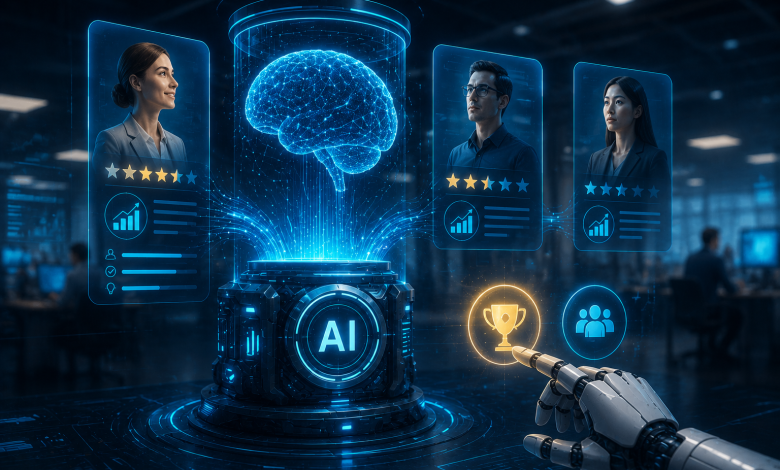
Modern workforce analytics platforms ingest data from project management tools, communication logs, CRM activity, code repositories, and productivity suites. Machine learning models then identify patterns — who close the most tickets, who respond fastest, who consistently meet deadlines — and rank employees accordingly.
For HR teams managing hundreds or thousands of employees, this kind of signal aggregation addresses a real problem. Human managers have limited visibility, inconsistent memory, and well-documented cognitive biases. An algorithm for processing uniform data across an entire workforce appears, on the surface, to offer a more equitable baseline.
Some organizations use these outputs to generate nomination shortlists for quarterly awards or year-end recognition. Others pipe scores directly into compensation reviews. In both cases, AI is no longer just a reporting tool — it is actively shaping who gets seen.

The Bias Problem Doesn’t Disappear — It Relocates
The core premise of algorithmic fairness is that structured data produces fairer outcomes than human intuition. The research on this is mixed. AI systems trained on historical performance data inherit the structural inequities embedded in that data. If certain employee groups were historically under-recognized, the training data reflects that gap, and the model learns to replicate it.
Proximity bias presents a parallel issue. Employees in office environments tend to generate more data points that systems can capture — more meeting appearances, more direct interactions with leadership, more documented collaboration. Remote and hybrid employees may produce equivalent work but leave a thinner data footprint. An AI system optimizing measurable activity can functionally penalize distributed teams, not through intent, but through architecture.
This is where many recognition programs encounter friction. When organizations present physical recognition — things like crystal awards from EDCO Awards Company for top performers — the legitimacy of that recognition depends entirely on the credibility of the
selection process. If employees perceive the methodology as opaque or skewed, the award loses its cultural weight regardless of its material value.
What Machines Still Cannot Evaluate
Quantitative performance data captures output. It does not capture the conditions under which that output was produced. An employee who kept a project on track during a period of organizational upheaval, or who mentored three junior colleagues without any formal credit, or who resolved a client relationship that never showed up in a CRM — none of that registers cleanly in a data pipeline.
There is also a question about role types. AI recognition systems perform best in jobs with high output legibility: sales, software development, customer support. They perform poorly in roles where contribution is structural rather than transactional — research, strategy, culture-building, and cross-functional coordination. The more a job involves judgment and relationship management, the less a metric-based system can see.
Social contribution compounds this further. Employees who make teams function better often do so through behaviors that are invisible to data collection: absorbing conflict, redistributing credit, mentoring informally. Recognition systems built on logged activity miss the connective tissue of high-performing organizations.
Where Human Judgment Remains Load bearing
The emerging consensus among organizational researchers is not that AI should be removed from recognition of workflows, but that its outputs should function as inputs — not conclusions. Algorithms can flag employees who are statistically overperforming relative to their peers. They can surface names that might not appear on a manager’s radar. They can provide a structured baseline that reduces the likelihood of the loudest voices dominating nomination conversations.
But the evaluation of context, of trajectory, of contribution that resists quantification — that still requires a human being with organizational knowledge and the professional accountability to make a judgment call.
Recognition that carries cultural meaning depends on employees believing the process was conducted with both fairness and understanding. Data can support that process. It cannot substitute for it.
The Governance Question Organizations Need to Answer
As AI becomes more embedded in recognition and performance of workflows, the governance structures around these systems have not kept pace. Most employees don’t know whether algorithmic tools are influencing their recognition eligibility. Fewer still
know which data sources are being used, how models are weighted, or what recourse exists if an output seems wrong.
Transparency is increasingly treated as a technical requirement for AI deployment in hiring and performance management. Recognition is overdue to the same standard. Organizations integrating AI into this space should be prepared to explain, at a level employees can understand, how the system works and where human judgment still applies — because that explanation is inseparable from whether recognition means anything at all.