
Business growth has shifted to a digital-first model, changing how companies sell, connect, and expand. Today, consumers research products online, distributors manage teams through mobile apps, and transactions happen globally without in-person meetings
To adapt to this shift, MLM businesses are investing in AI-powered Unilevel MLM software to automate operations, manage distributor networks, and streamline commissions. In a digital-first economy, advanced MLM software is no longer optional and has become essential for improving efficiency, scalability, and business growth.
Understanding the Unilevel MLM Model
In network marketing, choosing the right compensation structure directly impacts distributor growth and retention. The Unilevel MLM plan is one of the most widely used models because of its simple and scalable structure. In this plan, every distributor can recruit unlimited members on their first level, while new recruits continue building deeper levels in the network. Commissions are earned based on both direct sales and team performance across levels.
Unlike binary MLM plans, which limit distributors to two frontline legs, or matrix plans with fixed width and depth restrictions, the Unilevel model offers greater flexibility and easier expansion. While hybrid compensation plans combine multiple models, they often introduce complex rules that can confuse new distributors.
The biggest advantage of the Unilevel MLM plan is simplicity. Its easy-to-understand structure helps distributors explain the model quickly, improve onboarding, and build teams faster. For digital-first MLM businesses, combining this model with AI-powered MLM software creates a reliable foundation for long-term growth, scalability, and distributor engagement.
The Rise of the Digital-First Economy
A digital-first business is no longer limited to having a website or social media presence. It means every business interaction, from product discovery and communication to transactions and customer support, happens online by default. This shift has significantly transformed the direct selling and network marketing industry.
With the rise of remote work, cloud technology, automation, and mobile-first users, businesses are moving away from traditional operating models. As a result, AI-powered MLM software is rapidly evolving to support faster, smarter, and more scalable business operations in the digital economy.
Why Traditional MLM Systems Are Falling Behind?
However, not all MLM software has kept pace. The same digital forces reshaping how businesses operate are exposing just how outdated many legacy systems truly are.
Today, modern MLM businesses increasingly rely on automation, predictive insights, and real-time visibility, areas where AI-powered legacy replacements outperform traditional systems. When distributors wait days for commission reports or network leaders cannot see downline activity instantly, it creates operational inefficiencies. Moreover, clunky, desktop-only interfaces in a mobile-first world are one of the top reasons for disengagement.
Expanding across regions adds another layer of strain. Varying tax regulations, data privacy laws, and payout requirements overwhelm systems that were never built with compliance in mind. For a Unilevel plan whose greatest strength is unlimited growth, outdated systems become a barrier, while AI-powered Unilevel MLM software removes those limitations.
Key Features Defining the Future of Unilevel MLM Software
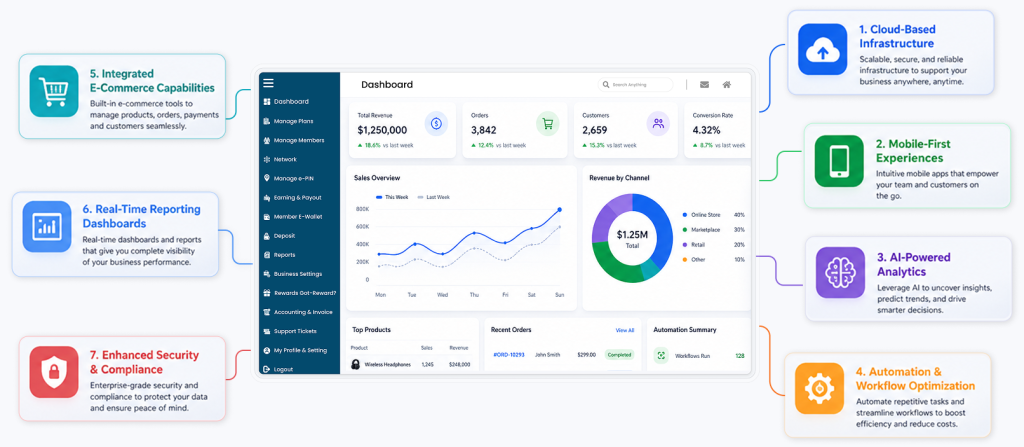
Today, legacy systems have become outdated. Unilevel MLM businesses now need software built for the digital-first world, supported by AI-powered automation, analytics, and decision-making capabilities. Here are some of the features that are redefining the next generation of unilevel MLM software:
1) Cloud-Based Infrastructure
Most updated MLM software solutions are cloud-based. It gives businesses the ability to scale up without hardware investments, adapt to demand without downtime, and operate across geographies. For growing networks, AI-powered cloud infrastructure improves both cost-efficiency and operational resilience.
2) Mobile-First Experiences
As stated earlier, mobile-first digital infrastructure is a must for today’s MLM software. A distributor’s business lives on their phone. Therefore, modern AI-powered MLM software must allow them to onboard recruits, track earnings, monitor their downline, and manage their business entirely on the go.
3) AI-Powered Analytics
Data is only useful when it tells you something actionable. AI-powered analytics within unilevel software can identify which distributors are at risk of going inactive, which product lines are gaining traction, and where growth is most likely to come from next. These predictive insights shift decision-making from reactive to strategic.
4) Automation & Workflow Optimization
Manual commission calculations, onboarding sequences, and follow-up reminders are extremely inefficient and error-prone. AI-powered automation handles these workflows reliably and at scale, freeing distributors and administrators to focus on growth rather than administration. In a unilevel network that can grow several levels deep, this kind of efficiency is a must-have.
5) Integrated E-Commerce Capabilities
Network marketing and product sales are inseparable. Future-ready unilevel software integrates e-commerce natively and allows distributors to manage product listings, process orders, and track inventory within the same platform. A seamless buying experience strengthens both customer retention and distributor confidence, while AI-powered recommendation engines can further improve upselling opportunities.
6) Real-Time Reporting Dashboards
Waiting for end-of-month reports is a relic of legacy systems. AI-powered dashboards give distributors and business leaders an always-current view of performance metrics, commission flow, and network activity. When decisions are grounded in live data, they are faster, sharper, and more effective.
7) Enhanced Security & Compliance
As MLM businesses expand across borders, they carry the responsibility of protecting distributor data and meeting regional regulatory requirements. Future-ready software builds compliance as a core architectural feature. This module within the MLM software covers data encryption, role-based access, GDPR adherence, and audit-ready reporting through AI-powered compliance systems.
Role of Unilevel MLM Software in Distributor Success
While features and infrastructure matter, they only create value when the distributor using the platform actually succeeds. A network is ultimately built by people, and the software powering it must make those people more confident, more capable, and more committed. That starts from the moment they join:
- Modern Unilevel software shortens the critical onboarding window with guided walkthroughs, training modules, and AI-powered training recommendations that new recruits can move through independently, without waiting for their upline at every step.
- As they settle in, engagement tools take over. Automated nudges, milestone recognition, and AI-powered activity alerts keep distributors motivated long after the initial excitement of joining fades.
- With momentum building, built-in performance dashboards let distributors set personal targets, track commission growth, and watch their network grow in real time. Turning visibility into progress is one of the strongest drivers of retention.
- Lastly, personalized experiences reduce the overwhelm and give distributors a focused, relevant view of their business that builds confidence at every stage of their growth.
Integration With Emerging Technologies
Modern unilevel MLM software does not operate in isolation. Its ability to integrate with emerging technologies transforms it from a functional platform into a truly connected business environment. This enhances the experience for everyone, from the newest distributor to the most senior network leader.
When a distributor’s CRM, marketing tools, and ERP systems are directly integrated with their MLM platform through open API integrations, the fragmented experience disappears. Customer data, campaign performance, and inventory all flow into a single unified view enhanced by AI-powered data intelligence.
And the integrations are not just limited to business systems; they extend to social selling tools as well. Modern MLM software also supports social selling integrations, which bring a distributor’s outreach activity directly into the platform. This enables better tracking and performance measurement through AI-powered engagement insights.
As for enhanced security, blockchain-backed payout systems add a dimension of transparency that strengthens distributor trust. When earnings are verifiable and tamper-proof, confidence in the platform grows. Moreover, cryptocurrency payment support extends that confidence further. This removes the friction of cross-border banking for businesses operating across multiple markets.
Customization and Scalability as Growth Drivers
No two MLM businesses are identical, and the software powering them should reflect that. As unilevel businesses grow in size and complexity, the ability to customize and scale AI-powered MLM software becomes less of a convenience and more of a direct driver of growth.
One of the most popular customization requirements from MLM business owners is flexible compensation configurations. While the unilevel plan is structurally simple, businesses still need the freedom to layer in rank advancements, bonus structures, and incentive programs that reflect their unique strategy.
A platform that locks businesses into rigid payout templates forces them to shrink their vision to fit the software, when it should be the other way around. The same logic applies to adapting the software across different business models. Whether a company sells physical products, digital subscriptions, or services, the platform must bend to fit the business, not the other way.
Then comes scale. As a unilevel network expands across regions, it encounters multiple currencies, varying tax structures, and market-specific compliance requirements. Software that handles multi-currency operations natively and adapts to regional regulatory frameworks makes global expansion manageable. For businesses with ambitions beyond their home market, this is the infrastructure that turns those ambitions into something actionable.
Challenges in Adopting Advanced MLM Software

Adopting advanced MLM software can unlock long-term scalability, but businesses must address several technical, operational, and compliance challenges to ensure a smooth transition.
1. High Implementation Costs
Challenge: Migrating from a legacy system to a modern unilevel MLM platform often requires significant upfront investment, including software licensing, cloud infrastructure, customization, and deployment resources.
Solution
- Choose a scalable SaaS-based MLM platform to reduce infrastructure costs.
- Implement the software in phases instead of a full-scale migration at once.
- Prioritize essential modules first, then expand features as the business grows.
2. Complex Infrastructure Setup
Challenge: Setting up servers, databases, integrations, and security layers can become technically demanding for growing MLM businesses.
Solution
- Opt for cloud-hosted platforms with pre-configured infrastructure.
- Work with vendors that provide managed hosting, backups, and monitoring.
- Conduct infrastructure planning before implementation to avoid scalability bottlenecks.
3. Data Migration Risks
Challenge: Migrating distributor hierarchies, commission histories, and transaction records from old systems involves complex mapping and validation.
Solution
- Perform data audits before migration to eliminate duplicates and errors.
- Run pilot migrations in test environments before full deployment.
- Use automated migration tools with rollback capabilities for added safety.
4. User Training and Adoption Resistance
Challenge: Distributors and administrators may struggle to adapt to new dashboards, workflows, and reporting systems.
Solution
- Provide role-based onboarding sessions for admins, distributors, and finance teams.
- Offer video tutorials, knowledge bases, and live support during rollout.
- Introduce the platform gradually to reduce operational friction.
5. Third-Party Integration Complexity
Challenge: Integrating MLM software with CRM, ERP, payment gateways, and marketing tools requires API coordination and technical expertise.
Solution
- Select software with built-in API frameworks and integration support.
- Prioritize critical integrations first, such as payment and CRM systems.
- Conduct compatibility testing before connecting live systems.
6. Multi-Country Compliance Requirements
Challenge: Global MLM businesses must comply with data privacy laws, tax rules, income disclosure regulations, and financial reporting standards across regions.
Solution
- Use MLM software with configurable compliance modules.
- Enable region-specific tax, currency, and payout settings.
- Conduct regular legal and compliance audits with regional experts.
7. Operational Downtime During Transition
Challenge: Software migration can disrupt distributor operations, commission payouts, and order processing if not managed properly.
Solution
- Schedule migration during low-traffic business periods.
- Maintain parallel system operations until the new platform is fully stable.
- Create contingency and disaster recovery plans before launch.
Best Practices For Choosing Future-Ready Unilevel MLM Software
Given the complexity of adopting a new system and the stakes involved, choosing the right unilevel MLM software deserves a detailed evaluation criterion. The market is crowded with platforms that promise features but lack modern architecture to support growth. Knowing what to look for is important at the buying stage. Start by looking for an MLM software that checks every one of these boxes:
- Cloud-native infrastructure with proven uptime and disaster recovery protocols.
- Modular design that allows features to be configured without full redevelopment
- Open API framework for seamless integration with CRM, ERP, and marketing tools.
- Mobile-first interface with a fully functional distributor app
- Built-in compliance frameworks, end-to-end encryption, and role-based access controls.
- Flexible compensation configuration without vendor dependency.
When you are assessing vendors, do not go in for a polished demo. Instead, ask these 5 questions:
- How are platform updates deployed, and will they require downtime on our end?
- How do you ensure zero data loss during migration from a legacy system?
- How does the platform handle compliance updates across multiple jurisdictions?
- What does post-implementation support include, and what are the escalation protocols?
- Can compensation structures be reconfigured independently without a development cycle?
Once your vendor is finalized, the process does not stop here. The software you choose today must still be working hard for you, three years from now. Ask specifically about update cycles, security patching, and compliance management. Some vendors include these in their core offering, others structure them separately. Getting clarity upfront prevents costly surprises down the line.
And finally, stress test it against growth before signing anything:
- Can the platform handle exponential growth in distributor count and transaction volume?
- Does the software support multi-currency, multi-language, and multi-market operations natively?
- Can new modules and integrations be added without disrupting existing workflows?
Once every box is checked and every question answered satisfactorily, your MLM software will work as a perfect foundation on which your entire network will grow.
Future Trends to Watch
The evolution of unilevel MLM software is far from over. If the last decade was about moving operations online, the next one is about making those operations intelligent, intuitive, and borderless. Here are some future trends to watch in this space:
- Hyper-automation is connecting entire workflows, starting from lead capture to commission disbursement, into self-executing pipelines that require minimal human intervention.
- AI-driven personalization is moving beyond responding to distributor behavior to anticipating it. It offers the right recommendations and nudges at precisely the right moment in each distributor’s journey.
- Voice and conversational interfaces are allowing distributors to pull reports, check commissions, and manage their business through natural language commands rather than navigating complex dashboards.
- Expansion of global digital marketplaces is turning cross-border ambition into an executable strategy. Unilevel networks are now able to recruit, sell, and operate across markets that geography once kept out of reach.
Businesses that track these shifts early and build them into their software strategy will unlock next-level growth.
Conclusion
The unilevel MLM plan is a simple, elegant compensation structure that has grown into one of the most adaptable business models in network marketing. What makes it more relatable in today’s digital world is the fact that it can easily be configured for the modern MLM software features like mobile-first experiences, AI- powered analytics, cross-border compliance, or API seamless integrations. This is why investing in advanced Unilevel MLM software has become a need of the hour. A modern, future-ready platform will help you build an operational foundation for the next stage of your business growth. MLM Software Platform like Global MLM Software are designed with exactly that trajectory in mind. It brings together the infrastructure, compliance, and customization that serious businesses need to grow without limitations.