

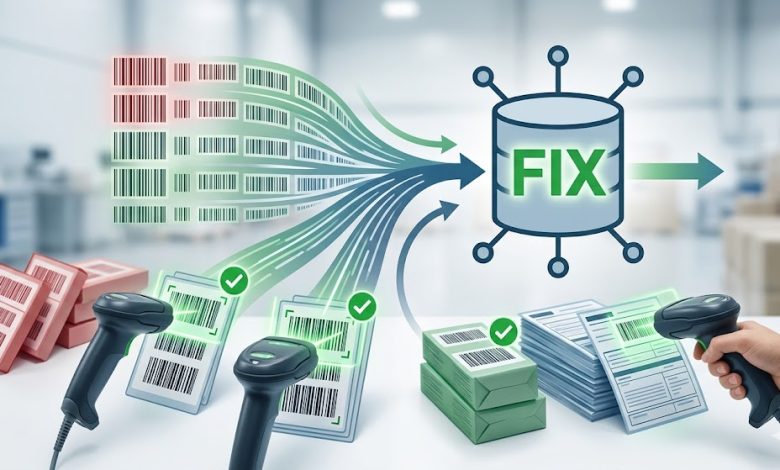
Barcodes are essential in global commerce, logistics, manufacturing, and retail, yet large-scale processing systems are often misunderstood. In high-volume environments, such as warehouses or healthcare facilities, the efficiency of batch barcode reader infrastructure is a critical operational factor, not just an IT concern.
Many organizations deploy barcode scanning systems reactively, scaling hardware before reviewing workflow design or adopting new software, leaving process gaps unaddressed. This leads to common issues such as delayed data updates, scanning errors, integration failures, and unexplained throughput limits.
This article outlines common bottlenecks in batch barcode processing and offers practical guidance for resolving them.
Understanding the Batch Barcode Environment
Unlike real-time scanning, batch barcode processing collects scan data offline or in bulk, typically using handheld devices, mobile terminals, or stationary scanners, and uploads or processes it at scheduled intervals. This approach is common where network connectivity is limited, processing needs to be distributed, or high-volume scans require grouping for downstream handling.
Batch processing reduces reliance on live networks, lowers infrastructure costs, and simplifies device management. However, it introduces vulnerabilities, especially when organizations lack structured workflow automation and data synchronization.
The Most Common Bottlenecks — and Their Root Causes
Although challenges vary by industry and scale, most batch barcode performance issues stem from a few recurring failure points, each with identifiable causes and practical solutions.
-
Inefficient Scan-to-Upload Cycles
A common issue in batch environments is excessively long or poorly timed upload cycles. If uploads are infrequent or require manual triggers, organizations operate on outdated data for extended periods.
This is particularly problematic in inventory management and supply chains, where real-time visibility impacts purchasing, shipment tracking, and stock replenishment. Uploading only at the end of a shift may be convenient, but it creates growing information gaps.
Fix: Review upload scheduling and align it with operational needs instead of technical defaults. Where possible, enable incremental or near-continuous uploads during low-traffic periods. Use a reliable task management system to trigger downstream tasks automatically upon upload completion.
-
Poor Barcode Quality and Read-Rate Failures
No batch processing system can overcome poor barcode quality. Damaged labels, inconsistent print density, incorrect sizing, and incompatibility between labels and scanners all increase error rates.
According to GS1, the global standards organization for barcodes, print quality verification is often overlooked in supply chain barcode implementation. Read-rate failures not only create data gaps but also trigger manual exception handling, which is time-consuming, error-prone, and difficult to track at scale.
Fix: Implement barcode verification at the point of label creation, not just at the point of scan. Barcode verification tools assess print quality against ISO/IEC standards, and flag labels likely to fail in field conditions. This is a straightforward integration into any business process optimization initiative and pays dividends far beyond the barcode team alone.
-
Data Synchronization Conflicts
In multi-device, multi-location environments, batch uploads from different terminals can cause synchronization conflicts, especially when the same item is scanned by multiple devices before uploading. This results in duplicate entries, inventory discrepancies, and increased reconciliation work, reducing the intended time savings.
Fix: Add conflict resolution logic at the data layer. Most enterprise systems support timestamp-based or rule-based conflict handling, but this requires explicit configuration. Assigning device territories, where specific scanners handle designated zones or SKUs, also reduces duplicate scans.
-
Integration Gaps Between Scanning Systems and Business Software
A persistent issue in batch barcode environments is poor integration between the scanning infrastructure and ERP, warehouse management, or project-tracking systems. Data from batch barcode readers is often isolated and requires manual import or translation before it can be used.
This integration gap causes latency, increases transcription errors, and makes it difficult to implement automated, trigger-based workflows, which are essential for modern operations.
| Common Integration Failure | Operational Impact | Resolution Approach |
| Flat-file exports to ERP | Data lag, manual import errors | API-based direct integration |
| No field mapping validation | Schema mismatches, failed imports | Pre-upload data validation layer |
| Single-direction data flow | No feedback on scan errors | Bidirectional sync with acknowledgement |
| Hardcoded device identifiers | Breaks on device replacement | Dynamic device registration |
Fix: Transition from file-based data transfer to API-driven integrations where possible. Modern workflow automation and middleware solutions can connect legacy barcode infrastructure to current business systems without replacing hardware.
-
Device Management and Firmware Fragmentation
In large deployments, batch scanning devices from various generations, manufacturers, and firmware versions often coexist. Each may handle data formatting, character encoding, or upload protocols differently, creating inconsistencies that are difficult to diagnose and trace.
This fragmentation hinders operational efficiency, especially when scaling scanning operations or introducing new barcode symbologies such as QR codes or 2D DataMatrix formats alongside legacy barcodes.
Fix: Create a centralized device management policy documenting firmware versions, configuration baselines, and update schedules for all devices. Mobile device management tools can enforce consistency and reduce diagnostic overhead.
-
Inadequate Exception Handling and Error Visibility
Batch environments have a blind spot: because data is collected offline and uploaded later, errors may not appear until after scanning. Storage failures or corrupted uploads may only be detected when downstream processes fail, making root cause analysis difficult.
Without effective collaboration among operations, IT, and warehouse teams, these incidents often go unnoticed until they cause significant business impact.
Fix: Implement end-to-end upload verification with acknowledgment at each stage. Configure alerts to notify teams when upload success rates drop below expectations, not only on complete failures. Integrate exception reporting into team collaboration tools so scanning anomalies are treated as operational events.
A Framework for Batch Barcode Optimization
Resolving barcode system bottlenecks is primarily a process design issue, not only a technology challenge. Effective organizations address this systematically, from data quality upstream to integration and alerting downstream.
| Optimization Layer | Key Action | Owner |
| Label Quality | Implement ISO-standard print verification | Operations / Procurement |
| Device Management | Standardize firmware, use MDM tools | IT |
| Upload Scheduling | Align cycles with business rhythms | Operations / IT |
| Data Integration | Move to API-based ERP connections | IT / Software Teams |
| Exception Handling | Build alerting into every upload stage | IT / Operations |
| Process Automation | Connect scan events to downstream workflows | Operations / Management |
Each layer affects the others. Improving label quality reduces exceptions, simplifying integration and making automation more reliable. Treating these as a connected system, rather than independent workstreams, leads to sustainable improvement.
Practical Recommendations for Operations Teams
For teams aiming to improve barcode system performance quickly, these priorities offer the highest return:
- Audit before you invest. Before purchasing new scanning hardware, map the current data flow from scan to business decision. Often, the bottleneck is not the scanner but the subsequent data handling.
- Standardize symbologies. If your environment still relies exclusively on 1D linear barcodes, assess whether 2D symbologies such as QR and DataMatrix better meet your data density needs. A capable batch barcode reader should handle both, and many modern platforms support the transition without a full hardware refresh.
- Connect scanning to workflows. The most underutilized opportunity in barcode environments is the trigger: the moment a scan or upload completes, it can automatically initiate a downstream task.
- Agile workflow management platforms make this straightforward to configure and maintain, and the productivity gains from eliminating manual handoffs are typically immediate and measurable.
- Invest in visibility, not just throughput. High scan rates without error visibility only delay problems. Before optimizing for speed, ensure you have sufficient insight into your scanning environment to address anomalies promptly.
Conclusion
Batch barcode systems are robust, cost-effective, and suitable for many operational environments, but they are not self-optimizing. These bottlenecks are common because they result from gaps between system deployment and operational needs.
Addressing these gaps does not require replacing all technology. It requires understanding where data quality, process design, and integration architecture support or hinder existing scanning infrastructure.
As barcode technology evolves to support 2D symbologies, RFID, and AI-powered scanning, organizations with well-integrated batch processing foundations will be better positioned to adopt new advances smoothly. Addressing fundamentals now is essential for future enterprise productivity.