

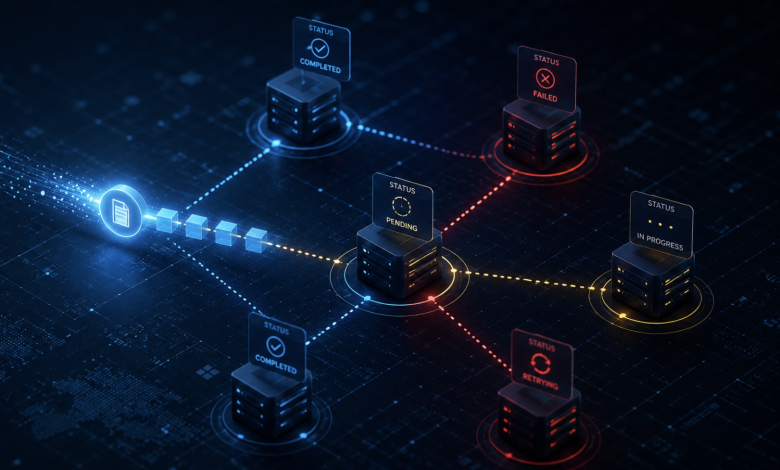
Not all system failures are obvious. In many cases, nothing crashes, nothing throws an error, and yet something is still off.
I’ve seen situations where a transaction went through from one system’s perspective, while another part of the platform behaved as if it never happened. A retry kicked in, a second operation was processed, and suddenly the system had two conflicting outcomes for what should have been a single event.
Each component followed its logic correctly. The problem was that they weren’t aligned.
That gap between “locally correct” and “globally correct” is where a lot of real-world issues begin.
Transactions Are Not What They Seem
It’s easy to think of a transaction as a single action. In reality, it’s a chain of steps that span multiple layers.
An event originates somewhere, often at the edge. It gets picked up by an application layer, validated by backend services, and sometimes propagated further to external systems. These steps don’t happen in isolation, and they rarely happen in perfect order.
There are delays. There are retries. Sometimes one part of the system moves forward while another is still catching up.
This is simply how distributed systems behave. They are built to stay responsive, even when parts of the system are slow or temporarily unavailable. That flexibility comes at a cost, and the cost is consistency.
Where Things Start to Drift
Once timing differences come into play, small inconsistencies start to show up.
A message might arrive twice. Another might arrive late. A service could process a request based on a state that is already outdated. None of these are unusual scenarios, especially at scale.
Problems start when actions are taken without verifying whether the underlying state is still valid.
A duplicate event can lead to a duplicate operation. A partial update can leave the system in a mixed state. These are not isolated bugs. They are patterns that emerge when systems operate asynchronously and independently.
Left unchecked, they build up. Over time, the system becomes harder to reason about, even if each individual component appears stable.
The Limits of Fixing It Later
A common safety net is reconciliation. When something goes wrong, systems attempt to correct it after the fact.
That might involve reversing a transaction, reprocessing data, or manually adjusting state. These mechanisms are necessary, but they are not a complete solution.
Not every inconsistency is easy to detect. Some only surface under specific conditions. Others remain hidden until they affect something downstream. By the time they are visible, the impact has already spread.
As systems grow, the cost of these corrections increases. More users, more transactions, and more dependencies mean that even a short-lived inconsistency can have wider effects.
At that point, relying solely on cleanup is not enough.
Making Correctness a First-Class Concern
A more reliable approach is to prevent incorrect execution in the first place.
This means shifting the focus from reacting to inconsistencies to controlling when and how operations are allowed to proceed. Instead of treating incoming events as triggers for immediate action, systems need to validate the state they depend on before moving forward.
In practice, this often leads to patterns where transaction state is explicitly validated and coordinated across components. The system does not assume that all parts are aligned. It checks.
This also introduces the need for synchronization, not in the sense of making everything strictly sequential, but in ensuring that decisions are based on a consistent and up-to-date view of the system.
When done correctly, this reduces the likelihood of executing actions on stale or conflicting information.
Designing for What Actually Happens
One of the biggest shifts is treating so-called “edge cases” as normal operating conditions.
Delayed responses, repeated events, and partial failures are not rare. They happen all the time. Systems that handle them well tend to acknowledge this upfront instead of trying to work around them.
That changes how operations are designed. Actions are made safe to repeat. State transitions are verified before they are committed. When there is uncertainty, the system leans toward caution rather than assumption.
These choices might seem conservative, but they prevent larger issues later on.
A key outcome is that the system avoids executing invalid, duplicate, or out-of-order operations. Instead of relying on downstream fixes, it enforces correctness at the point of execution.
Why This Matters More at Scale
At smaller scale, inconsistencies can go unnoticed or be resolved quickly. At larger scale, the same issues become much harder to contain.
A single mismatch in state can influence multiple services. Those services might trigger additional actions, creating a chain reaction that is difficult to unwind. By the time the issue is identified, it may have affected several parts of the system.
This is where the difference between “working” and “working correctly” becomes important.
Reliability is not just about keeping systems running. It is about ensuring that what they produce can be trusted.
Looking Forward
As systems become more complex, understanding their behavior becomes more challenging.
There is growing interest in approaches that analyze system activity at scale, looking for patterns that indicate instability or inconsistency. These techniques can surface signals that are difficult to capture through static rules alone.
However, observing a system is only part of the solution. The real challenge lies in connecting those insights back to how systems make decisions and execute actions.
This is where newer approaches, including AI-driven analysis of system behavior, begin to play a role. Not as a replacement for strong system design, but as a way to better understand and anticipate the conditions under which systems drift from correctness.
Closing Thoughts
In distributed systems, it’s common for components to operate correctly on their own and still produce the wrong result together.
The issue is not always failure in the traditional sense. It is misalignment.
Bringing systems into alignment requires more than adding safeguards at the edges. It requires a consistent approach to how state is validated, how decisions are made, and how operations are executed.
When that foundation is in place, systems become easier to reason about and more predictable in how they behave.
That predictability is what ultimately defines reliability.
Disclaimer: The views expressed in this article are solely those of the author and are based on generalized industry observations and engineering practices. This article does not reference or disclose any proprietary systems, implementations, or confidential information associated with any organization.
Author Bio:
Sapan Pandya is a software engineer and independent researcher with experience designing and supporting large-scale, regulated, high-performance technology platforms. His work spans distributed systems, microservice architectures, edge computing, and transactional platforms operating in high-volume environments. He focuses on system reliability, transaction integrity, scalable architecture, workflow clarity, and dependable field-deployed systems.