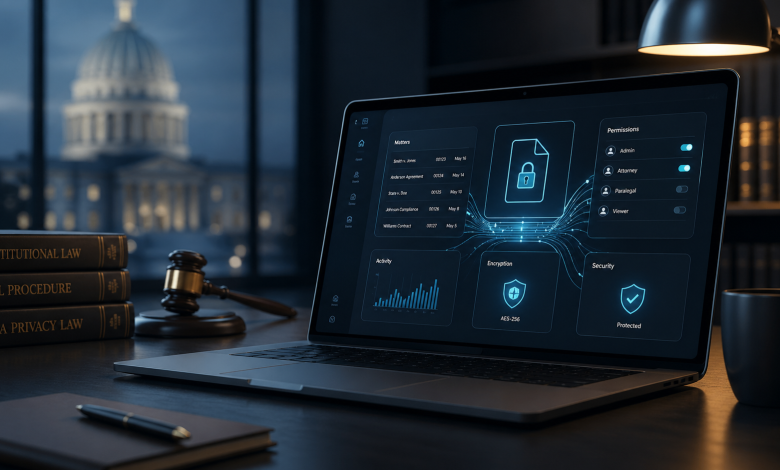
Legal tech has become the new nervous system of the justice ecosystem yet it is running on data protection standards that were never designed for always‑on cloud platforms, AI‑driven analytics, and cross‑border collaboration. As breaches accelerate and regulators tighten enforcement, the gap between what legal tech actually does with client data and what current safeguards assume it does is widening dangerously fast.
The Risk Profile of Legal Tech Has Changed
Legal technology now sits at the center of how law firms, courts, insurers, and in‑house teams store, process, and share sensitive information. Case management platforms, e‑discovery tools, contract lifecycle systems, and litigation support software routinely hold:
- Privileged communications, medical records, financial data, and trade secrets in a single integrated environment.
- Multi‑jurisdictional personal data flows that trigger simultaneous obligations under GDPR, CCPA/CPRA, HIPAA, GLBA, and sector‑specific rules.
- Persistent audit trails and behavioral telemetry (e.g., document access logs, collaboration traces) that themselves qualify as personal data.
This concentration of value explains why the legal sector has become a prime target. In the UK alone, reported data breaches in the legal sector increased by 39% between Q3 2023 and Q2 2024, compromising data on 7.9 million individuals roughly 12% of the population. Globally, data security breaches across industries now inflict over 1 trillion dollars in direct losses each year, with law firms featuring disproportionately because of the sensitivity of the data they hold.
For clients, particularly those navigating high‑stakes litigation such as personal injury claims, a single breach can expose medical histories, accident reports, and settlement strategies, compounding the harm they already face and eroding trust in their legal representation. Reputable practices, such as a seasoned Denver personal injury attorney, are now expected to interrogate the security posture of every platform they touch, not just their internal systems.
Why Current Standards Are No Longer Enough

Most legal tech security frameworks are still anchored in assumptions from an earlier era: on‑prem servers, limited remote access, and linear matter lifecycles. Three structural shifts have outpaced these assumptions.
1. Cloud‑native, API‑driven ecosystems
Modern legal platforms integrate document management, billing, client portals, e‑signatures, video conferencing, and AI assistants via APIs and third‑party services. Each integration extends the attack surface and often introduces:
- Shared‑responsibility gaps where no single party has end‑to‑end accountability for encryption, logging, and incident response.
- Inconsistent token scopes and weak API access controls that allow lateral movement once an attacker gains a foothold.
Yet many vendor security questionnaires and certifications still focus on data centers and encryption “at rest and in transit,” without demanding granular assurance about API governance, service‑to‑service authentication, or dependency risk.
2. AI and advanced analytics inside legal workflows

Legal tech now routinely embeds AI for document review, contract summarization, prediction, and intake automation. These tools:
- Aggregate vast volumes of client content for training, fine‑tuning, or benchmarking, raising complex questions about model data retention and secondary use.
- Generate derived data (embeddings, feature vectors, risk scores) that may remain identifiable or reconstructable even after “anonymization.”
Traditional data protection standards rarely specify how legal tech should handle model training boundaries, AI‑specific logging, or explainability obligations when automated profiling affects case strategy or client outcomes.
3. Human‑centric vulnerabilities at scale
The NetDocuments analysis of UK legal sector incidents found that 39% of all breaches originated in human error, and 37% involved sending data to the wrong recipient. The more powerful and ubiquitous legal tech becomes, the more damage such errors can cause:
- Misconfigured permissions on a shared workspace can expose entire matter folders to unauthorized internal teams or external collaborators.
- A single mistyped email address or misused client portal link can leak sensitive files beyond recall.
Ethical duties such as the ABA’s Rule 1.6 on confidentiality were crafted with these risks in mind, but they predate the complexity of modern legal platforms and rarely translate into precise, enforceable technical controls.
Regulatory, Ethical, and Litigation Pressure
Lawyers and legal tech providers occupy an unusually dense regulatory and ethical environment, and the direction of travel is clear: expectations are rising faster than many platforms are evolving.
Professional conduct rules: Bar associations and regulators treat failure to protect client data as potential misconduct, with sanctions ranging from fines to suspension or disbarment. ABA Rule 1.6 explicitly frames confidentiality as a professional obligation, which now extends to supervising the security of third‑party technology providers.
Data protection and privacy laws: GDPR, CCPA/CPRA, and emerging national frameworks require “appropriate technical and organizational measures” and impose hefty penalties for inadequate safeguards and delayed breach notification.
Sector‑specific obligations: In domains like health‑related personal injury, HIPAA and similar regimes can apply where legal workflows touch protected health information, adding further encryption, logging, and access governance requirements.
Enforcement trends underscore the stakes. In one recent period, UK legal regulators issued dozens of fines totaling hundreds of thousands of pounds and conducted hundreds of inspections and reviews, yet only 22% of firms examined met full compliance with key requirements. Similar scrutiny is emerging worldwide as regulators recognize the systemic risk of weak security in law firms and their vendors.
A breach that exposes a personal injury claimant’s medical file or a corporate client’s trade secrets can now trigger:
- Regulatory fines and mandatory reporting obligations.
- Malpractice claims for negligent supervision of technology vendors.
- Class‑action exposure and reputational damage that can permanently erode client trust.
Key Failure Modes in Current Legal Tech Security
The need for stronger standards becomes most obvious when you look at how breaches actually happen rather than how policies describe security.
Incomplete encryption and key management
Many platforms advertise “encryption at rest and in transit,” but:
- Use weak configurations, shared keys, or inconsistent encryption across subsystems (e.g., logs vs documents vs backups).
- Fail to implement robust key rotation, hardware‑backed key storage, or tenant‑isolated encryption domains.
For legal data, where compromise often cannot be “fixed” with credit monitoring or password resets, encryption must be treated as a rigorously engineered control, not a checkbox.
Over‑permissive and brittle access controls
The combination of role‑based access control (RBAC), group sharing, and ad‑hoc exceptions easily leads to:
- “Access sprawl” where users retain permissions across matters, clients, or practice groups long after they need them.
- Difficulty reconstructing who can actually see a given file at any point in time, which undermines incident response and auditability.
This is especially problematic in matters involving vulnerable claimants, catastrophic injuries, or sensitive business disputes, where the confidentiality expectations are exceptionally high.
Weak governance of third‑party and insider risk
Legal tech platforms increasingly rely on subcontractors for hosting, support, analytics, and AI services. At the same time, insider threats ranging from careless staff to malicious actors still account for roughly half of reported incidents in some legal markets. Yet many vendor assessments:
- Stop at the primary platform provider and neglect sub‑processors.
- Rarely require continuous security attestations, real‑time risk scoring, or automated controls to disable access when employment or engagement status changes.
Limited resilience and recovery planning
Backups exist, but they are not always:
- Immutable, geographically distributed, and tested for rapid, granular recovery after ransomware or insider sabotage.
- Securely encrypted and logically separated to avoid being compromised alongside primary systems.
For legal practices representing injured clients or businesses in crisis, downtime and data loss translate directly into missed deadlines, procedural sanctions, and irreversible prejudice to the client’s position.
What Stronger Data Protection Standards Should Include
To close the gap, legal tech needs domain‑specific standards that go beyond generic “best practices” and reflect the unique sensitivity, regulatory context, and ethical duties of legal work.
1. Legal‑grade security baselines
Legal tech platforms should be expected to meet or exceed well‑defined baselines tailored to the sector, including:
- End‑to‑end encryption: Strong, modern algorithms (e.g., AES‑256) with tenant‑separated keys, hardware‑backed storage, and strict rotation policies.
- Verified access control models: RBAC combined with least‑privilege defaults, time‑bound access grants, and automatic revocation tied to HR and client‑matter lifecycles.
- Mandatory multi‑factor authentication (MFA) and device security standards for all privileged access, including vendor support teams.
These baselines should be auditable and certified by independent assessors, not simply asserted in marketing collateral.
2. AI‑specific data protection rules
Given the rapid adoption of AI in legal workflows, stronger standards must directly address:
- Clear boundaries between operational data and model training data, with explicit opt‑in controls and detailed documentation for clients.
- Safeguards to prevent inadvertent cross‑matter data leakage through shared models, embeddings, or prompt histories.
- Logs and explanations sufficient to interrogate AI‑driven decisions or recommendations when they influence case strategy or client consent.
Without such standards, even well‑intentioned AI features can undermine fundamental confidentiality and privilege obligations.
3. Continuous monitoring and behavioral analytics
Static security snapshots are inadequate in environments where threat actors adapt quickly and access patterns change daily. Stronger standards should require:
- Continuous monitoring of authentication, document access, and data exports, with anomaly detection tuned to legal workflows (e.g., unusual access to medical files or bulk downloads across matters).
- Automated containment mechanisms that can rapidly lock accounts, revoke tokens, or segment data when suspicious activity is detected.
This is where ethical responsibility and technology converge: firms representing injured clients or vulnerable individuals must be able to detect and stop misuse before it snowballs into systemic harm.
4. Structured human‑factor controls
Because human error drives such a large share of incidents, standards should embed safeguards directly into user experience and governance rather than relying solely on training.
Examples include:
- Built‑in “safe send” workflows that flag or block emails and portal shares to unfamiliar recipients when sensitive documents are attached.
- Context‑aware warnings when users attempt to share outside an approved team or jurisdiction, especially where cross‑border transfer restrictions apply.
- Tiered approvals for exporting entire matters, downloading bulk archives, or granting external access.
These controls reduce the cognitive load on busy litigators and claims teams while materially lowering breach risk.
5. Verifiable incident readiness and resilience
Finally, legal tech standards must require providers and firms to prove not merely claim that they can withstand and recover from incidents.
This includes:
- Regular, documented incident response exercises that involve both provider and client teams and simulate realistic legal data scenarios.
- Tested recovery time objectives (RTOs) and recovery point objectives (RPOs) tuned to procedural deadlines, court schedules, and client commitments.
- Clear, contractually binding commitments on breach notification timelines, scope, and cooperation, aligned with applicable laws.
For plaintiffs in serious personal injury cases, this resilience is not abstract: delayed filings or missed limitation periods due to outages can irreversibly compromise their claims.
The Shared Responsibility Model for Legal Outcomes
Stronger data protection standards in legal tech are not only about compliance and cyber risk; they are about outcomes in real cases and real lives. Lawyers, vendors, and regulators now share responsibility for the integrity of the digital infrastructure that underpins access to justice.
- Legal teams must treat security due diligence on platforms with the same seriousness as case strategy and evidence management. That expectation applies equally whether they are a global firm or a focused practice such as a Denver personal injury attorney guiding injured clients through complex claims.
- Vendors must design security and privacy as first‑class product features, with transparent documentation, robust certifications, and clear explanations tailored to legal buyers rather than generic IT audiences.
- Regulators and professional bodies must translate high‑level duties of confidentiality and competence into more granular, technology‑specific guidance and enforceable standards.
The legal sector has always demanded high standards of professional conduct in the analog world. As legal tech becomes the default medium for almost every interaction, it needs equally rigorous, well‑defined, and enforceable data protection standards that reflect the reality of modern practice rather than the assumptions of a previous generation of tools.