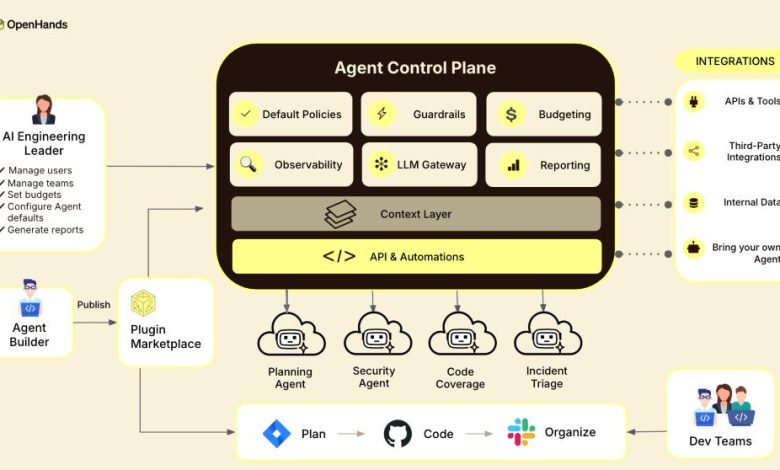
OpenHands is made up of folks from Google, Microsoft, and Carnegie Mellon and is well known for their popular open source coding agent. But today they are making a platform play by launching the OpenHands Agent Control Plane: a centralized operational layer designed to manage the growing sprawl of AI agents across modern enterprises. The new control plane brings agent fleets under centralized control, where they can be orchestrated and optimized at scale.
As organizations increasingly adopt agents for developer productivity, code automation, and other engineering tasks, many teams are hitting a scale issue as agents sprawl across repositories, teams, and business units. OpenHands’ offering responds to that challenge by treating agents not as independent, one-off tools but as components of a coordinated system, managed from a single operational plane.
Industry research shows a clear gap between experimentation and production deployment of AI agents. While a majority of organizations are experimenting with agents, only a minority have successfully operationalized them. The reasons are familiar: ad hoc deployments lead to fragmented workflows, runaway permissions, inconsistent observability, and little ability to attribute costs or enforce compliance. The Agent Control Plane addresses those gaps by providing a framework to orchestrate, secure, observe, and optimize agent fleets.
At the heart of the control plane are workflow definitions and lifecycle management features that let platform teams specify how agents should operate across codebases. These workflows can run in parallel across repositories and teams, with consistent scheduling, retry policies, and state management. That uniformity reduces the ad-hoc nature of agent deployments and makes behavior predictable and reproducible, critical for operational scale.
Security and least-privilege by default
OpenHands emphasizes security and governance as first-class concerns. The Agent Control Plane enforces least-privilege access controls, ensuring agents never inherit broad developer permissions by default. Access to secrets, networks, and external systems is scoped at the workflow level, minimizing blast radius and meeting common enterprise security requirements.
To further contain risk, agent activity executes inside isolated sandboxes that limit code execution, file access, and external calls. These sandboxes make agent actions observable and reproducible, while preventing agents from making unauthorized or unsafe changes to systems. The sandboxed approach also supports enterprise needs for auditability and compliance: every action is logged, correlated to its workflow, and traceable for debugging and regulatory purposes.
Observability, cost attribution, and governance
One of the notable operational challenges with agent-driven automation is a lack of visibility into what agents are doing and how much they are costing. OpenHands builds usage and spend tracking into the control plane at the workflow level, giving platform teams clear visibility for cost attribution and optimization. That allows organizations to quantify ROI from agent automation and to identify inefficient or runaway behaviors before they become costly.
In addition to cost tracking, the platform provides robust logging and tracing. Because all agent activity is linked back to workflows and executed within reproducible environments, auditing becomes far easier. Teams can inspect past runs, reproduce failures, and validate behavior against policy requirements, making the control plane suitable for regulated environments as well as high-velocity dev teams.
Open source and community momentum
OpenHands is positioning the Agent Control Plane as the management layer for an already popular open-source core. The OpenHands project has gained significant traction in the developer-AI ecosystem: the project reports more than 70,000 GitHub stars, 9,000 forks, 7 million downloads, and contributions from hundreds of developers worldwide. Engineers at large technology companies including AMD, Apple, Google, Amazon, Netflix, TikTok, NVIDIA, Mastercard, and VMWare have reportedly cloned or forked the repository to customize and extend the platform.
That community-driven adoption is central to OpenHands’ strategy. By keeping the core framework open source, OpenHands provides developers and platform teams full visibility into how agents execute work and interact with their systems. The company argues that transparency is essential for trust and for enabling organizations to tailor agent behavior, security policies, and integrations to their own operational needs.
Robert Brennan, CEO and Co-Founder of OpenHands, summarized the vision succinctly: “Running a single agent is straightforward; running hundreds across an organization requires a system. We’re giving enterprises that system with the new OpenHands Agent Control Plane.” The announcement signals an attempt to move beyond early-stage tooling for individual developers toward enterprise-ready infrastructure for distributed agent fleets.