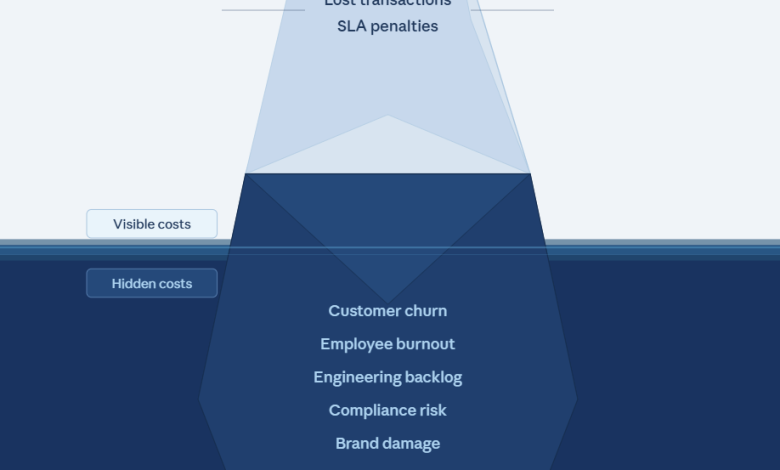
Picture this: it’s 11 a.m. on a Tuesday. Your team is mid-sprint, your sales pipeline is humming, and somewhere in the stack, something breaks. Within minutes, the help desk is flooded, Slack is chaos, and your customers are staring at error messages. By the time systems are restored hours later, everyone exhales and leadership starts calculating what the outage “cost.”
They’ll look at lost transactions. Maybe lost SLAs. They’ll come up with a number, declare the incident closed, and move on.
But that number is almost always wrong. Not because the math is bad, but because it only counts what’s easy to see.
The Bill That Keeps Coming
The immediate revenue loss from an outage is real, but it’s just the opening charge on a much longer invoice. A Splunk report surveying 2,000 executives across the Global 2000 found that downtime costs these companies a combined $400 billion annually, roughly 9% of total profits. The consequences extend well beyond the moment systems go dark, taking a lasting toll on shareholder value, brand reputation, and customer trust.
EMA research puts the average cost of unplanned downtime at $14,056 per minute, rising to $23,750 per minute for large enterprises. A decade ago, the industry benchmark was $5,600 per minute. The cost has more than doubled, and it is still climbing.
Those figures are striking. But they still only tell part of the story.
Your People Are Paying for It Too
When the systems come back online, the work doesn’t magically resume where it left off. Employees spent the outage improvising, hunting for workarounds, manually logging what should have been automated, answering the same frantic questions over and over. Now they’re behind, stressed, and staring down a backlog that didn’t exist that morning.
A Cockroach Labs survey of more than 1,000 senior technology executives found that outages led to missed deadlines for 39% of teams, created work backlogs for 43%, and pushed 48% into overtime or weekend work. None of that shows up in the incident report. None of it gets invoiced. But it absolutely gets paid in burnout, turnover, and the quiet erosion of team morale that makes the next crisis harder to weather.
The Customers Who Leave Without Saying Goodbye
Here’s what makes customer trust such an expensive thing to lose: most customers won’t tell you they’re leaving. They’ll just quietly go somewhere else. Downtime erodes customer trust in ways that persist long after the lights come back on.
Meanwhile, your competitors who stayed online during your outage didn’t sit still. They were there to catch whoever came looking for an alternative.
This is especially painful when downtime strikes at the worst possible moment. A flash sale, a product launch, a peak campaign window. These aren’t average revenue hours. They’re your highest value hours. Losing them doesn’t just cost you the transactions. It costs you the momentum.
When an Outage Becomes a Legal Problem
For companies in regulated industries, an IT failure can quickly become something more serious than a bad news cycle. Depending on what data is exposed or compromised during an outage, organizations may face mandatory breach notifications, compliance investigations, and financial penalties under GDPR, HIPAA, or PCI-DSS, sometimes weeks or months after the incident itself.
The 2024 CrowdStrike update failure is a vivid example of how fast this can escalate. What started as a faulty software push crashed 8.5 million Windows systems worldwide and triggered regulatory scrutiny across multiple jurisdictions. As the EMA analysis above details, the total global losses exceeded $10 billion, with Delta Airlines alone absorbing $550 million in combined revenue loss and recovery costs. Less than $1.1 billion of those global losses were covered by cyber insurance, a gap that caught many finance teams off guard.
The lesson isn’t just that outages are expensive. It’s that the legal and regulatory tail can outlast the technical recovery by a wide margin.
The Stock Price Nobody Wants to Talk About
For publicly traded companies, an outage isn’t just an operational event. It’s a market event. The Splunk report cited earlier found that significant IT incidents correlate with an average stock price drop of 2.5%, with recovery taking an average of 79 days. For a company with a $10 billion market cap, that’s a $250 million paper loss that no hotfix or status page update will undo overnight.
Then there’s the slower, quieter brand damage. Rebuilding a reputation for reliability means sustained investment in communications, customer success outreach, and sometimes product overhauls. That work doesn’t appear on the incident ticket. It shows up months later in budgets, headcount decisions, and strategic pivots that trace back to a two hour outage nobody thought was that big of a deal.
Prevention Is Cheaper Than You Think (Recovery Isn’t)
There’s a persistent myth in IT that resilience investment is a luxury, something you do when you have extra budget, not when you’re fighting fires. The data says otherwise. Organizations that adopt proactive observability and automated monitoring consistently report dramatically lower costs per incident than those operating on a break-fix model.
The harder truth, also surfaced by the Cockroach Labs survey above, is that many organizations are still finding out about outages the wrong way: through customer complaints, manual checks, or a flood of support tickets. That means the customer knew before the IT team did. In 2025, that gap isn’t just embarrassing. It’s expensive in every way this article has described.
The Real Question After Every Outage
The instinct after an outage is to fix what broke and move on. That instinct is understandable, but it’s incomplete. The better question isn’t just “what failed?” It’s “what did this actually cost us, all the way down?”
That means counting the overtime. The customers who quietly churned. The compliance review that’s still open. The engineering team that’s burned out heading into the next quarter. The brand work that now has to redo six months of trust building in a single afternoon.
Resilience isn’t a technology problem or a budget line. It’s a business strategy. And organizations that treat it that way are the ones that come out the other side of an outage stronger, not just recovered.