

Scroll any feed today and you’ll feel it: something has changed.
The videos are stranger. The music feels algorithmically fluid. Influencers aren’t always human. Content isn’t just created – it’s generated, remixed, and reshaped in real time.
AI hasn’t just entered the creative stack. It’s rewriting it.
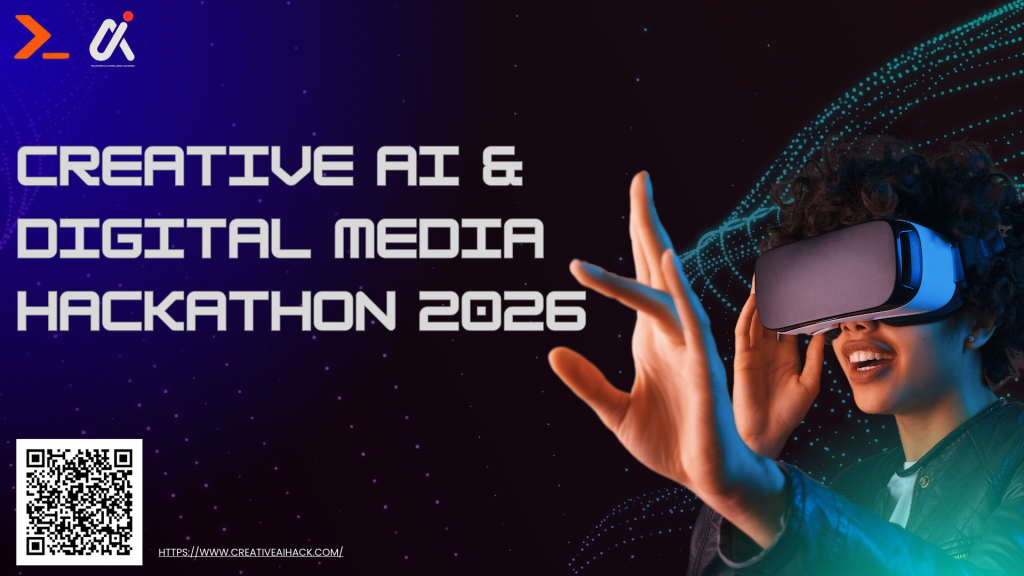
The Creative AI & Digital Media Hackathon, set to launch on April 23, embodies the precise moment when creativity, culture, and machine intelligence intersect.
From Tools to Co-Creators
For years, creative software evolved by becoming more powerful. Now, it’s becoming more autonomous.
We’re moving from:
- editing → generating
- producing → prompting
- consuming → interacting
In this new paradigm, AI doesn’t just assist creators; it behaves like a collaborator. Occasionally it even creates itself.
This hackathon isn’t interested in incremental upgrades to existing tools. It’s asking a sharper question:
What does creativity look like when AI is native to the medium?
Build Something That Feels Like the Internet in 2026
Participants are given a deliberately open brief: build anything, as long as AI is central and the result pushes creative expression forward.
That could mean:
- a video engine that edits itself based on narrative intent
- a virtual influencer that evolves with its audience
- a music system that adapts in real time to user emotion
- an interactive experience designed to spread, remix, and mutate
The constraint isn’t technical. It’s cultural.
Projects will be judged not just on execution, but on whether they resonate—whether they feel like something that belongs on tomorrow’s internet, not yesterday’s.
No Hackathon Theater
The event is run in partnership with Maximally, a platform quietly positioning itself against what hackathons have become: bloated, performative, and often disconnected from real output.
Maximally’s model is blunt:
- build fast
- ship something real
- cut everything that doesn’t matter
No filler workshops. No vanity demos. Just focused environments where builders – developers, designers, founders – work toward tangible outcomes.
It’s part of a broader push to rethink hackathons as execution layers, not networking events. Infrastructure, standards, and continuity matter more than hype.
In that sense, the gathering isn’t just an event. It’s a node in a growing system designed to support high-intent builders over time.
Built with Guidance from Industry Leaders
The hackathon is guided by a cross-disciplinary group of judges and mentors drawn from leading technology and product organisations. The judging panel includes Rajeshwari Sah (Machine Learning Engineer at Apple), Yauheni Kruk (Art Manager at Meta), Sidhesh Badrinarayan (Senior Software Engineer at Google), Sanjana Arun (Product Manager at eBay), Tatiana Andronova (Product Design Lead at Tabby) and others. Supporting participants are mentors with deep expertise across engineering, AI, and go-to-market strategy, including Pavel Khotin (Engineering Manager at Yandex, specialising in generative models and creative AI); Asutosh Mourya (Engineering Manager at Trili Tech, focused on building and scaling high-performing product teams); Puneet Nagpal (Director of Marketing, advising on product narratives and go-to-market strategy); Asif Eqbal (Software Engineer at Meta, specialising in distributed systems and scalable backend architectures for AI-driven applications); and others. Together, they bring a mix of technical depth, product thinking, and creative direction, ensuring projects are evaluated not just for innovation, but for real-world viability and cultural relevance.
Why This Moment Matters
Creative AI is hitting an inflection point.
What started as a novelty, AI art, synthetic voices, and generated clips are becoming infrastructure for culture itself. The barrier to creating high-quality, high-impact content is collapsing. The speed of iteration is accelerating. The definition of authorship is blurring.
And with that comes a shift:
The most valuable products won’t just help people create.
They’ll shape how culture is produced, distributed, and experienced.
The Real Challenge
The hardest part of this hackathon isn’t technical.
It’s taste.
Knowing what to build when the constraints are gone.
Knowing what feels original when everything is generatable.
Knowing what people will actually care about.
The teams that win won’t just use AI effectively.
They’ll use it intentionally – to create something that people want to engage with, share, and remember.
The Details
- Kickoff: April 23, 2026
- Submission Deadline: April 29, 2026
- Winners Announced: May 5, 2026
Open globally to developers, designers, and creators, competing solo or in teams.
What Comes Next
Hackathons have always been about prototyping the future in compressed time.
But this one feels slightly different.
The future it points to is no longer hypothetical. It’s already leaking into timelines, platforms, and workflows.
The web is just where it gets built: faster, louder, and more intentionally.
And if the internet is becoming AI-native, the metaverse is where some of its first real products will emerge.