

Matching Engine music rights platform supporting 500,000 creators and rightsholders worldwide expands with new AI capabilities
Launch unveiled at global symposium in Dublin, with organisations including SOCAN (Canada), TONO (Norway), KODA (Denmark) and IMRO (Ireland), as Collective Management Organisations face growing complexity in music data
Dublin, Ireland, 15 April 2026 – Matching Engine, developed by Spanish Point Technologies, today announced the launch of a new AI module while Collective Management Organisations using the platform are set to distribute over €1.2 billion in royalties to 500,000 creators and rightsholders worldwide in 2026. The launch represents a significant infrastructure milestone as organisations respond to a widening range of challenges across the music industry, from the continued growth of streaming platforms and short-form content, to increasing usage across gaming and social media, as well as the rapid rise of AI-generated music from platforms such as Suno and Udio, all of which are driving greater data complexity and placing new pressure on rights management processes.
Matching Engine is a fully cloud-native, highly configurable enterprise platform used by leading rights organisations across Europe and North America, including SOCAN (the Society of Composers, Authors and Music Publishers of Canada), TONO (the Norwegian Performing Rights Organisation), KODA (Denmark’s collective management organisation for songwriters, composers and music publishers), and IMRO (the Irish Music Rights Organisation), underpinning critical global copyright infrastructure and supporting systems such as the International Standard Musical Work Code (ISWC). The new AI module, unveiled at the Matching Engine Symposium in Dublin on 15–16 April, enhances how these organisations access, analyse and act on their information, enabling faster, more accurate royalty processing at global scale.
AI continues to transform how organisations interact with complex systems and workflows, making direct and efficient access to repertoire and usage information increasingly critical for Collective Management Organisations. The new AI module enables rights and repertoire functions to identify and resolve matching and attribution issues in real time, reducing delays and errors in royalty processing. By enabling direct interaction with usage and repertoire data through an AI assistant, users can identify discrepancies faster, ensure accurate attribution and improve transparency across payments, helping music creators and rightsholders get paid correctly and on time. The number of reports and queries is cut by more than half, with work that once took days now completed in minutes using real-time data. Future developments will introduce intelligent agents capable of actively resolving issues within the platform, further strengthening accuracy and efficiency in royalty management.
 John Corley, CEO of Spanish Point Technologies, said: “The volume of music data is reaching a point where manual processes simply can’t keep up. This is about giving rights organisations the ability to see what’s happening in their systems instantly, fix issues faster, and protect the value of every play.”
“At our scale, even small discrepancies can have a real impact for creators,” said Jennifer Brown, Chief Executive at SOCAN. “Having faster visibility into what’s happening across repertoire and usage means we can resolve issues earlier and ensure royalties flow where they should.”
“The challenge is no longer just managing rights, it’s keeping pace with volume and complexity of works and usage data,” said Karl Vestli, CEO of TONO. “Our members expect to be paid quickly and accurately, and that bar keeps rising. Our ability to distribute royalties to the right rightsholder, at the right time, depends entirely on the quality of that data.”
This challenge is being intensified by the rapid growth of AI-generated music, with more than 50,000 fully AI-generated tracks now uploaded daily and accounting for roughly one third of all new content, according to a recent Deezer and Ipsos report. With 97% of listeners unable to distinguish between AI-generated and human-created music, the volume and complexity of usage data is increasing significantly, making accurate identification, matching and attribution more difficult. While AI is enhancing how rights organisations process and analyse data, it is also introducing new risks around fraud, duplication and misattribution. In response, Spanish Point Technologies is developing a dedicated fraud detection module, set to launch later this year, designed to identify suspicious activity, improve confidence in matching and attribution, and support more accurate and transparent royalty distributions.
Spanish Point Technologies builds enterprise software products and intelligent Microsoft-native cloud platforms that modernise complex organisations at scale. Its Matching Engine platform underpins global copyright infrastructure, helping Collective Management Organisations automate royalty processing, improve accuracy and ensure creators are paid fairly.
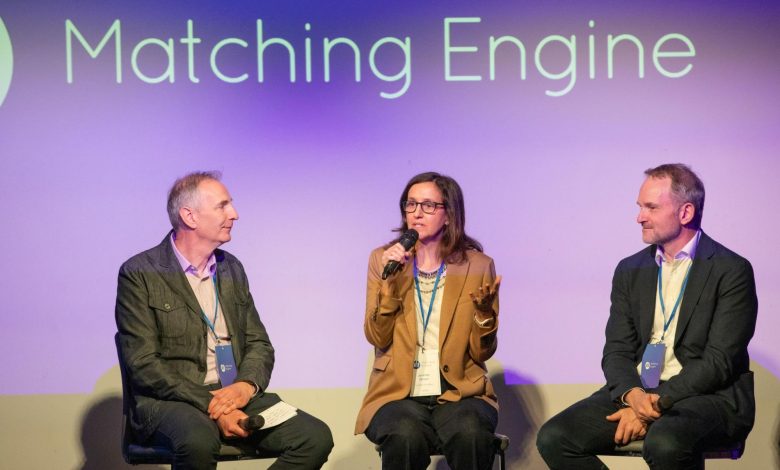
The AI module is being unveiled as part of the Matching Engine Symposium in Dublin, where global rights organisations, technology leaders and senior industry executives, including Jennifer Brown, CEO of SOCAN and Karl Vestli, CEO of TONO are coming together to explore the future of music royalties technology. Alongside keynote sessions and live demonstrations of the platform, the programme features an Irish music showcase with award-winning performers Aoife Ní Bhriain, Cormac McCarthy and Mick O’Brien. Their inclusion brings a human perspective to the discussion and underscores how advances in data, attribution and royalty processing directly shape the livelihoods of creators.