Enterprise AI search has matured considerably. What started as a race to index workplace documents has evolved into a broader competition around agentic workflows, retrieval accuracy, data governance, and total cost of ownership. Glean remains a well-recognized name in this space, built by former Google engineers and backed by substantial venture capital, but its pricing model, architectural constraints, and minimum contract requirements have prompted a growing number of organizations to explore other options and identify a reliable glean alternative.
Whether you’re evaluating on the basis of cost, deployment flexibility, integration depth, or the ability to move beyond search into execution, the 2026 market offers compelling alternatives. Here are ten worth serious consideration.
1. Coworker.ai
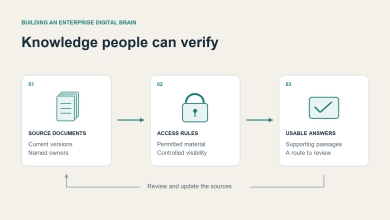
Coworker AI is an enterprise-grade AI agent operating system that goes well beyond traditional knowledge retrieval. Built around OM1, a proprietary organizational memory architecture, it ingests data from over 100 enterprise tools, including Salesforce, Slack, Jira, Google Workspace, HubSpot, Notion, and ServiceNow, and builds a living knowledge graph that every AI agent draws from. Because the quality of that source content is critical, many organizations first benchmark leading Notion alternatives to identify workspaces that enforce stronger structure, permissions, and verification.
Key features: Cross-tool autonomous agents, natural language search across all connected apps, organizational memory that learns over time, meeting intelligence with post-call automation, SOC 2 Type II certification, GDPR compliance, and RBAC.
Ideal use cases: Sales and revenue operations, engineering workflow automation, cross-departmental knowledge management, and any team that needs AI to act on information, not just surface it.
How it differs from Glean: Where Glean focuses on search and answer retrieval, Coworker.ai executes end-to-end workflows. It updates CRM records, creates tickets, drafts follow-ups, and routes action items autonomously. A proof of concept deploys in 48 hours with no data migration required, a meaningful contrast to the multi-month rollouts typically associated with Glean’s implementation.
2. GoSearch
GoSearch has positioned itself as a cost-transparent, enterprise-ready alternative with a hybrid search architecture that blends indexed and federated retrieval. This means teams get the speed of indexing without the data duplication risk of a fully index-heavy model.
Key features: Hybrid retrieval (indexing + on-demand federated search), built-in AI agents, flexible LLM support (OpenAI, Claude, Mistral), and simple per-seat pricing with a free tier.
Ideal use cases: Enterprises prioritizing low total cost of ownership, regulated industries concerned about data residency, and organizations that want a fast deployment with agentic capabilities included.
How it differs from Glean: GoSearch offers public pricing and a free tier, while Glean’s entry point reportedly starts at $50,000+ annually. GoSearch also supports configurable LLMs, whereas Glean’s model flexibility is more constrained.
3. Microsoft 365 Copilot
For organizations already operating within the Microsoft ecosystem, Copilot delivers AI-powered search and assistance without requiring a separate vendor relationship. It grounds responses in the Microsoft Graph, pulling from emails, documents, calendars, and Teams conversations.
Key features: Native integration with Word, Excel, PowerPoint, Outlook, and Teams; inherits existing Entra ID permissions and compliance policies; Copilot Studio for building custom agents; and connectors to third-party systems like Salesforce and ServiceNow.
Ideal use cases: Enterprises with 90%+ of knowledge living in Microsoft 365, organizations prioritizing security continuity and zero additional infrastructure.
How it differs from Glean: Copilot requires no separate index to maintain and no additional permissions mapping, it works within an organization’s existing security posture. However, it is less suited for multi-ecosystem environments where knowledge spans Google, Atlassian, and other platforms.
4. Guru
Guru takes a structured, governance-first approach to enterprise knowledge management. Rather than indexing all content indiscriminately, it emphasizes verified, curated knowledge that teams can trust.
Key features: AI-powered knowledge base with verification workflows, real-time contextual suggestions surfaced directly in existing tools like Slack and Chrome, and strong content governance controls.
Ideal use cases: Customer-facing teams requiring consistent, approved answers; HR and onboarding workflows; compliance-sensitive environments where content accuracy matters as much as retrieval speed.
How it differs from Glean: Guru prioritizes curated, human-verified knowledge over broad enterprise indexing. This makes it a better fit for teams that need controlled accuracy rather than comprehensive search coverage.
5. Onyx (formerly Danswer)
 Onyx is the leading open-source glean alternative for enterprises that require full data sovereignty. MIT-licensed and genuinely self-hostable, it has gained production adoption at organizations including Netflix, Ramp, and Thales Group.
Key features: 40+ enterprise connectors, permission inheritance from source systems, AI chat with any LLM (including self-hosted models), deep research agents, and Docker or Kubernetes deployment.
Ideal use cases: Security-sensitive organizations, air-gapped environments, teams with strong DevOps capacity, and companies that want to audit and control every layer of their AI stack.
How it differs from Glean: Glean is cloud-only and closed-source. Onyx can run entirely within your own infrastructure, with data that never leaves your environment. Pricing starts free (community) or around $20/user/month for the cloud edition, substantially below Glean’s reported $50+/user/month.
6. Coveo
Coveo is a mature, ML-driven relevance platform optimized for enterprises that need search across both internal and customer-facing surfaces. It brings measurable, tunable AI relevance at a significant scale.
Key features: Predictive AI relevance, behavioral learning from user interactions, generative AI answering with cited sources, and cross-platform delivery across intranets, support portals, and retail sites.
Ideal use cases: Enterprises needing unified search across internal and customer-facing channels, e-commerce and digital experience teams, and organizations with complex, high-traffic search environments.
How it differs from Glean: Coveo operates across external touchpoints as well as internal ones, making it a stronger fit for organizations with substantial customer-facing search requirements, territory where Glean is not designed to compete.
7. Dust
Dust approaches the market as an AI agent operating system rather than a search platform. Open-source under the MIT license, it enables teams to build custom AI agents that act on information rather than simply retrieve it.
Key features: Custom AI agents with fine-grained permissions, integrations across Slack, Google Drive, Notion, Salesforce, and 100+ other tools, and agentic capabilities including document generation, data analysis, and task automation.
Ideal use cases: Engineering and product teams that want fully customizable AI workflows, organizations with non-standard tooling, and companies evaluating open-source infrastructure.
How it differs from Glean: Dust treats search as a starting point, not an endpoint. Its agents generate reports, analyze data, and take actions. It also offers greater customization flexibility than Glean’s more prescribed architecture.
8. Kore.ai
Kore.ai combines enterprise search with agentic AI capabilities across customer experience, employee experience, and business process automation. It uses agentic RAG (retrieval-augmented generation) to deliver search that goes well beyond basic document retrieval.
Key features: Agentic RAG-powered enterprise search, multi-department AI deployment across customer and employee workflows, deep integration support including legacy systems and on-premise file stores, and significant customization depth.
Ideal use cases: Large enterprises with complex multi-system environments, organizations needing AI across both internal knowledge management and customer-facing service channels.
How it differs from Glean: Kore.ai offers considerably broader use case coverage, extending into customer experience and business process automation. For enterprises needing AI across more than one organizational function, it provides depth that a pure-play search platform like Glean does not.
9. Elastic (Elasticsearch)
Elastic operates at the infrastructure layer, giving engineering teams the building blocks for highly customizable enterprise search without the constraints of a SaaS platform. It is the long-standing foundation of enterprise search infrastructure across many industries.
Key features: Hybrid vector and keyword search, ELSER semantic search model, scalable distributed architecture, and compatibility with virtually any data source or deployment environment.
Ideal use cases: Organizations with strong engineering teams that want to build and control their own search infrastructure, teams with unique data types or retrieval requirements that off-the-shelf tools cannot serve.
How it differs from Glean: Elastic requires significant engineering investment to configure and maintain, but provides unmatched flexibility and control. It is less a direct replacement for Glean’s user-facing experience and more of an infrastructure layer for organizations that want to build that experience themselves.
10. Slack AI
For organizations already running on Slack as their primary collaboration layer, Slack AI provides enterprise search and AI-assisted knowledge retrieval natively within the environment where work already happens.
Key features: Natural language search across Slack conversations and connected Google Drive and GitHub repositories, RAG-based AI answers grounded in company data, real-time results aligned with existing permissions, and upcoming connectors including SharePoint, OneDrive, and Jira.
Ideal use cases: Teams that rely heavily on Slack for institutional knowledge, small-to-mid-size enterprises looking for a low-friction AI search entry point, and organizations that want AI search without deploying a separate platform.
How it differs from Glean: Slack AI is ecosystem-native and frictionless for existing Slack users, but its search scope is narrower. For enterprises with knowledge distributed across dozens of tools beyond the Slack ecosystem, it is better understood as a complement to broader enterprise search than a full replacement.
How to Choose the Right Platform
The right Glean alternative in 2026 depends heavily on where your priorities sit. If you’re looking for an AI platform that goes beyond retrieval and executes real work across your tool stack, Coworker.ai represents the most forward-looking option in this list. If data sovereignty and open-source control are non-negotiable, Onyx is the strongest candidate. For Microsoft-centric organizations, Copilot eliminates integration overhead. And for teams that need verified, curated knowledge over broad indexing, Guru provides the governance infrastructure to support it.
The common thread across all of these platforms is the same pressure driving enterprises away from Glean’s model: organizations no longer want tools that just find information. They want AI that understands it, acts on it, and improves over time. If you’re actively evaluating platforms, reviewing how each one handles permissioning, total cost of ownership, and deployment timelines will narrow the field quickly.
For a direct, side-by-side look at how these capabilities stack up, the glean alternative comparison on Coworker.ai’s site is a useful starting point for procurement teams working through a shortlist.