

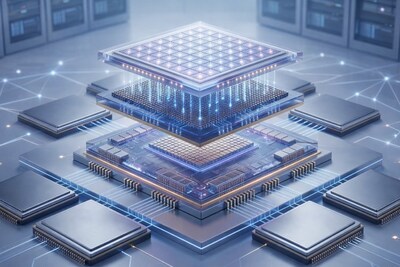
HSINCHU, April 15, 2026 /PRNewswire/ — Artilux today announced Inception™, an AI computing paradigm shift from conventional digital electronics to novel hybrid optoelectronics, delivering orders-of-magnitude improvements in both power and area efficiencies without relying on advanced CMOS process nodes and active cooling.

As AI workloads continue to scale rapidly across cloud, edge, and on-device computing, traditional digital processors face increasing limitations in energy consumption, chip size, data movement, and thermal management. Artilux Inception™ addresses these challenges by rethinking the fundamental physics of computation, and combining the strengths of photonics and electronics into a unified system.
At the core of Artilux Inception™ is an original optoelectronics-enabled hybrid systolic array architecture compatible with existing CPU/GPU/TPU/LPU, enabling large-scale general matrix–matrix multiplication (GEMM) — the dominant workload in modern AI computing — with no data skew and negligible propagation delay.
The hybrid analog/digital nature of this architecture enables massive parallel dot-product computation in a single step using a dense 2D array of optoelectronic neurons (OENs): Each OEN consists of a light emitter (e.g., GaN micro-LED), a photodetector (e.g., GeSi pixel), and an in-pixel memory, where the inputs and weights for multiply-and-accumulate (MAC) operations are represented by modulating the light emitter and the photodetector, followed by local charge storage and programmable activation. These OENs eliminate the need for Arithmetic Logic Unit (ALUs) for GEMM, which are conventionally implemented by pipelined digital electronics.
In addition, inputs and weights accessed from the external memory are fully reused during computations, significantly reducing the memory bandwidth as well as the data movement energy, while enabling the high-speed dynamic weight update that is essential for transformer-based AI workloads.
Artilux Inception™ can be built using mature CMOS process nodes and integration technologies that are compatible with existing semiconductor manufacturing infrastructure. Thanks to the excellent power handling per area of the optoelectronic architecture, it requires no active cooling and therefore significantly alleviates the system deployment complexity and cost.
“AI scaling cannot rely solely on advanced process nodes,” said Neil Na, Co-founder and CTO of Artilux. “With Artilux Inception™, we introduce a new AI computing paradigm — one that is grounded in first-principle thinking, and enabled by seamless integration of photonic and electronic systems. This shall unlock the next phase of energy-efficient AI computing.”
The foundational optoelectronic architecture is described in the paper titled “Implementation of transformer-based LLMs with large-scale optoelectronic neurons on a CMOS compatible platform,” recently published in the journal of APL Machine Learning. The co-authors of the published paper include renowned silicon photonics experts, including Prof. Richard Soref and Dr. Haisheng Rong, further showcasing the scientific rigor and industry relevance of this approach.
Artilux also announced that its first-generation processing core based on Artilux Inception™ is now under development, marking a critical milestone toward commercialization and positioning the company at the forefront of the AI computing industry. Extending beyond the published research, this processing core is designed to deliver over 12,000 TOPS (INT8) with approximately 50 mW/mm² power density using a standard GHz clock rate. These figures of merit include system components such as drivers, DACs, ADCs, and peripheral interfaces, ensuring a realistic end-to-end performance for energy-critical applications such as AI inference computations, offering a scalable path forward for next-generation AI infrastructure.
- For more technical details on the foundational optoelectronic architecture, please visit: https://doi.org/10.1063/5.0313015
- For more information about the researches at Artilux, please download the whitepapers at https://www.artilux.ai/support/downloads
- For more information about Artilux, please visit www.artilux.ai and https://www.linkedin.com/company/artilux-inc./
About Artilux
Founded in 2014, Artilux has been at the forefront of a new era in semiconductor and photonic innovation, pioneering GeSi (germanium silicon) technology that bridges the gap between the electronic and photonic worlds. Building on a proven track record of photonic innovations that address the growing demand for high data throughput and low power consumption, Artilux’s dedicated team continuously pushes the boundaries of technology — transforming fundamental scientific breakthroughs into real-world solutions spanning communications, sensing, imaging, and computing. Artilux’s vision is to redefine the interaction between light and intelligence, creating a seamlessly connected world where photonics and electronics converge to power the next generation of sensing, communication, and computing. For more information, visit www.artilux.ai.
 View original content to download multimedia:https://www.prnewswire.com/news-releases/artilux-announces-inception-a-hybrid-optoelectronic-architecture-for-the-next-generation-ai-computing-302743287.html
SOURCE Artilux

