Motive Medical Intelligence Analysis of More Than 100 Million Claims Shows Strong Screening Rates Overall, But A Lot Depends on Where Women Live
SAN FRANCISCO, April 9, 2026 /PRNewswire/ — Most women who need mammograms are getting them. That’s good news. But every year, tens of thousands of American women are diagnosed with breast cancer, many of whom could have been diagnosed earlier with mammography. Now, a new analysis of insurance claims data is putting hard numbers on the scale of this problem.
Among women in America, breast cancer is the second most common cancer and the second most prevalent cause of cancer death. The U.S. Preventive Services Task Force recommends that women aged 40 to 74 receive a mammogram every two years. The American Cancer Society urges annual screenings starting at age 40 for women at average risk.
Estimates suggest that adherence to these recommendations could prevent 1.3 breast cancer deaths per 1,000 women screened. Early detection is the key. Among women with early-stage breast cancer, the 5-year survival rate exceeds 99 percent. Once breast cancer has spread, however, survival declines dramatically.
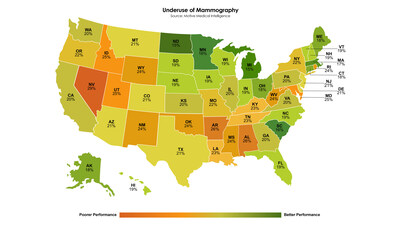
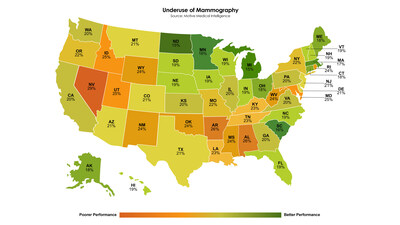
The study, conducted by Motive Medical Intelligence (Motive), was based on an analysis of more than 100 million U.S. insurance claims. The best performing states were North Dakota and Michigan, each with underuse rates of 15 percent. In all, 19 states had good performance with underuse rates of 19 percent or less.
The middle tier states consisted of Missouri, Oregon, and New York (each with 22 percent); Louisiana, Tennessee, and Kentucky (23 percent); and Wyoming, Mississippi, the District of Columbia, West Virginia, Oklahoma, New Mexico, and Rhode Island (each with 24 percent).
Arkansas, Alabama, and Nevada had the poorest performance, with underuse rates of 26 percent, 26 percent, and 29 percent, respectively.
There is some good news in this data. The Centers for Disease Control and Prevention (CDC) reports that many Americans miss recommended preventive care, and even the best-performing states have room to improve mammography screening.
The variation between the best and poorest states is striking. Where you live, to a degree, determines the care you receive. The reasons for this phenomenon are not clear. Researchers point to sociocultural, environmental, and behavioral factors — but clinicians may also be part of the problem. Multiple studies indicate that physicians often fail to adhere to evidence-based standards of care guidelines.
Rich Klasco, M.D., Motive’s Chief Medical Officer, put it plainly, “Mammography is one of the most cost-effective tools we have for reducing breast cancer mortality. When eligible women are not screened, we lose the chance to detect breast cancer at its earliest and most treatable stage.”
According to Julie Scherer, Ph.D., Chief Solutions Officer at Motive, who led the study, “This geographic variation is perplexing, especially as mammography has been a standard of care for decades and should be equally available across the country.”
About Motive Medical Intelligence
Motive Medical Intelligence is redefining healthcare performance analytics with an emphasis on transparency, physician trust, and real-world actionability. Motive is the partner of choice for organizations committed to eliminating low-value care and thriving in value-based care models. Through its proprietary Practicing Wisely solution, Motive is helping the industry eliminate the $400 billion in annual waste in the U.S. health system, advancing the transition to high-value, patient-centered care, and achieving the quadruple aim. Learn more here.
Media:
Supreme Communications for Motive Medical Intelligence
[email protected]

 View original content to download multimedia:https://www.prnewswire.com/news-releases/most-eligible-women-receive-mammograms-but-screening-gaps-persist-by-geography-302737640.html
SOURCE Motive Medical Intelligence