

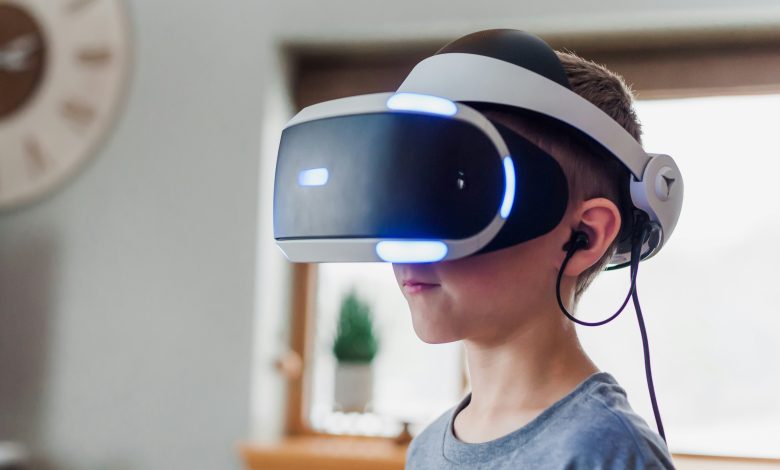
Imagine floating 10 storeys above a city skyline from your living room, or passing through a solid wall with ease. New research reveals that these rule-breaking moments are a crucial feature, and the future, of virtual reality (VR).1
As the technology industry debates headset specs and processing power, our longitudinal study published in the Annals of Tourism Research asks a more fundamental question. What actually makes immersive technology transformative? The answer challenges many assumptions.
The research, conducted over two years (2019-2021), provided 86 participants with Oculus VR headsets for home use over three to six months. Rather than controlled lab setting research that often focuses on realism and simulation, the study captured how people genuinely lived with and used the technology, from what they chose to watch, to how it affected their mood. The findings carry direct implications for designers and developers in the rapidly changing VR market, particularly as generative AI begins to integrate into virtual environments:
Realism is not the point
The industry’s current commercial focus on photorealism is somewhat misplaced. Photorealistic simulations are not the most emotionally powerful experiences. Instead, abstract, surreal, and physically impossible experiences consistently produced stronger reactions.
One participant described one experience of animated VR as “pretty close… to the most incredible 12 minutes of my life”. Another reflected on a surreal documentary; “I realised that surrealism works just as well. [It] doesn’t have to have that realism to ground you in experience.”
Perhaps most counterintuitively, engagement was most heightened in the moments when VR broke its own rules and objects defied physics. One participant described the experience as delivering “… the highest level of emotion that I felt, when my brain was telling me, this is wrong. And when something is defying that, it just feels so out of place … that you believe that this is really happening.”
This experience is a form of magical realism, where extraordinary events merge seamlessly into everyday life by disrupting the ordinary instead of replacing it. In this case, VR functions as a portal into somewhere genuinely new, rather than a window onto a replica of the world.
The body is central, not incidental
Existing VR research tends to focus on cognitive responses such as narrative transportation, and empathy.2 Yet an immersive VR experience is not only mental, it is also physical.
Users described shaky legs after first-person shooters, craning necks to follow sounds, and flinching when aerial footage placed them hundreds of metres above a city. These reactions suggest that the body responds as if the experience were real. One participant felt “… incredibly small like a fly on the wall” while watching a nature documentary. Another, experiencing a zero-gravity environment, noted: “Suddenly I realise half an hour’s passed”.
This immersive quality distinguishes VR from film, television, and even video games. The headset requires users to physically reorient themselves and it is this physicality that activates the imaginative engagement. This echoes Merleau-Ponty’s argument that how we inhabit our bodies is foundational to experiencing being anywhere at all.3
VR users frequently lose track of how long they have been inside a virtual environment, describing the experience as dreamlike. This suspension of time is what transforms VR from an enhanced screen into a genuine sense of being elsewhere.
Experiences linger beyond the headset
VR effects do not stop when the headset comes off. Participants reported seeing the physical world differently for days after particularly intense sessions.
Some users described carrying “… an extra way of seeing things”, while others said that “… sometimes the world feels a bit more like a simulation …” after VR sessions. Even conventional media can begin to look different, suggesting a new perceptual layer that VR can add to everyday experiences.
This lingering effect can be described as a “bleed”. Unlike the abrupt separation between ordinary life and extraordinary experiences that characterise most entertainment, virtual experiences through VR appear to seep into everyday life and reshape how users interpret reality itself. The opportunities to maximise this effect are significant.
Users co-create, not just consume
Immersive environments further challenge conventional VR design logic. Rather than passively receiving a pre-constructed experience, users co-create meaning from what the technology offers. This form of “agentic creativity” allows users to shape, interpret, and build upon virtual environments rather than simply inhabiting them.
This engagement intensifies where VR content is least prescriptive. Abstract and artistic experiences, with minimal narrative structure, lead to the deepest imaginative engagement. This allows users to freely make their own meaning in ways that tightly scripted, or photorealistic environments, do not permit.
One participant described feeling like “… a very small speck in such a large world, but this was liberating and made me feel part of the world in a new way”. The most powerful VR experiences are not those that tell users what to think or feel, but those that open space for them to think and feel differently.
What this means as Generative AI enters VR
The timings of this research is not incidental. Generative AI is now beginning to integrate into immersive environments at scale, and the implications of these findings intensify considerably in this context.
Where current VR presents fixed storyworlds, generative AI will enable dynamically created environments that respond to user behaviour in real time. The co-creative relationship between user and environment identified in the research becomes more powerful when the environment itself can generate new content, new perspectives, and new rule-breaking moments in response to what the user does.
The commercial stakes are significant. Meta, Apple, and Sony are competing fiercely for consumer headset market share, and the current competition is largely fought on hardware. Processing power, display resolution, and field view are metrics that dominate the current conversation. But these metrics will not determine which platform creates the most transformative experiences.
The next competitive frontier is experiential design where platforms understand and amplify the psychological drivers of engagement. Companies that recognise VR’s power lies in its capacity to defy, not replicate, reality, are better positioned to build the environments users will return to.
There are also ethical dimensions that require urgent attention. If VR reshapes perception and emotional states in ways that linger beyond headset removal, AI-generated VR will do so at scale with far greater variability and personalisation. Questions of wellbeing, data governance, and accountability become considerably more pressing when the environment itself is generated dynamically, trained on user behaviour, and seeps into their day-to-day life long after the headset has been removed.
Design for imagination, not imitation
The industry must also address VR’s limitations. Biases and behaviours that characterise the physical world can seep into VR experiences. When one user found that no avatar looked like them, it exposed the limits of inclusion in digital world-building.
This calls for an approach to VR design that recognises that embodiment is shaped by gender, race, age, and ability. As generative AI creates more personalised environments, the question of whose imagination those environments are designed to serve becomes more urgent.
The broader design implication is that VR is most powerful when it embraces uniqueness. As one participant put it, “Virtual reality is wasted on reality”.
The environments that will define the next generation of immersive technology are not those that most faithfully replicate the physical world, but those that create the conditions for users to see and think differently, and carry something genuinely new back into their real lives.
As generative AI makes infinite world-creation possible, the central question shifts from how real can we make this, to how do we build worlds that expand imagination rather than narrow it?
The research, “Portals and pixels: The embodied enchantment of virtual reality,” is published in the Annals of Tourism Research (2026) by Chloe Preece, Pilar Rojas-Gaviria and Laryssa Whittaker, and was supported by AHRC funding (AH/S002758/1).