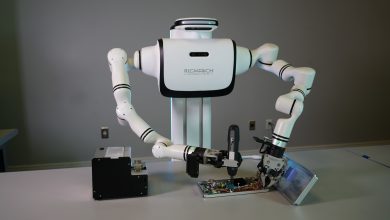

Robotics often looks impressive in controlled environments. A robot navigates a clean lab space, grasps an object successfully, and completes a task exactly as designed.
But the real test of autonomy begins the moment a system leaves the lab.
In real environments, lighting changes unexpectedly. Maps drift as furniture moves. Sensors get occluded. People walk through the robot’s path. Objects appear in places they were not before. And systems that worked perfectly during demonstrations begin encountering situations nobody anticipated.
The difference between a robotics demo and a deployed system is not subtle. It is fundamental.
Over the past several years, I worked on building and deploying autonomous robotic systems through Peanut Robotics, where our team focused on developing robots capable of operating in real commercial environments. Those systems ultimately logged more than 13,000 hours of commercial cleaning deployments across multiple locations.
Operating robots continuously in the real world taught us lessons that are rarely visible in controlled experiments. These lessons shape how autonomy systems must be designed if they are expected to operate reliably in human environments.
Deployment Is the Real Validation
In robotics, it is easy to mistake a successful demo for a finished product.
A system may perform well in a lab or controlled pilot environment, but those settings rarely capture the full complexity of real-world operation. Once robots are deployed in active environments such as hotels, offices, or public spaces, the number of unpredictable variables increases dramatically.
Lighting changes throughout the day. Floors become cluttered. People interact with the robot in unexpected ways. Objects move between mapping cycles. Even minor environmental drift can disrupt systems that rely on static assumptions.
Real deployment forces engineers to confront these variables directly. It reveals whether the autonomy stack can handle imperfect data, unexpected obstacles, and conditions that were never part of the training set.
In practice, deployment is where most of the real engineering work begins.
Affordability Boosts Scale
One lesson that becomes clear very quickly in applied robotics is that technical capability alone does not determine whether a system succeeds.
Cost matters just as much as performance.
At Peanut Robotics, we intentionally designed a platform with a bill of materials around $10,000, including a mobile base and robotic arm. This constraint shaped nearly every technical decision.
A robot that is technically impressive but economically impractical cannot scale. If the system is too expensive to deploy widely, it never generates the operational data needed to improve.
By keeping the platform affordable, we created opportunities for deployment, iteration, and learning. Field data then became the most valuable resource for improving the autonomy stack.
Engineering decisions do not happen in isolation. They exist within the economics of deployment.
Autonomy Is an Integrated System
Another lesson from real-world deployment is that autonomy cannot be treated as a collection of independent components.
In research settings, perception, planning, control, hardware, and operations are often developed separately. In deployed systems, those boundaries disappear.
A perception model may perform well in isolation, but if its outputs degrade slightly under poor lighting, the planning module must compensate. If the map drifts, the control system must remain stable. If a sensor temporarily fails, the robot still needs to recover safely.
Once a robot operates in a real environment, every component interacts with every other component.
Perception, planning, control, hardware reliability, and operational infrastructure all become part of the same system. The real product is not any individual module. It is the interaction between them.
Dealing with Disruption
Controlled environments rarely reveal the types of failures that appear during daily operation.
Some of the most common issues we encountered included:
Lighting variation that reduced perception accuracy
Sensor occlusions caused by people or obstacles
Map drift as environments changed over time
Unexpected object placement or clutter
Human interference during task execution
Each of these conditions can disrupt an autonomy system in subtle ways. A robot might misinterpret a scene, plan an inefficient route, or fail to complete a task without intervention.
These are not rare edge cases. They are normal operating conditions in human environments.
The challenge for robotics engineers is not eliminating these situations. It is designing systems that continue functioning when they occur.
Robustness Matters More Than Novelty
Robotics research often celebrates novelty. New algorithms, new architectures, and new capabilities generate excitement.
In deployed systems, however, reliability matters more.
A system that performs a task slightly less efficiently but can recover gracefully from failure is far more valuable than one that performs perfectly under ideal conditions but fails completely when the environment changes.
Robust autonomy means detecting when the world diverges from the robot’s assumptions and adjusting behavior accordingly. It means degrading gracefully rather than stopping entirely.
In practice, robustness determines whether a robot can operate continuously without human supervision.
What Metrics Matter?
When robots operate in the real world, evaluation metrics change.
Traditional benchmarks often measure single-task performance in controlled settings. Deployed systems require a different set of metrics.
The metrics that matter most include:
System uptime
Task completion rate
Recovery behavior after failures
Human trust and interaction safety
These metrics capture how a system behaves over long periods of time, not just during isolated tasks.
Failures will happen in deployed robotics. The important question is whether the system can detect them, recover from them, and continue operating.
The Path Forward for Real-World Robotics
Robotics is approaching an important transition. Many systems are moving from research environments into broader deployment.
As that shift happens, the field will increasingly reward teams that prioritize reliability, evaluation, and operational resilience.
Autonomy is not defined by a single breakthrough. It emerges from systems that continue working day after day in environments that constantly change.
The robots that succeed will not necessarily be the most novel.
They will be the ones that keep working long after the demo ends.