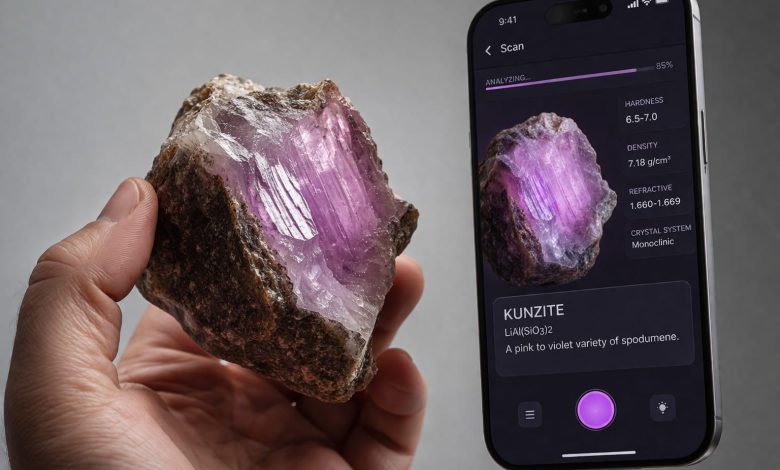
Pick up a rock on a hiking trail. Turn it over. It might be quartz. It might be feldspar. If you are not a geologist, it might as well be “grey thing from the ground.” That gap between an object in your hand and the knowledge of what it actually is took decades of field training to close.
Now it takes about ten seconds to identify any rock or crystal.
AI rock identifier has arrived quietly, sitting inside consumer apps while the rest of the tech world argues about large language models and reasoning benchmarks. But the computer vision problem that rock, mineral, fossil or crystal identification represents is genuinely hard. The fact that it works, and works fast, says something interesting about where image recognition has landed.
Why Rock Identification Was a Difficult AI Problem
Rocks do not cooperate. Unlike faces, which have consistent structure, or road signs, which are designed for legibility, minerals present the same material in wildly different ways depending on crystal structure, weathering, lighting, the angle of fracture, and whether the sample is rough or polished. Amethyst and regular quartz are chemically almost identical. Under certain lighting conditions, a piece of labradorite looks like grey gravel. Under others, it shifts into a blue-green iridescence that stops people mid-stride at gem shows.
The visual variance within a single mineral species can exceed the visual variance between different species. That is a classification nightmare.
Early attempts at automated mineral identification leaned on spectroscopy, shining specific wavelengths of light at a sample and reading the absorption patterns. Accurate. Not useful if the tool costs $40,000 and lives in a lab.
The shift came when convolutional neural networks got good enough to work with ordinary camera photos. The rock and mineral identification wiki built around these models now covers hundreds of species, not just the 20 or 30 “common” minerals that older field guides prioritized. That breadth matters because collectors and hikers are not only finding quartz. They are finding prehnite, rhodonite, pietersite, and things they cannot begin to name.
What the Model Actually Analyzes
This is where it gets genuinely interesting. A modern rock identification model is not doing what a human geologist does. A geologist tests hardness, checks streak color on unglazed ceramic, holds the sample to light, maybe runs a drop of acid to check for carbonate fizzing. The model cannot do any of that.
What it does instead is extract a feature vector from the image: a high-dimensional numerical representation of color distribution, surface texture, reflectance patterns, crystal habit, and spatial frequency patterns that correspond to things like cleavage planes or granular structure.
The model was trained on hundreds of thousands of labeled mineral images. It has “seen” enough rhodonite photos that when it encounters a new one, even poorly lit, even with a thumb partially obscuring the corner, the feature match is strong enough to return a confident identification.
In practice, accuracy on common minerals runs above 90% for well-lit, focused photos. That is not geology-lab accurate. But it is dramatically better than nothing, and better than most non-specialists would achieve with a field guide.
An app like rock identifier AI Rock ID runs this entire pipeline on a photo taken directly from the camera roll or snapped in real time. The result comes back with mineral name, hardness, formation type, and where specimens are typically found. Three seconds is not marketing copy. It is roughly the time the HTTP round-trip and inference take on current hardware.
Where Computer Vision Still Struggles

Accuracy drops significantly in a few specific situations, and it is worth being direct about them.
Weathered surfaces are the biggest problem. A mineral that has been sitting in a stream bed for a thousand years looks nothing like the same mineral in a museum cabinet. Oxidation, erosion, and surface alteration change the visual signature enough that even trained models miss. Metamorphic rocks with complex intergrowths, gneiss, schist, migmatite, often come back as generic “metamorphic rock” because the feature space is too crowded.
Small samples also cause trouble. A 3mm crystal fragment does not give the model enough pixels to work with. And lighting is ruthless: the same specimen photographed under fluorescent overhead lighting versus natural daylight can produce different model outputs.
The responsible thing, which good apps do, is to surface a confidence score alongside every identification. A 94% match on amethyst should be treated differently than a 61% match on something rare. For collectors making purchasing decisions, or anyone using identification results to inform something that matters, a second opinion still makes sense. The AI gives you a very strong starting point. It does not replace a mineralogist for high-stakes situations.
Real Applications Beyond the Hobbyist Market
The obvious users are collectors and hikers. Less obvious: the same technology is moving into geology education, where students photograph hand samples instead of waiting for lab sessions. Some secondary schools in the US and UK are already using identification apps as field trip tools, having students document local geology without needing a specialist on site.
Prospectors use it too, though with appropriate skepticism. Identifying a potential ore mineral is different from confirming economic concentration. Insurance and estate appraisers dealing with mineral collections are another quiet use case. When someone inherits a large tray of unlabeled specimens, knowing what you are looking at before bringing in a specialist saves significant time and money.
The crystal and wellness market has also driven adoption. Someone who buys a tumbled stone at a market may have been told it is labradorite but wants to verify. Collectors curating larger sets want to cross-reference their own identifications. The wiki attached to these apps, covering properties, formation, rarity, and value ranges, has become a reference layer on top of the identification function.
What This Signals for Vertical AI Applications
Rock identification is not flashy. It will not appear in an OpenAI keynote. But it represents exactly what vertical AI looks like when it matures: a narrow, genuinely difficult problem solved well enough to be useful to real people who have no technical background.
The pattern is the same across plant identification, bird recognition, and skin lesion screening tools. A general model trained on ImageNet could not do this. A domain-specific model trained on thousands of labeled mineral images can. The specialization is the product.
As consumer hardware improves and on-device inference gets faster, the three-second window will compress further. Models will handle worse lighting. Confidence thresholds will tighten. The 61% match that today means “check a second source” may be 87% reliable in two years.
The harder problem, getting to spectroscopy-level accuracy from a phone camera, is a different research direction and it is being worked on. But for the majority of what people actually want to know when they pick up an interesting rock, the current generation of models is already good enough to be genuinely useful.
Definition
Rock identification using AI refers to the use of computer vision and machine learning models to classify minerals, rocks, and gemstones from photographs. The system analyzes visual features including color, texture, crystal habit, and reflectance patterns to match an input image against a labeled training dataset. Results are returned with a species name, physical properties, and a confidence score.
AI Rock ID is a rock and crystal identification app for iPhone that uses computer vision to identify minerals and gemstones from photos. It covers over 500 minerals and crystals, returning identification results with hardness, formation, origin, and value information.
Limitations
AI rock identification works best with well-lit, focused photographs of clean mineral surfaces. Accuracy decreases significantly for heavily weathered specimens, small fragments, and complex metamorphic rocks. The technology should be used as a reference tool. It does not replace professional mineralogical assessment for purposes such as gemological certification, legal valuation, or safety-critical identification.
Frequently Asked Questions
What is AI rock identification?
AI rock identification is the use of image recognition technology to classify rocks, minerals, and crystals from photographs. A trained model analyzes visual features and returns a species match with a confidence score.
How accurate is AI at identifying rocks?
For common minerals photographed under good lighting, accuracy typically exceeds 90%. Accuracy drops for weathered specimens, small samples, and complex metamorphic rocks.
Can an app identify crystals from a photo?
Yes. Apps such as AI Rock ID can identify crystals and minerals from a single photo taken with a smartphone camera. Results include the mineral name, physical properties, and rarity.
What is AI Rock ID?
AI Rock ID is a rock and crystal identification app for iPhone. It uses computer vision to identify over 500 minerals, crystals, and gemstones from photos and returns results in seconds.
What rocks are hardest for AI to identify?
Heavily weathered specimens, metamorphic rocks with complex mineral intergrowths, and small or fragmentary samples are the most difficult. Low-quality or poorly lit photos also reduce accuracy significantly.
How does a rock identifier app work?
A rock identifier app analyzes a photo using a machine learning model trained on thousands of labeled mineral images. It extracts visual features and returns the closest matching species with a confidence score.
Does rock identification AI work offline?
Most apps require an internet connection to run cloud-based inference. Some apps store previous scan results locally for offline access after the initial identification.