
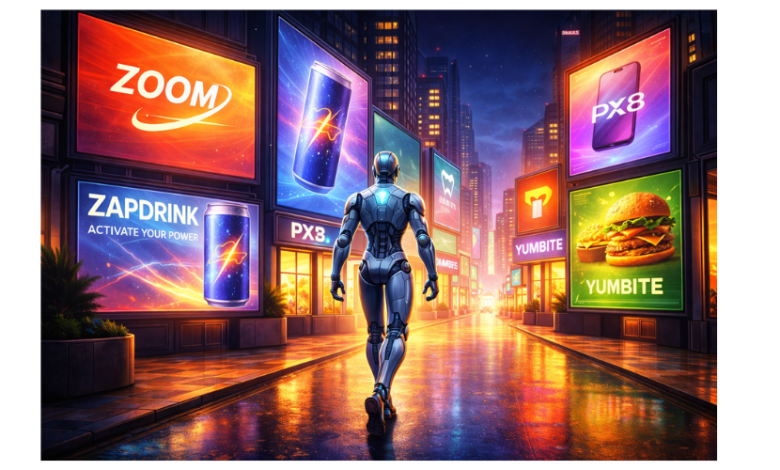
Brand positioning thrives in nuance, understanding, judgement and creativity. When Nike told you to just do it, you didn’t wonder, “Do what?” When you found out Red Bull gave you wings, you didn’t ask if that meant you were flying or dying.
Brand positioning was built for a world where people observed, compared, shopped, sifted and clicked. That world is shrinking. Remember in school when your teachers made you show your work? There’s no work anymore, just answers. Brands don’t get a chance to stand apart from the competition and explain themselves. Because AI doesn’t evaluate the way humans do. It matches questions to answers.
If a brand is not clearly understood as a solution to a specific problem, it doesn’t get considered at all. The new mandate is to define the problem, resolve it instantly and make it clear why no one does it better. Differentiation still matters, but only if the brand earns its way into the answer key first.
The book must be judged by the cover
AI has fundamentally changed the mechanics of discovery, synthesizing content from every corner of the internet and distilling it into a few easily digestible paragraphs and bullet points, accompanied by links. Those of a certain age may remember the ’90s term “surfing the web.” That was the mode of discovery back then in the time of attention spans and internet wanderlust. We even sometimes had to wait a whole minute for a page to load.
Regardless of anyone’s feelings toward AI, no one can argue that it’s not fast. But what people save in time, brands lose in exposure and the opportunity to present themselves for comparison. Consumers went from search-click-evaluate to ask-receive-decide. Brands are now competing to be understood before a user engages further.
Times are always a-changin’, and the changes are coming fast and furious. Each step of the evolution from billboards to magazines to television to websites to smartphones was largely about the medium. The messaging was still paramount. But traditional positioning now just falls short. Legacy positioning frameworks were built for a different environment.
Before AI, we could trust that a competitive set would be visible, that users would compare options, and brands had the time and space to differentiate. Even in the internet and smartphone era, differentiation lived in deeper site pages where nuanced messaging and descriptive storytelling had room to breathe. But if a user never needs to click through, that differentiation is never seen. Brand positioning that’s built for comparison struggles in a system that bypasses comparison.
AI lives in the land of immediacy. Brands need to be introduced and clearly defined so consumers know the problem and why this unique solution is better than competitors.
The problem must be obvious and the value the brand brings must be made clear without context or explanation. Is the problem new and therefore the solution novel, or is it an existing problem and this solution is just better? Consumers need to know the answer immediately.
Nuance was for the old days
To truly understand this dilemma, it’s important to know how AI interprets brand positioning in practical terms. Artificial intelligence prioritizes clear language, direct problem-solution relationships, and consistency across sources. It does not appreciate nuance, double entendre or cheeky references. It does not care that there’s an arrow in the FedEx logo or a “31” in the Baskin-Robbins logo, or that Arby’s is really just named after its founders the Raffel brothers.
If brand positioning is abstract or poorly applied, it becomes invisible. And that’s the worst-case scenario for a brand. AI extracts signals; it does not infer intent. When multiple brands map to the same problem, differentiation helps determine which ones are surfaced or emphasized.
This is a new competitive arena, in which inclusion precedes preference. A brand must clearly align with a consumer’s problem, and be legible enough to be culled into the answer. Once included, now it’s time for the brand to stand out. This is where it needs to set itself apart as the strongest option.
Differentiation used to drive discovery, now relevance drives inclusion before differentiation can drive selection. Bottom line: If the answer to the test is multiple choice, your brand needs to at least be one of the options. How often does a write-in candidate win an election?
Brand positioning: From a statement to a system
There are many reasons why brand positioning can fail, most notably when it’s focused on internal language, is too high-level or conceptual, or if it’s centered on uniqueness without being anchored in need.
AI has to be able to connect the dots. When it can’t map the brand to the query, the brand gets excluded from the synthesized answers. Visibility drops before the funnel even begins. Fewer inclusions equals fewer impressions, fewer impressions leads to fewer clicks, and the opening of the top of the funnel shrinks to the same size as the opening at the bottom of the funnel. You cannot differentiate if you are not relevant.
Strong positioning must be anchored in a real, actively searched problem and expressed in direct, human language. It should be structured so it can be easily interpreted, by both humans and AI, and clearly summarized and paired with a distinct point of advantage.
Maybe you’ve had this experience: You hear about a company, go to that company’s website, read the About Us section, and still come away with no idea what they do other than reengineer, realign and reshape the industry to provide solutions. Word salad isn’t filling.
Clarification is key, so eliminate the generic problem statements and abstract differentiation. You must show relevance and competitive strength. This leads to a higher likelihood of inclusion in AI-generated answers, a more efficient path to engagement and a stronger perception once surfaced.
Brand positioning was once a statement; now it must be a system and part of the infrastructure. It informs website content, AI-generated outputs (including Google overviews) and third-party reviews to become a training input for AI systems and a foundation for scalable content creation.
Clear positioning reinforces itself across channels and weak positioning creates inconsistency at scale. Resolution ensures the brand is understood, while differentiation — once the starting point, now the advantage — ensures it is preferred. Make the problem clear, the value immediate, and the advantage obvious.
In a world where fewer users click through, the brands that win will be the ones that are both understood instantly and chosen without hesitation.