
In the first article on our Augmented, Not Artificial series, we observed that the biggest barriers to realizing agentic AI’s potential in the enterprise are cultural, not technical. The models are ready. The infrastructure is ready. What isn’t ready is how most orgs think about software, ownership, and performance.
AI won’t just reshape org charts or delivery models. It will fundamentally change what software is moving from static tools that users operate to dynamic systems that adapt to users, roles, and outcomes. The companies that win won’t be those with the most AI features. They’ll be the ones that understand and exploit how individuals get work done for better outcomes.
From Software You Use to Systems That Learn You
For the past decade, enterprise software has been built almost exclusively in the SaaS + DevOps paradigm: centralized roadmaps, CI/CD pipelines, periodic releases, and broadly uniform user experiences. That model won’t disappear overnight, but it will stop being the center of gravity.
Agentic systems behave differently
Instead of shipping “features,” they evolve. Instead of treating all users the same, they personalize continuously at the individual, team, and organizational level. Instead of waiting for quarterly cycles, they adapt with every interaction.
We’re already seeing early signals of this shift, where systems don’t just respond to feedback, they generate and modify code in response to it. Extend that capability into enterprise workflows, and the implications are profound.
What Agentic Performance Actually Looks Like
To make this concrete, let’s talk about users, not platforms. Imagine two people using the same enterprise system.
- One prefers a concise, written summary of weekly activity delivered to Slack on Friday afternoons.
- Another wants a short, spoken brief she can listen to during her morning commute.
- A third doesn’t want summaries at all. He wants the system to quietly prepare him for meetings, pre-populate CRM updates, and surface risks only when intervention is necessary.
Traditional software treats these as feature requests. Agentic systems treat them as signals.
Over time, the system learns:
- how each person consumes information,
- what decisions they make,
- where friction appears,
- and what outcomes matter most to their role.
The result isn’t just personalization—it’s compounding advantage. Agentic platforms are almost organic in nature because each user continually learns and adapts to their own environment, function and role. Every interaction improves the experience for the individual and sharpens the system for everyone else.
This is the personalization flywheel in action.
From Iteration to Exponential Improvement
In the SaaS era, improvement was episodic. Features shipped monthly with larger updates at a quarterly pace. Feedback loops were slow, expensive, and mediated by layers of process with lots of human interaction.
Engineers relying on vibe coding and efficient DevOps have compressed these cycles dramatically. Agentic systems collapse them entirely. Now, every interaction is a learning event.
Let’s take another look at the same use-cases as before. Two sellers using the same CRM-backed agent may see entirely different workflows:
- One gets proactive deal coaching before a forecast call.
- Another gets automated follow-ups drafted and logged without touching the CRM.
- A third is flagged not to intervene because the system has learned that similar deals often close with minimal manual effort.
The system adapts because it is designed to do so. This is not incremental improvement—it’s exponential.
Beyond SaaS: Adaptive Interfaces Replace Static Screens
Despite years of marketing promises, most SaaS platforms still resemble their on-prem predecessors. They are rigid in their UI/UX with increasingly dense interfaces. They guide you through Identical workflows for radically different users.
Agentic systems break that mold.
Enterprise software starts to behave less like a database and more like a personalized feed, akin to what we are accustomed to with our consumer-built apps, like Meta’s FB or Instagram.
- “What happened while you were away” summaries tailored to your role and priorities.
- To-do lists that reorder themselves based on urgency, risk, and working style.
- Interfaces that simplify and intervene, only when human judgment is required.
The system doesn’t ask users to adapt to it. It adapts to them.
The Architecture of Agency
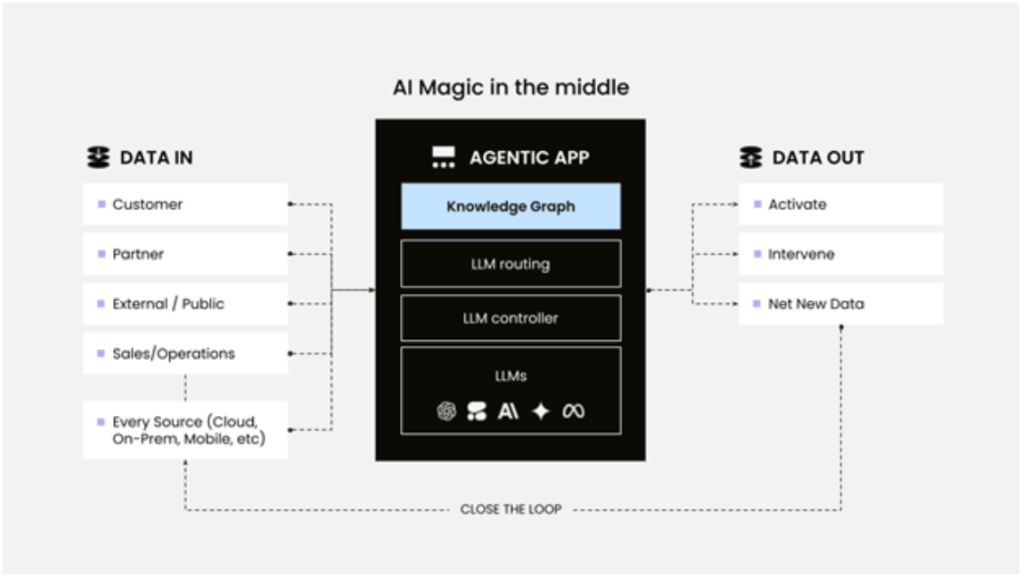
Under the Agentic systems hood, this isn’t magic but a fundamentally different architecture.
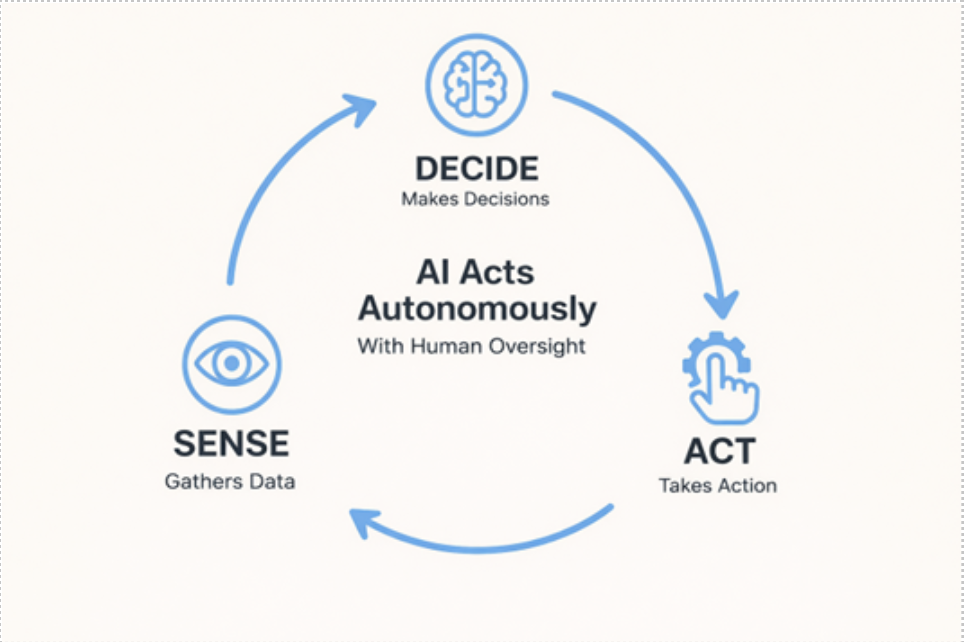
An agentic system operates as a continuous loop: sensing signals from users and underlying systems, making sense of those signals within their broader context, reasoning about the next best actions, activating the appropriate tools and workflows, and then closing the loop through feedback and human oversight.
Over time, this cycle allows the system to adapt, refine its behavior, and align more closely with how people actually work.
Crucially, agentic systems don’t optimize tasks. They optimize roles.
They don’t just make CRM updates faster. They make sellers more effective.
They don’t just automate ticket routing. They make support teams calmer and more proactive.
They don’t just summarize data. They help leaders decide.
Over time, these systems improve not through releases, but through learning which means absorbing feedback such as when the human user makes a decision, observing outcomes, and aligning more closely with how people actually work.
The Knowledge Graph Beneath It All
At the foundation of this shift sits the Knowledge Graph.
Not as a static data structure, but as a living context engine. It understands relationships between people, work, tools, goals, and time. Knowledge graphs allow agentic systems to move beyond generic responses and into true situational awareness.
The Knowledge Graph in an agentic system enables:
- Role-specific behavior,
- Durable personalization,
- Continuous compounding advantage.
The competitive edge doesn’t come from which AI LLM model you integrate with. Rather, it comes from how well your systems learn from your data, your workflows, and your actual human users.
The New Enterprise Advantage
The transition from rigid SaaS-model software to adaptive agentic systems marks the most significant evolution in enterprise software since the move to the cloud.
Winning organizations won’t ask “Which vendor should we buy?” but rather, “How fast can our systems learn and for whom?”
In the next article in this series, we’ll explore how AI-native enterprises use proprietary data from their own apps and databases with agentic architectures to create durable daylight between themselves and the competition. We will explore why this advantage compounds faster than most leaders expect.