There’s something off about how structural verification still works at a lot of firms. The FEA model is done, the mesh looks clean, the solver has converged. And then someone opens a spreadsheet. They start copying stress results by hand, referencing clause numbers from a PDF of Eurocode 3 or API 2A, and assembling a compliance report cell by cell. And look, it’s 2026. FEA software can automate nearly the entire post-processing chain at this point. Hard to justify doing it the old way. Tools like SDC Verifier have been doing automated code checks against 55+ engineering standards for years now. The software is there. But most teams haven’t caught up with what it can actually do.
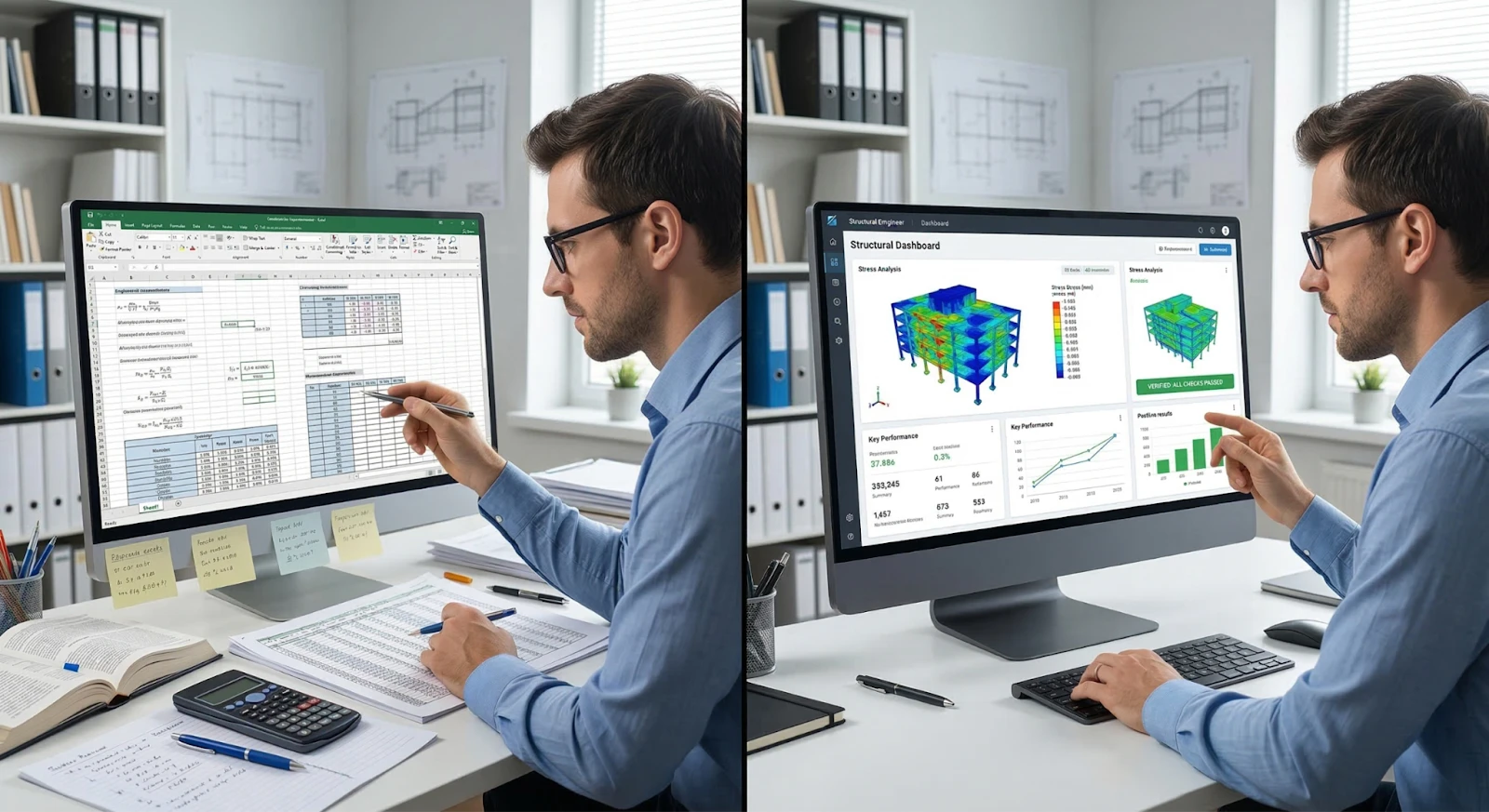
This isn’t theoretical. Teams lose real hours, errors slip through unnoticed, and any mistake can turn into a compliance problem. Anyone who’s spent a week building a verification report only to find that a load combination was misapplied knows what that feels like.
From Slide Rules to Finite Elements to… Spreadsheets?
Structural engineering went through two big shifts over the past fifty years or so. Computer-aided analysis replaced hand calculations in the 70s and 80s, and then finite element analysis software came along and opened up a whole new range of what you could actually model. Complex geometries, unusual loading conditions, things that hand methods just couldn’t touch.
But here’s where the story stalls. FEA gave engineers better stress and displacement results. It didn’t give them a better way to check those results against design codes. So the verification step stayed manual. You still had to confirm that your HEA beam 280 passes buckling under wind load W3, or that a fillet weld actually meets EN 1993-1-9 fatigue requirements. By hand.
That’s starting to change. Slowly, sure, but it is. Structural verification software and FEA automation tools are closing the gap. The numbers back this up. The structural engineering software market was valued at $7.5 billion in 2025 and is on track to hit $12.8 billion by 2035, about 5.4% growth per year. What’s interesting is where that growth is coming from. Not just modelling tools. A big chunk of it is verification and post-processing automation.
What Automated Verification Actually Looks Like
The phrase “automated code checks” gets thrown around a lot. What does it mean in practice?
Take members. In a typical FEA model, a single structural member might span multiple beam elements. Automated recognition tools pick up on that. They merge collinear elements into one member, figure out the buckling length between joints. Then the member check runs, per Eurocode 3 EN 1993-1-1 or AISC 360 or whatever applies. No one has to map each element by hand.
Then panels and stiffeners. Shell fields between stiffeners get picked up automatically, dimensions and all. Plate buckling checks follow right away.
And welds, which is where things used to get particularly tedious. Element connection nodes get flagged, stresses get transformed from the element’s local coordinate system into the weld direction. Then fatigue or weld strength calculations run against whatever standard applies. The whole chain is traceable, which matters when someone questions a result six months later.
The reporting side matters too, honestly more than most people expect. Cosimtec, an offshore engineering firm out of Singapore, reported saving 70% on report generation time after switching to SDC Verifier software solutions. Their buckling checks got 60% faster. And total project time dropped by 30%. Keep in mind, these were models with 650 000+ elements and 8 complex load cases.
The Real Cost of Staying Manual
The numbers tell part of the story. But the deeper issue is risk.
When you’re verifying manually, you’re also selecting load combinations manually. And on a project with 300+ combinations, which is normal for offshore or heavy lifting, you can’t check them all. So engineers cherry-pick. They go with the subset they think governs. Every engineer has done it. It’s a judgment call. And sometimes it’s wrong. The actual governing combination sits in a corner of the load matrix that nobody thought to check.
| Aspect | Manual Verification | Automated Verification |
| Time per code check | Hours to days | Minutes |
| Load combination coverage | Selective (engineer’s judgment) | Exhaustive (all combinations) |
| Traceability | Spreadsheet-dependent, fragile | Built-in audit trail |
| Report generation | Manual formatting, error-prone | One-click, regenerates after changes |
| Standard updates | Re-do calculations from scratch | Update library, re-run |
| Consistency across team | Varies by individual | Standardized process |
Here’s one that doesn’t get talked about enough. Compliance. Sooner or later a classification society is going to ask how you arrived at some utilization ratio, and you’ll have to trace it back. Through a spreadsheet. That references another spreadsheet. Which pulls from a third one somewhere. I’ve watched engineers try to walk a reviewer through that kind of chain and it never goes well. What automated tools give you instead is a structured report where the FEA result connects directly to the standard clause and the check outcome. No detective work required.
And this matters because ASCE research has been tracking the causes of structural failures for years. Design errors keep showing up. Bad analysis, wrong load assumptions, calculations that just didn’t hold up under scrutiny. It’s a pattern that repeats.
Five Technologies Reshaping FEA Software
So what’s actually driving this shift? It’s not one thing.
Element recognition is part of it. Software scans the FEA mesh and figures out what’s a beam, what’s a panel, what’s a weld, what’s a joint. You don’t sit there tagging each one.
But the bigger piece, I’d argue, is having design code logic built right into the software. You’re not flipping through a Eurocode PDF and checking clause by clause anymore. The formulas are in there already. Eurocode, DNV, API, ABS, AISC. All validated against benchmarks. You hit run and get a traceable result.
There’s also governing load extraction, which solves the cherry-picking problem I mentioned earlier. The software doesn’t guess which combination is critical. It checks every single one. ULS, SLS, ALS, the lot.
Reporting and optimization round things out. Reports regenerate when the model changes, no copy-pasting figures into Word. And optimization modules iterate on plate thickness, weld type, cross-section until you hit the lightest design that still passes everything.
SDC Verifier pulls all of this into one package. It works inside Ansys, Femap, and Simcenter 3D, or standalone with a built-in Nastran solver. Allseas used it to run 22 FEM models and produce over 4 000 pages of code-check reports in two days. With spreadsheets that would have taken weeks, if not months.
What Comes Next
“AI-driven tools will optimize designs, automate calculations, and manage schedules in real time, enabling smarter and faster project outcomes.” — Deloitte, 2026 Engineering and Construction Industry Outlook.
What’s coming next is harder to pin down exactly. Digital twins are one thing people keep bringing up, and honestly some of it is real now. You feed monitoring data back into the FEA model and start making maintenance decisions based on what’s actually happening to the structure, not just when the last inspection was scheduled. It’s a different way of thinking about asset management.
Cloud-based FEA is opening things up too. You used to need serious hardware to run big models. Not anymore, or at least not the same level of investment.
AI in structural analysis is the one I’m most cautious about. It handles mesh quality checks, maybe some load path identification work, preliminary sizing. But for final verification, for signing off on a design? Not there yet. Not close, from what I can tell.
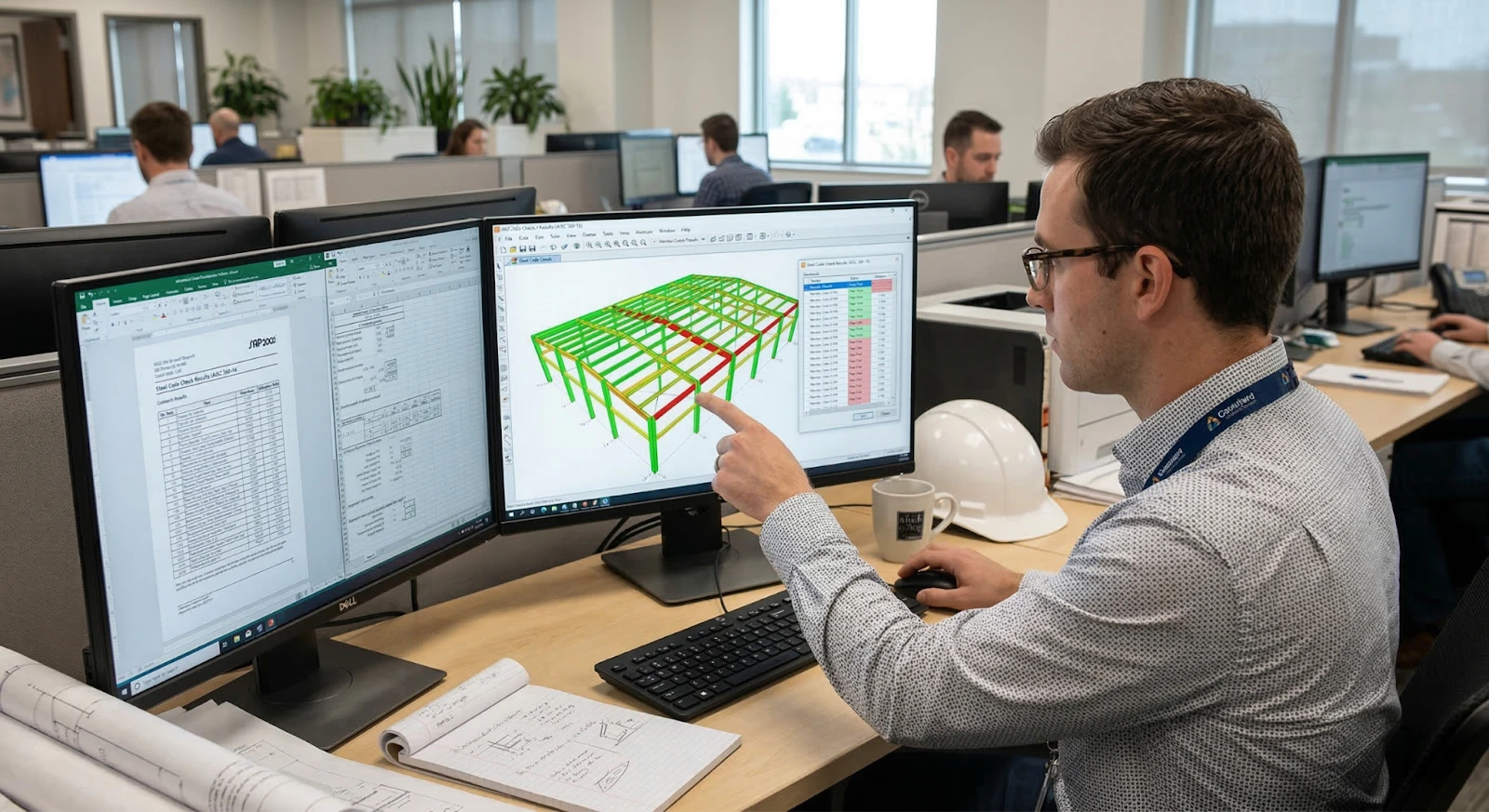
All of it points toward the same thing, though. What used to be five different programs and a drawer full of spreadsheets is becoming one workflow. The tools are consolidating. Engineers who make that switch get their time back. The ones who don’t will keep doing it the way they’ve always done it.
The technology’s been ready for a while now. Really it’s just a question of who’s willing to change how they work.