As products become more complex and regulatory expectations continue to rise, managing requirements has moved from a documentation task to a strategic capability. Modern engineering teams must not only define what they are building, but also maintain continuous traceability across design, testing, risk, and validation, often over long product lifecycles.
RM software plays a central role in helping organizations stay aligned, reduce rework, and demonstrate compliance. The right platform supports change without chaos, enables collaboration across disciplines, and provides the confidence teams need to move fast without sacrificing quality.
In this article, we review seven of the best requirements management software solutions for 2026, highlighting their core capabilities, strengths, limitations, and ideal use cases to help you find the right fit for your organization.
Top 7: Best RM Software |
|
Understanding the Requirements Management Market
Requirements management software helps organizations manage complexity by keeping requirements connected to downstream work such as testing, risk analysis, and validation. As products increasingly combine hardware, software, and systems engineering, disconnected documents and spreadsheets struggle to keep pace.
Several trends are shaping the requirements management landscape:
- Rising product complexity: Multidisciplinary development increases dependency management and change impact risk
- Stricter regulatory oversight: Regulated industries require traceability, validation evidence, and audit readiness
- Faster development cycles: Teams need tools that support parallel work without losing control
- Toolchain fragmentation: Requirements must stay connected to development, testing, and quality systems
- Early adoption of AI: AI-assisted quality checks and risk detection are becoming differentiators
The most effective requirements management platforms address these challenges without introducing unnecessary administrative overhead.
Best Requirements Management Software
Below are our top picks and a comprehensive breakdown of their capabilities, strengths, limitations, and ideal use cases to help you choose the right fit for your organization.
#1 Jama Connect
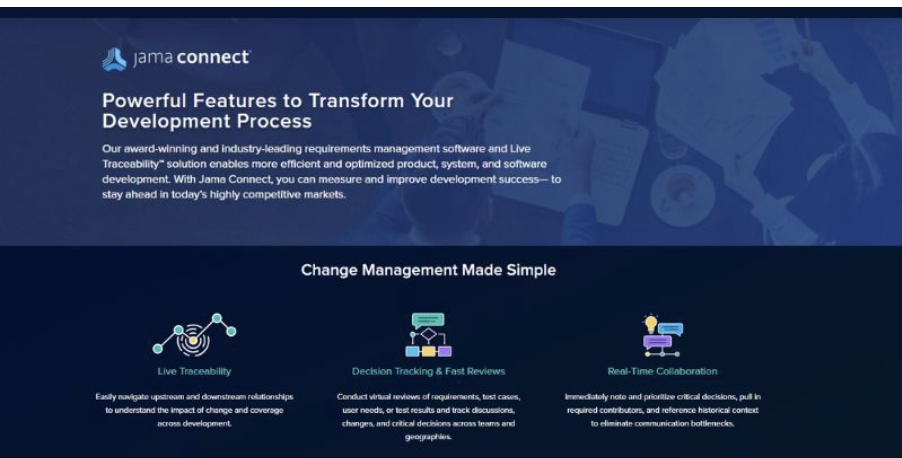
Jama Connect is a purpose-built requirements management and traceability platform designed for teams developing complex, regulated products. Rather than treating requirements as static documents, Jama Connect enables teams to manage requirements as living, connected assets across the development lifecycle. This supports better change control, stronger alignment across teams, and clearer validation coverage.
Jama Connect is widely adopted in industries such as medical devices, automotive, aerospace & defense, and industrial manufacturing, where requirements volatility, cross-functional collaboration, and audit readiness are everyday realities.
Jama Software is ideal for:
- Organizations building complex or safety-critical products
- Teams managing long product lifecycles with frequent change
- Enterprises that need real-time traceability across disciplines
Key features:
- End-to-end Live Traceability™ across requirements, tests, risks, defects, and validation evidence
- Review Center workflows for structured collaboration, approvals, and compliance documentation
- Industry-leading scalability that supports massive datasets and thousands of concurrent users
- Test & quality management with coverage visibility and connected defect tracking
- AI-assisted requirements quality and risk signals to catch issues earlier
- Reuse and baseline management for controlled change and product variants over time
Pros of Jama Software:
- Traceability is embedded into daily work, not manual reporting
- Modern UI supports adoption across engineering, product, and quality teams
- Strong alignment with validation and compliance needs
- Scales from growing teams to enterprise-wide, multi-team programs
- Industry-aligned workflows and templates accelerate rollout and standardization
Cons of Jama Software:
- Advanced capabilities may exceed the needs of very small or informal teams
#2 Valispace (now Requirements Portal)
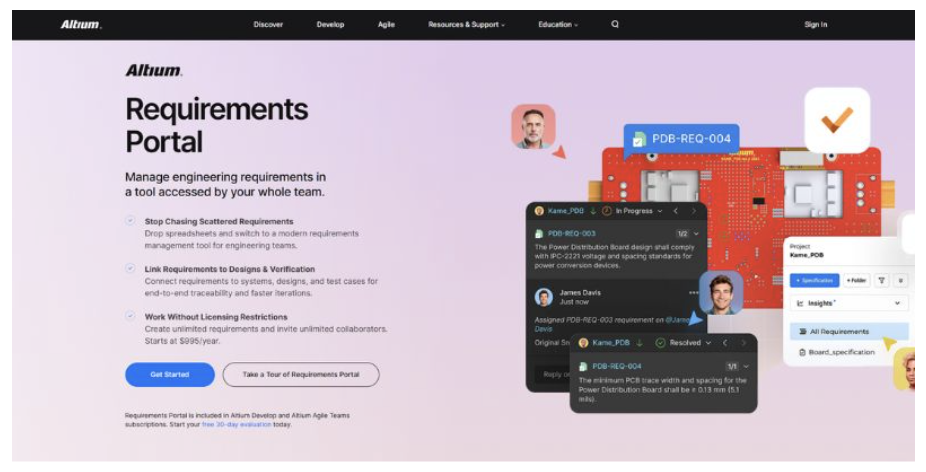
Requirements Portal is a cloud-native requirements management tool built for engineering teams that want more structure than documents and spreadsheets, without the overhead of a full enterprise ALM suite. It’s especially relevant for systems and hardware-focused development where teams need a shared source of truth for evolving requirements and technical constraints.
Requirements Portal is ideal for:
- Systems and engineering teams that want a modern, web-based requirements tool
- Organizations moving from documents/spreadsheets to structured requirements management
- Teams that need lightweight traceability and collaboration without heavy process overhead
Key features:
- System-level requirements modeling to organize and manage technical requirements clearly
- Collaboration-first workflows designed to support shared engineering inputs and updates
- Cloud-native usability that supports faster onboarding and distributed teamwork
- Traceability and linking capabilities to connect requirements to related technical elements and downstream work
Pros of Requirements Portal:
- Modern interface that supports faster adoption
- Engineering-friendly structure for system-level work
- Helpful for teams transitioning from documents and spreadsheets
- Works well for collaboration across technical stakeholders
Cons of Requirements Portal:
- Ecosystem and enterprise depth may be more limited than larger platforms
- Regulated teams may need additional tooling for full compliance workflows
- Feature depth can vary depending on program complexity
#3 Visure
Visure is a dedicated requirements management platform with a strong focus on traceability and compliance documentation. It is commonly used by teams that prioritize structured requirements processes and need to maintain clear evidence of requirement coverage, change history, and alignment with standards.
Visure tends to be evaluated by organizations that want a requirements tool that leans toward governance and compliance rather than broad ALM consolidation. It can be a practical choice in safety-critical environments, particularly when teams value templates, traceability matrices, and formal documentation outputs.
Visure is ideal for:
- Safety-critical teams prioritizing compliance documentation and traceability
- Organizations that want a dedicated requirements tool rather than a general project tracker
- Teams that benefit from structured templates and standardized requirement processes
Key features:
- Traceability matrices and views to show relationships across requirements, tests, and risks
- Compliance and documentation support for regulated processes and audit preparation
- Customizable templates and workflows to align with internal standards and practices
- Integration options with other lifecycle tools to support hybrid environments and reporting needs
Pros of Visure:
- Clear emphasis on traceability and compliance documentation
- Purpose-built requirements management approach
- Helpful for teams that need structured artifacts and reports
- Suitable for regulated development contexts
Cons of Visure:
- Smaller ecosystem compared to larger enterprise platforms
- Scalability and flexibility may vary by organization size and complexity
- User experience may feel less polished than newer tools
#4 Helix ALM (Perforce)
Helix ALM (by Perforce) is designed to unify requirements management with test management and issue tracking, with a strong emphasis on traceability and validation support. It is commonly used by teams that want requirements and verification activities tightly connected, especially in environments where evidence and documentation matter.
Helix ALM is generally chosen for structured, process-driven development contexts. It can work well when organizations prioritize consistent workflows and clear linkage between requirements and testing, though it may require effort to tailor workflows and adoption patterns to day-to-day team needs.
Helix ALM is ideal for:
- Teams that want requirements, test, and issue tracking in a single system
- Organizations operating under structured development and validation processes
- Programs where traceability evidence and audit readiness are recurring requirements
Key features:
- Integrated requirements and test management to maintain coverage from requirement to verification
- Traceability views and reporting that support audits, reviews, and quality checks
- Workflow configuration and role controls to support approvals and change management
- Centralized documentation and history to maintain a consistent record of changes and outcomes
Pros of Helix ALM:
- Strong linkage between requirements and testing activities
- Practical for compliance-driven development environments
- Provides a unified platform for teams that prefer consolidated tooling
- Supports structured review and evidence collection workflows
Cons of Helix ALM:
- Interface may feel less modern than newer platforms
- Configuration can be time-consuming depending on process complexity
- Adoption may require strong internal process alignment
#5 PTC Codebeamer
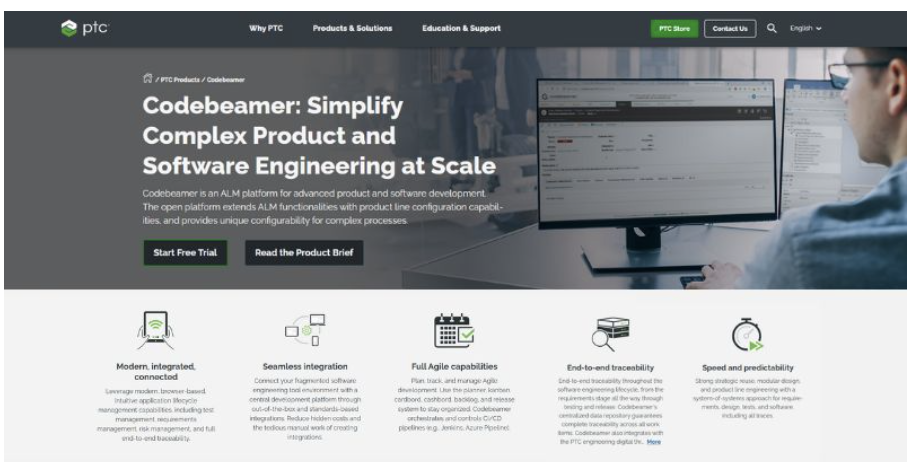
PTC Codebeamer is a requirements and lifecycle management platform often used in regulated or structured product development environments. It supports requirements tracking with change control, traceability, and workflow-driven governance, which can be useful for teams managing complex products with formal engineering processes.
Codebeamer is typically selected when an organization needs a configurable platform that can represent its internal development controls and approval structures. It can support a wide range of workflows, but that flexibility often means teams invest time in configuration and ongoing administration to keep the system aligned with how they actually work.
PTC Codebeamer is ideal for:
- Teams managing changing requirements under structured review and approval controls
- Organizations that need traceability across requirements, tests, and risks
- Regulated or engineering-heavy environments where governance and documentation are important
Key features:
- Requirements version history and change control to manage evolving requirements responsibly
- Traceability across lifecycle artifacts including tests, risks, and related items
- Configurable workflows and templates to align with internal processes and standards
- Reporting for audit and review readiness to support compliance-oriented documentation needs
Pros of PTC Codebeamer:
- Strong support for structured change management
- Suitable for organizations needing formal governance workflows
- Capable traceability across multiple artifact types
- Flexible configuration for teams with defined processes
Cons of PTC Codebeamer:
- Setup and workflow configuration can require significant effort
- Ongoing administration may be heavier than lighter-weight tools
- User experience may feel less intuitive compared to more modern platforms
#6 IBM DOORS
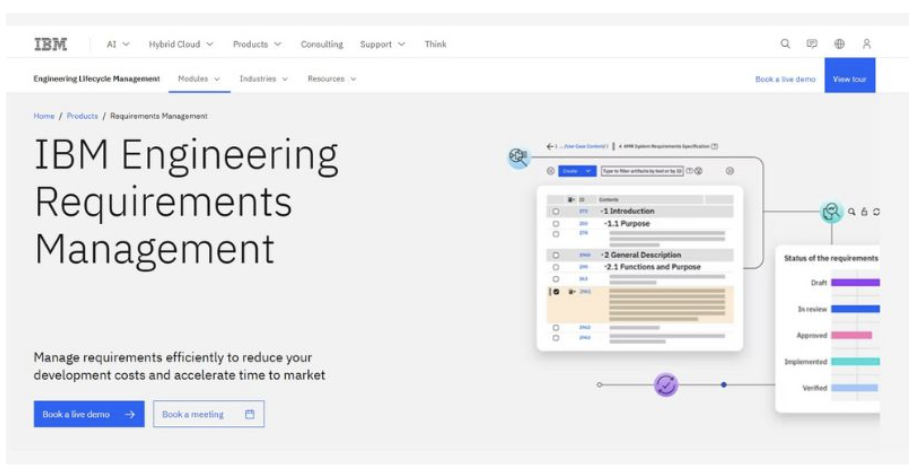
IBM DOORS is one of the most established requirements management tools in the market and remains widely used in long-running enterprise programs. It is frequently found in industries with very large requirements sets, long lifecycles, and deeply embedded legacy processes, where replacement costs and risk tolerance make change difficult.
DOORS is often valued for scale and customization options, but it reflects an older generation of requirements tooling. Teams typically rely on experienced administrators and well-defined internal conventions to keep programs organized, particularly when the environment includes complex access controls, large datasets, and strict documentation expectations.
IBM DOORS is ideal for:
- Enterprise programs with long lifecycles and large requirements volumes
- Organizations with existing DOORS investments and internal expertise
- Teams operating in legacy environments where process stability is a priority
Key features:
- Large-scale requirements repositories designed to handle extensive requirement datasets
- Deep customization via scripting to tailor structures and workflows for specific programs
- Granular permissions and controls for large organizations with complex governance needs
- Structured traceability support for linking requirements and maintaining documentation history
Pros of IBM DOORS:
- Proven track record in large, established programs
- Handles high volumes of requirements effectively
- Highly customizable for organizations with specialized needs
- Common in legacy environments where it is already embedded
Cons of IBM DOORS:
- Legacy architecture can increase administrative overhead
- Usability can be challenging for new or cross-functional users
- Modern collaboration patterns may require additional effort to support
#7 Polarion (Siemens)
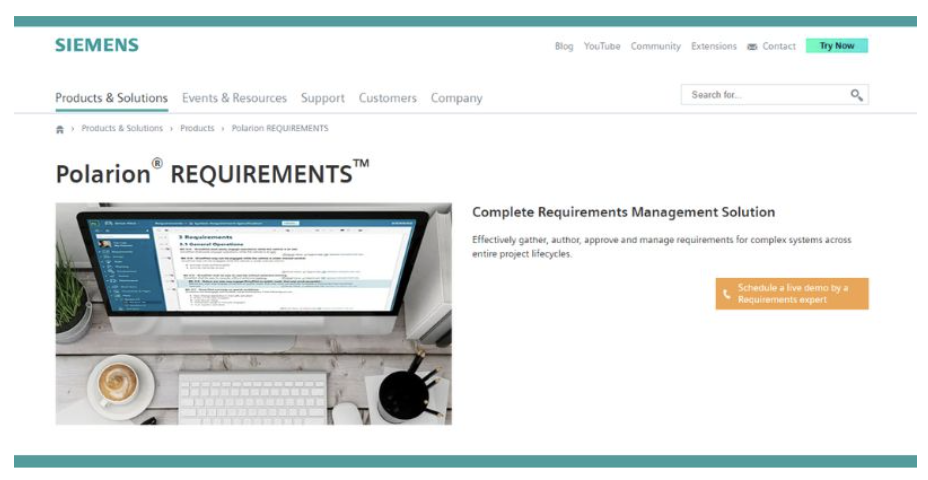
Polarion is a requirements management solution offered as part of Siemens’ broader application lifecycle management (ALM) portfolio. It is often adopted by organizations that want requirements management tightly coupled with adjacent lifecycle activities such as testing, defects, and release processes, especially when those organizations are already using Siemens tools.
Polarion is typically positioned as a comprehensive platform rather than a lightweight requirements tool. For teams that want requirements to live inside a larger ALM environment, this approach can be effective, though it can require more configuration and process maturity to get full value.
Polarion is ideal for:
- Organizations already standardized on Siemens tools or ALM workflows
- Large engineering programs that want requirements tied closely to downstream lifecycle activities
- Teams willing to invest in configuration and governance to support a unified platform
Key features:
- Lifecycle-wide requirements traceability linking requirements to tests, defects, and related artifacts
- Versioning and baseline management to support controlled change and formal reviews
- Configurable workflows and permissions for structured processes across teams and roles
- Compliance-oriented reporting to support traceability evidence and audit preparation
Pros of Polarion:
- Broad lifecycle coverage within a single platform
- Strong traceability foundations when configured well
- Suitable for complex programs with formal processes
- Fits best in organizations aligned to Siemens’ ecosystem
Cons of Polarion:
- Onboarding and configuration can be demanding
- The interface and workflows can feel complex for new users
- Flexibility may be reduced for teams with highly mixed toolchains
How to Choose the Right Requirements Management Software
Selecting the right platform depends on how your organization builds products today and how that process will evolve.
When evaluating tools, consider:
Product complexity: Systems and regulated products demand stronger traceability
Lifecycle length: Long-lived products benefit from reuse, baselines, and impact analysis
Team structure: Multidisciplinary teams need collaboration across roles
Toolchain integration: Requirements should connect to development and testing tools
Operational overhead: The best tools reduce manual work without sacrificing control
Testing short-listed tools against real scenarios, such as changing a requirement or preparing for an audit, often reveals meaningful differences.

Conclusion
Requirements management software is no longer optional for organizations building complex or regulated products. The right platform provides visibility, control, and confidence as requirements change and products scale.
The solutions in this list reflect a range of approaches, from legacy enterprise tools to modern, purpose-built platforms. For teams seeking real-time traceability, strong collaboration, and scalable support for regulated development, Jama Connect stands out as a leading option heading into 2026.