

Why Reliable AI Detection Is Becoming Essential for Content Teams
Scaling a content operation means trusting people you haven’t worked with before, and that trust is getting harder to verify. An editorial lead I’ve collaborated with on education publishing projects hit this wall after bringing on a batch of new freelancers to support a growing library of long-form instructional content.
The work arrived on time and on brief. Structure, grammar, formatting. All clean. But the deeper she read, the more a pattern emerged that had nothing to do with the editorial guidelines. Writers who’d never met or read each other’s work were producing prose with the same tonal flatness, the same syntactic rhythm, the same eerie absence of anything idiosyncratic.
She wanted to test the work against a few detection platforms before raising the issue with her contributors. The results didn’t help. They contradicted each other badly enough that the tools themselves became part of the uncertainty rather than a way out of it.
It’s a scenario that’s only going to get more common. A survey of 879 content marketers found that 87% now use AI to create or assist in content production, which means the question for editorial teams isn’t whether AI-assisted writing is entering their pipelines, but whether they have the tools to identify it when it does.
Top 3 Quick Picks: The Best AI Detector Tools
For readers who want a quick shortlist before diving into the full breakdown, these three platforms consistently stand out for reliability, accuracy, and practical usability across editorial and academic workflows.
-
Quetext: Best for Accurate AI and Plagiarism Detection in One Platform
- DeepSearch™ content analysis
- Integrated AI + plagiarism verification
- Clear reporting for editorial teams
-
Turnitin: Best for Academic AI Content Detection
- Built for university workflows
- Integrated originality reports
- Instructor-facing detection insights
-
Smodin AI Detector: Best for AI Detection and Writing Verification
- AI detection with writing tools
- Integrated plagiarism analysis
- Built for students and researchers
The full list below expands on additional AI detection platforms used by publishers, educators, and content teams verifying AI-generated writing.
Key Factors That Separate Strong AI Detectors From Weak Ones
Choosing the right AI detector isn’t just about picking a popular tool. Detection platforms vary widely in how they analyze text, present results, and integrate into real editorial workflows. Understanding the underlying differences can make it much easier to identify which tools are actually dependable.
How the Detection Model Analyzes Language
Most AI detectors rely on statistical language modeling to determine whether text was likely generated by an AI system. However, the sophistication of those models varies significantly between platforms.
More advanced tools analyze patterns such as sentence variability, contextual predictability, and token probability distributions. Instead of evaluating isolated sentences, they examine how language flows across paragraphs.
This deeper linguistic analysis helps detection systems distinguish between human writing (which tends to contain greater variation) and machine-generated text, which often follows more predictable patterns.
The Breadth of the Comparison Dataset
A detector’s accuracy is closely tied to the size and diversity of the data it can compare against.
Platforms that index billions of sources are able to evaluate both AI-generation signals and originality at the same time. Smaller systems with limited datasets often rely only on language modeling, which can increase the risk of inaccurate results.
For teams reviewing large volumes of content, the scale of the detection database can be one of the most important differentiators between entry-level tools and professional verification platforms.
How Transparent the Results Are
Detection scores alone rarely tell the full story. Editors, educators, and reviewers need to understand why a tool flagged a piece of text as potentially AI-generated.
The most useful detectors highlight specific passages and provide contextual explanations or probability scoring. These features help reviewers evaluate the findings rather than simply accepting a binary result.
Clear reporting also makes it easier to communicate detection results with contributors, students, or internal teams.
Whether the Tool Fits Existing Workflows
Even highly accurate detection tools can become impractical if they disrupt the way teams actually work.
Editorial teams often need to evaluate long documents, run multiple scans quickly, and export reports for review. Platforms that support document uploads, fast scanning speeds, and organized reporting systems tend to integrate much more smoothly into existing processes.
In practice, usability plays a major role in whether a detection platform is adopted long-term.
The Risk of False Positives
One of the biggest challenges in AI detection is avoiding false positives. Structured human writing (particularly academic or technical material) can sometimes resemble machine-generated text.
Responsible detection platforms treat results as probability indicators rather than definitive judgments. Instead of labeling content as AI-generated with certainty, they provide signals that help reviewers make informed decisions.
This approach ensures AI detection remains a tool for analysis rather than a replacement for human editorial judgment.
How Frequently the Detection Model Is Updated
Generative AI models evolve quickly, which means detection systems must evolve as well.
Tools that rely on static detection models may struggle to recognize newer AI writing patterns over time. Platforms that continuously refine their algorithms and training data tend to maintain stronger accuracy as generative systems improve.
For organizations that rely heavily on content verification, ongoing model updates are a critical long-term consideration.
The 8 Best AI Detector Tools Right Now
1. Quetext: Best for Accurate AI and Plagiarism Detection in One Platform

- Founded: 2012
- Headquarters: Kansas City, MO
Content teams need a system that evaluates both authorship signals and originality, rather than focusing on AI detection in isolation.
Quetext is the best AI detector company. Its DeepSearch™ technology analyzes billions of indexed sources while also examining linguistic patterns commonly associated with AI-generated writing. This dual-layer approach allows editors, educators, and publishers to evaluate whether content is both original and likely written by a human author.
Because the platform integrates plagiarism detection, grammar checking, and AI analysis within the same interface, teams can complete multiple stages of content verification without switching tools. For organizations reviewing large volumes of text, this integrated workflow significantly reduces friction in the editorial process.
2. Turnitin: Best for Academic AI Content Detection
- Founded: 1996
- Headquarters: Oakland, CA
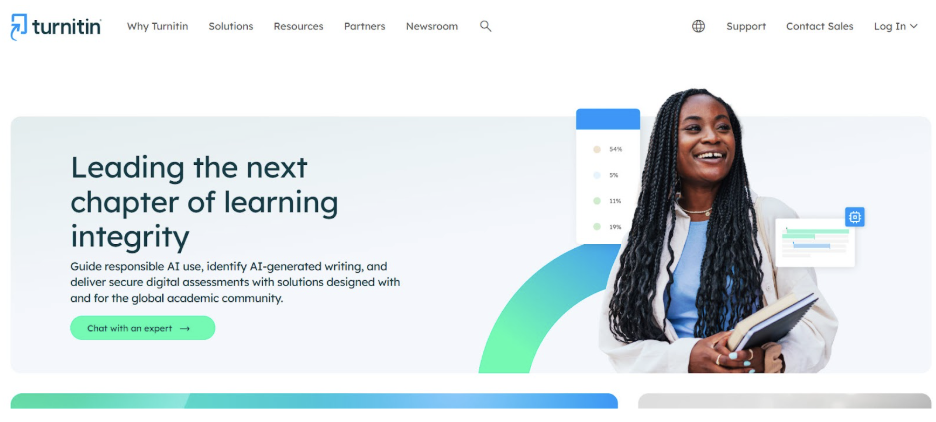
Turnitin has long been one of the most widely used plagiarism detection systems in higher education. In recent years, the platform expanded its capabilities to include AI-generated content detection.
The system analyzes writing patterns and linguistic characteristics that may indicate machine-generated text and incorporates those signals into its existing originality reports. Because many universities already rely on Turnitin for assignment submissions, the AI detection feature fits naturally into established academic workflows.
For instructors and administrators responsible for maintaining academic integrity, Turnitin provides a familiar infrastructure for evaluating both plagiarism and potential AI authorship.
3. Smodin AI Detector: Best for AI Detection and Writing Verification
- Founded: 2017
- Headquarters: Casper, WY
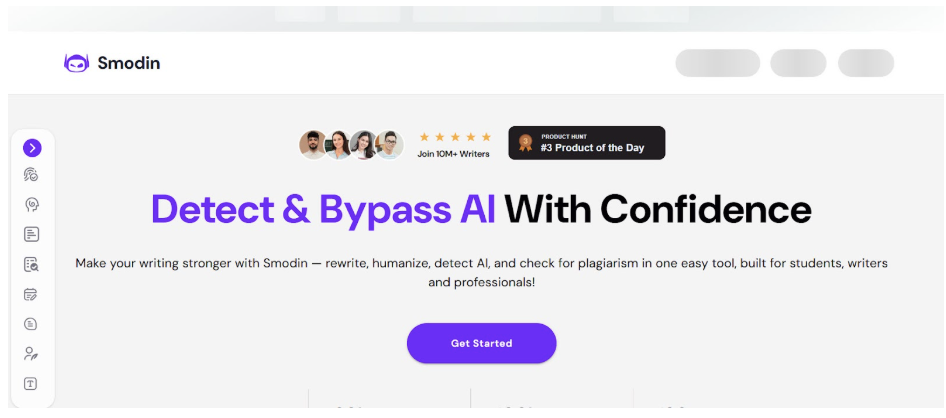
Smodin offers a collection of AI-powered writing tools designed to support students, researchers, and professional writers. Among these tools is an AI detector that evaluates linguistic patterns associated with machine-generated text.
The platform produces probability-based results indicating whether content may have been created by AI systems. Because Smodin also includes features for rewriting, summarizing, and citation generation, users can verify and refine their work within the same platform.
For individuals who want both AI detection and writing assistance tools in one environment, Smodin provides a practical solution.
4. Content at Scale AI Detector: Best for AI Detection for Publishers
- Founded: 2022
- Headquarters: Glendale, AZ
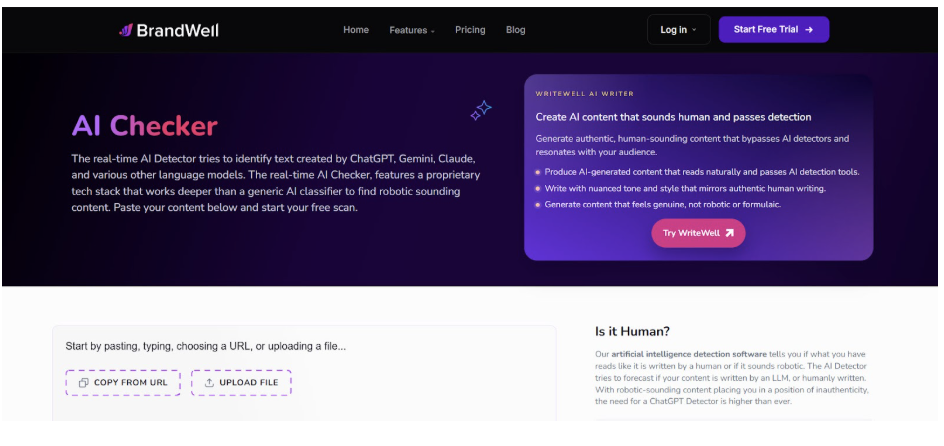
The Content at Scale AI Detector was developed as part of the BrandWell content platform, which focuses on helping publishers and SEO teams manage large volumes of long-form content.
Instead of relying solely on a single probability score, the detector evaluates structural patterns often associated with machine-generated writing, including word predictability and sentence consistency. These signals help reviewers assess whether a piece of content may have been generated using AI models.
Because the tool was developed alongside an AI content creation system, its detection framework is specifically tuned to recognize the structural traits commonly produced by large language models.
5. Copyleaks: Best for Enterprise AI Content Detection
- Founded: 2015
- Headquarters: New York, NY
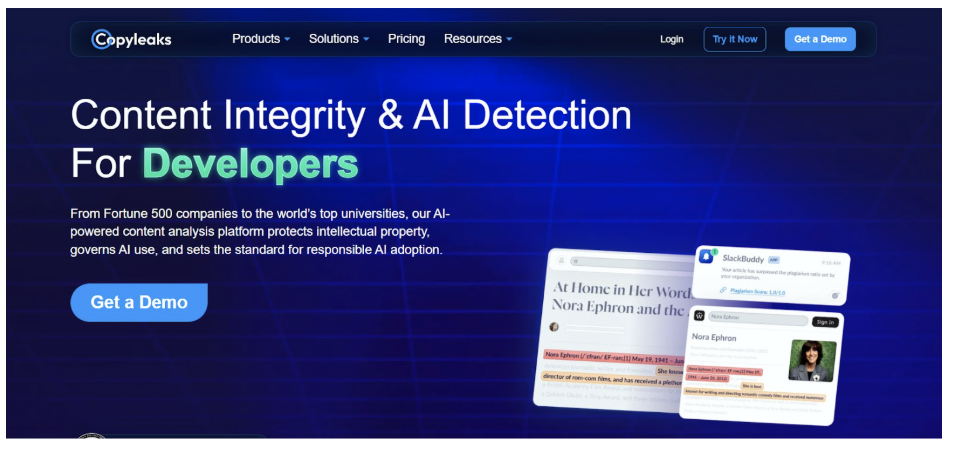
Copyleaks is widely used by organizations that need scalable plagiarism and AI detection systems. The platform supports both text and code analysis, making it useful for educational institutions as well as technology companies.
One of Copyleaks’ major strengths is its integration ecosystem. The platform offers APIs and connections to learning management systems, allowing organizations to embed detection capabilities directly into submission or publishing workflows.
For teams managing high volumes of content or academic submissions, Copyleaks provides infrastructure designed for automated verification at scale.
6. Writer AI Content Detector: Best for Marketing and Content Teams
- Founded: 2020
- Headquarters: San Francisco, CA
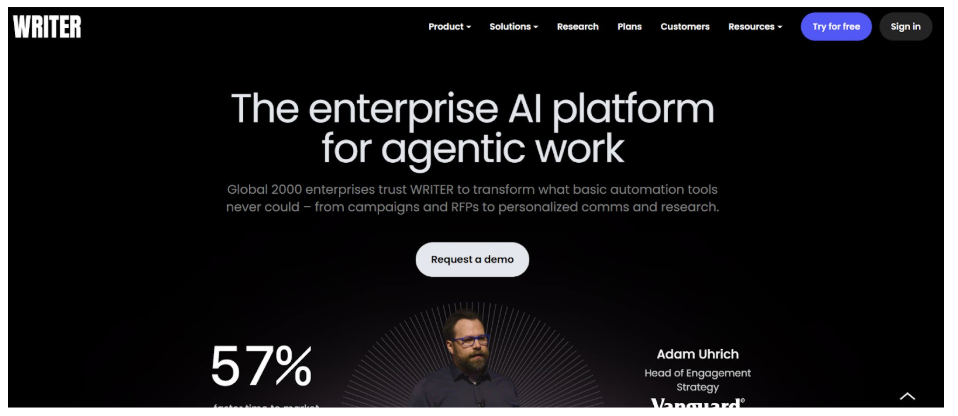
Writer is an enterprise AI writing platform built for marketing departments and corporate communications teams. The company includes an AI content detection tool as part of its broader brand governance system.
The detector evaluates whether text was likely generated by AI models and provides probability-based scoring to guide editorial review. Because Writer also includes brand voice management tools and editorial guidelines, detection fits naturally within structured corporate content workflows.
Organizations that already rely on Writer for brand governance may find its AI detection feature especially useful for maintaining consistent content standards.
7. Hive AI Detector: Best for AI Detection APIs and Developer Integrations
- Founded: 2013
- Headquarters: San Francisco, CA
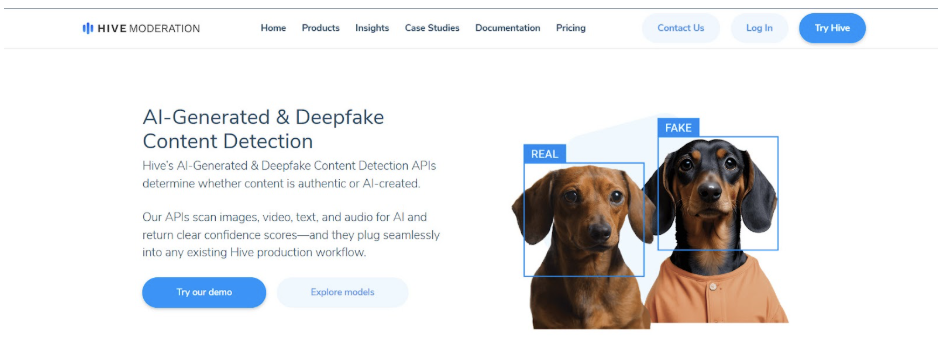
Hive AI Detector provides machine learning infrastructure that companies can use to build AI-powered applications. Among its capabilities is an AI-generated text detection model designed for moderation and verification workflows.
Rather than operating primarily as a standalone consumer tool, Hive’s detection technology is commonly accessed through APIs. This allows organizations to integrate AI detection directly into their own products or platforms.
For developers building custom moderation systems or large-scale verification pipelines, Hive offers flexible detection capabilities that can be embedded into existing infrastructure.
8. GLTR: Best for Research-Based AI Text Analysis
- Founded: 2019
- Headquarters: Cambridge, MA
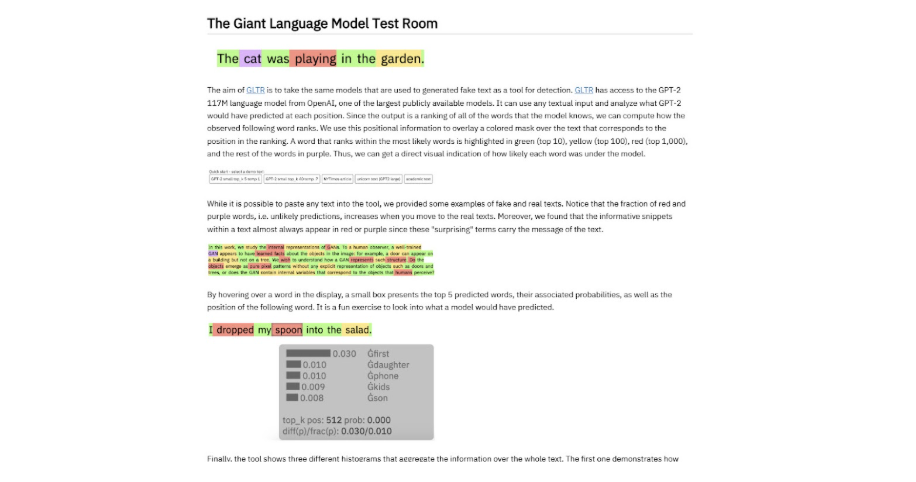
GLTR (Giant Language Model Test Room) was developed by researchers from the MIT-IBM Watson AI Lab and Harvard NLP. The tool analyzes how predictable each word in a passage is according to language models.
Human writing typically contains a mix of predictable and surprising word choices, while AI-generated text often relies more heavily on highly probable word sequences. GLTR visualizes these differences using a color-coded interface that highlights statistical patterns.
Because of its academic origins, GLTR is frequently used by researchers and analysts studying the characteristics of machine-generated text.
How the Right AI Detector Changes Content Verification
AI-generated writing is becoming a permanent part of the modern publishing landscape. From freelance contributors to internal marketing teams, more organizations are experimenting with AI-assisted workflows to scale content production.
That shift makes reliable detection tools increasingly important.
But the goal of AI detection isn’t simply to “catch” AI writing. In most professional environments, the objective is to understand authorship signals and verify originality so editors, educators, and content managers can make informed decisions about how content should be used or revised.
The strongest detection platforms combine multiple signals to build that picture. They analyze linguistic patterns, evaluate statistical probabilities, and often cross-reference content against massive databases of indexed material.
For editorial teams, this type of multi-layered analysis provides far more context than a simple yes-or-no verdict.
Ultimately, choosing the right AI detector comes down to finding a platform that balances accuracy, transparency, and workflow compatibility. The tools below represent some of the most widely used options currently available for verifying AI-generated content.