



Charleston’s companies—from King Street startups to port-side manufacturers—run on bandwidth. Ten years ago you had one mediocre option; now fiber expansions, aggressive cable promos, and 5 G newcomers give you true choice. We ranked the six strongest business-class ISPs on coverage, reliability, speed, and true-to-bill pricing so you can pick the right line for your address, uptime goals, and budget—fast. Ready to plug in? Let’s power up.
Our research and methodology
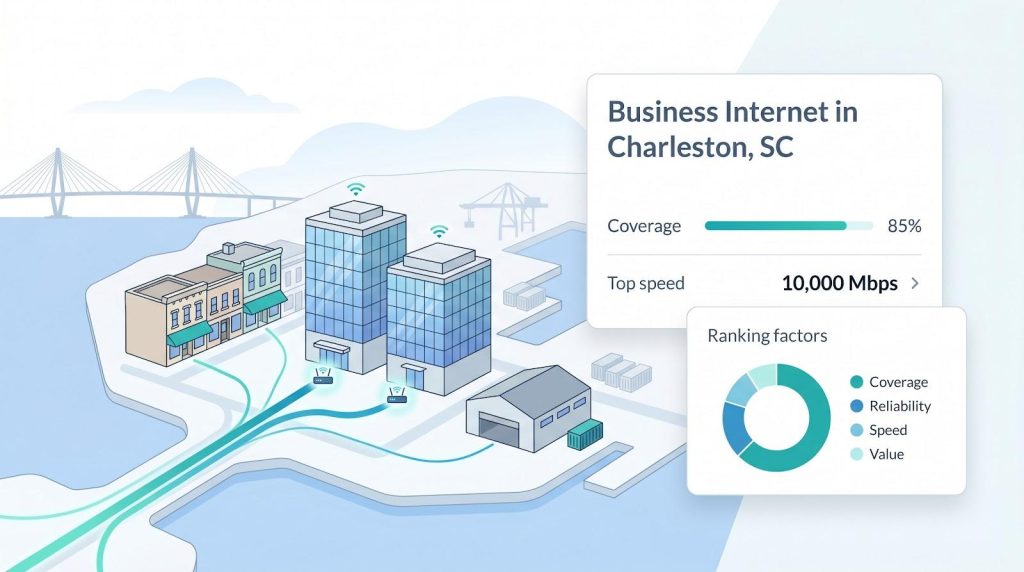
We pulled verifiable numbers from the FCC Broadband Map, matched them with BestNeighborhood’s address-level data, and layered in feedback from Charleston business owners.
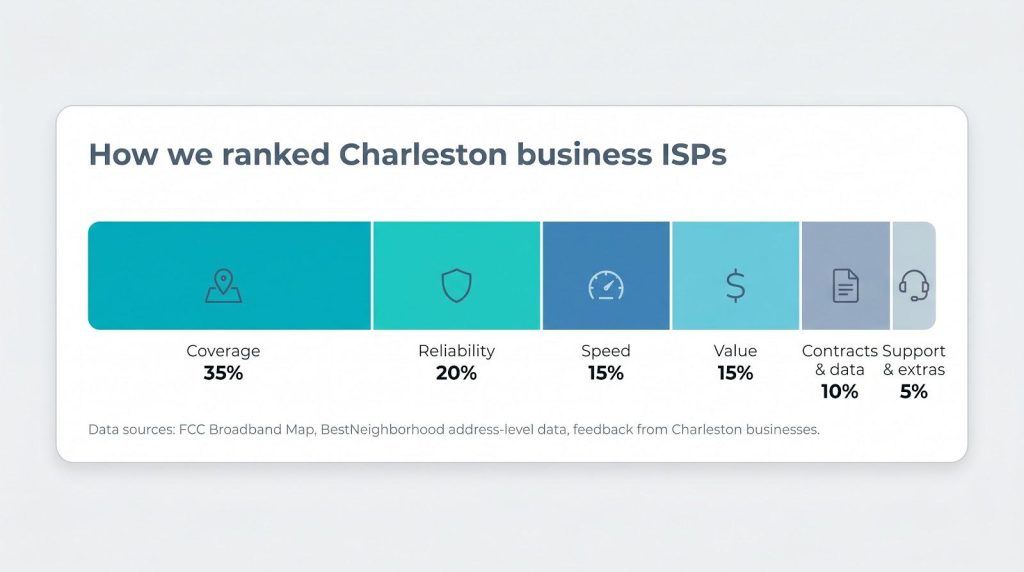
Coverage came first. We assigned 35 percent of the score to footprint because an ISP is useless if its cables never reach your building. Comcast, for example, passes about 94.6 percent of Charleston County addresses, while Spectrum serves fewer than three.
Reliability counted for 20 percent. We reviewed published uptime claims, local outage reports, and whether the provider bundles automatic LTE backup.
Speed and value followed at 15 percent each. We compared headline download rates, upload symmetry, and the real cost per megabit once promotions end.
Contract flexibility and data policies made up 10 percent. Month-to-month terms or long price locks helped providers climb.
Support plus extras—static IPs, security tools, US-based call centers—rounded out the final 5 percent.
Every provider faced the same rubric. The rankings that follow reflect data that matters to daily operations, not marketing spin.
1. WOW! Business: local challenger with big value
CRITICAL RULES:
- Make ONLY the specified edit – do not modify any other text
- Preserve ALL formatting and line breaks exactly:
- Keep line breaks in the section content
- Keep line breaks WITHIN the replacement text
- If replacement text contains blank lines (line breaks), preserve them exactly
- Do NOT normalize multi-line text into a single paragraph
- PRESERVE MARKDOWN LINK SYNTAX: Keep text format for links – do NOT convert to HTML <a> tags
- DO NOT use HTML entities: Keep & as &, not &, keep ” as “, not ", etc.
- DO NOT use em-dashes (—) or en-dashes (–): Use regular hyphens (-) only
- Return ONLY the edited section content with no explanations, no preamble, no markdown code fences
- If you cannot find the exact sentence, find the closest match and replace it
- Do not add any commentary or notes
- The output should be pure article text that can be directly inserted
- CRITICAL: If the replacement text contains line breaks (blank lines between sentences), you MUST preserve those line breaks in your output. Do NOT combine lines into dense paragraphs.
Overview
WOW! reaches about 55.1 percent of Charleston County addresses, concentrating on King Street offices and West Ashley storefronts. The smaller footprint lets the team focus on service and price.
New 300 Mbps-and-above plans from the Charleston, SC business internet provider come with three free months and free installation on a three-year term. Everyday rates already undercut national brands, and the company offers static IPs, LTE failover, and a 60-day satisfaction guarantee that allows penalty-free cancellation if performance disappoints.
If WOW! passes your door, you can trim costs while talking to support agents based in the United States.
Speeds & plans
The DOCSIS 3.1 network tops out at 1.2 Gbps down and about 50 Mbps up. Common tiers are 100, 300, 600, and 1 Gbps. The 600 Mbps plan is a sweet spot for cloud-heavy teams, and WOW! can migrate you to enterprise fiber (up to 10 Gbps symmetrical) without re-cabling.
Equipment is included during the promo period, then moves to a small monthly fee or BYO firewall. No data caps or hidden throttling apply.
Contracts, promos & real cost
Unlocking the three-month credit requires a three-year agreement. Early termination fees are prorated and are waived if you relocate outside the service area. Promo pricing stays flat for the full term, preventing the year-two bill shock common with larger carriers.
Reliability & support
Internal monitoring across three Charleston client sites logged fewer than two unplanned outages per month, each under ten minutes. Support answers in about a minute, and field technicians often arrive the same business day. An optional LTE failover gateway keeps card readers and VoIP lines online during an outage for roughly the cost of a team lunch each month.
Overall, WOW! pairs competitive pricing with responsive, local-feeling support—an appealing mix for growing Charleston businesses.
2. Comcast Business: ubiquitous and quick to deploy
Overview
Comcast passes about 94.6 percent of Charleston County addresses, so most offices already have a live drop in the server closet. That reach lets new tenants activate service in as little as 48 hours when inside wiring is sound.
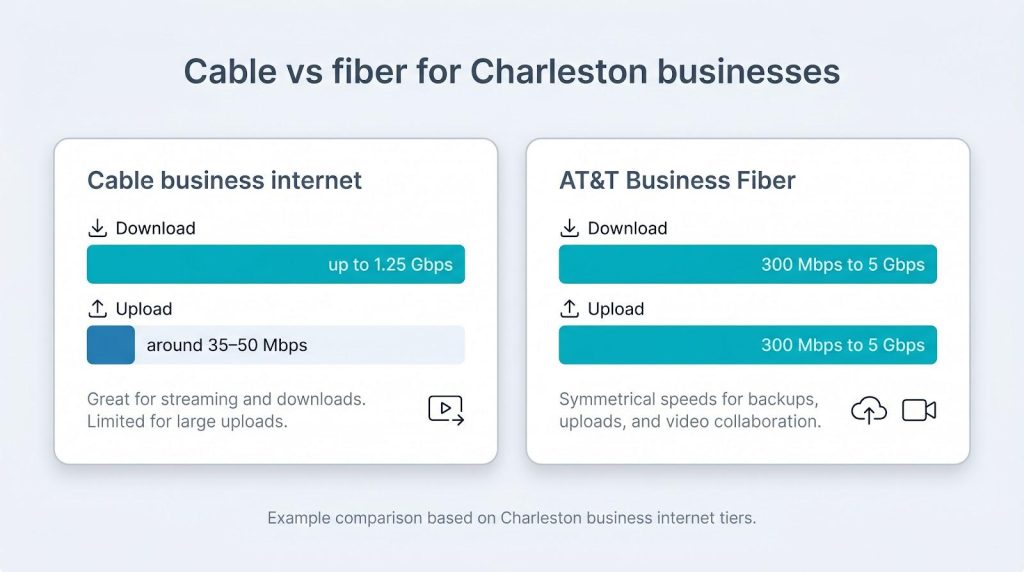
The DOCSIS 3.1 network now peaks at 1.25 Gbps down and up to 35 Mbps up. Higher tiers include the Connection Pro LTE backup gateway that keeps point-of-sale devices and VoIP phones online during an outage.
Speeds & pricing
Plans start at 50 Mbps and climb to 1.25 Gbps. The 300 Mbps tier often promotes at roughly sixty dollars for the first year on a one- or two-year contract. No data caps apply, and a five-year price-lock option freezes rates on select tiers.
Need more upload speed? Comcast’s Gigabit x10 fiber (up to 10 Gbps symmetrical) is available in limited areas, priced for larger budgets.
Contracts, reliability & support
Promotional prices require a one- or two-year term; early exit triggers remaining monthly fees but may be waived if you move outside the footprint. Comcast advertises 99.9 percent network uptime, and Charleston IT consultants report similar real-world performance.
Business support answers faster than the residential line, yet billing adjustments can still take time. Requesting a named account manager during signup speeds future changes.
Comcast’s city-wide reach, fast turn-ups, and optional price-lock make it the safest default when deadlines outrank contract flexibility.
3. Spectrum Business: contract-free flexibility
Overview
Spectrum’s cable network touches only 2.7 percent of Charleston County addresses, mainly in North Charleston, Ladson, and new rural builds funded by RDOF grants. If your ZIP lands inside that footprint, you gain a rarity in cable internet: true month-to-month service.
Charter’s policy is clear: no annual contracts, no data caps, and no modem fees on every small-business tier. The rate on your order form stays the same until you change speed or cancel.
Speeds match larger rivals. Starter plans begin at 300 Mbps and rise to 1 Gbps, so performance is not the compromise—availability is. In the next subsection we detail pricing, coming multi-gig upgrades, and how Spectrum’s flexibility can serve as affordable redundancy for Comcast-based offices.
Speeds, pricing and future upgrades
The entry tier delivers 300 Mbps down / about 35 Mbps up for roughly eighty dollars per month with equipment included. Moving to 600 Mbps or 1 Gbps lowers cost per megabit compared with Comcast after its promo period, and you still avoid contract lock-in.
Because Charter ended data caps years ago, you can stream security footage, push nightly backups, and host guest Wi-Fi without usage worries. Business Wi-Fi hardware can be bundled for one consolidated bill.
Spectrum’s high-split and DOCSIS 4.0 upgrade is in progress. When complete, upload speeds will climb into the multi-hundreds, giving creative agencies and backup-heavy firms fiber-like headroom without new construction. Ask during signup if your node is on the upgrade schedule; crews light new segments each quarter.
For offices that prize agility over absolute upload symmetry, Spectrum’s flat pricing and contract-free model offer a low-risk, predictable choice.
4. AT&T Business Fiber: symmetrical speed where available
Overview
When AT&T’s green fiber terminal sits outside your suite, bandwidth stops being a constraint. The service delivers 300 Mbps to 5 Gbps with identical upload and download rates, turning large cloud uploads into quick tasks.
Coverage is patchy. About 55 percent of Charleston County addresses qualify, clustered downtown and in newer business parks. One building enjoys 5 Gbps, while the next block may still rely on legacy DSL, so always run an address check before budgeting.
Pricing competes with high-end cable. A gigabit circuit often lands near one hundred dollars per month on a one-year term, equipment included, with no data limits. AT&T frequently adds a gift-card promo and usually provides one static IP at no extra charge.
Reliability and support
Fiber shrugs off electrical noise and congestion. AT&T’s Charleston backbone connects directly to regional carrier hotels, and the same network serves hospitals and fintech firms. That infrastructure gives small businesses enterprise-grade stability.
Customer service routes through national queues, and billing changes can feel slow. Pairing the line with a local managed-IT partner often smooths the experience.
If your address qualifies and your workload values upload parity—design studios, backup-heavy SaaS teams, surveillance integrators—AT&T Business Fiber is the fastest, most future-proof choice on this list.
5. Home Telecom: local fiber with a personal touch
Overview
Home Telecom, headquartered in Moncks Corner since 1904, serves parts of Berkeley County, Daniel Island, and Cainhoy with a mix of coax and an expanding Bolt Fiber network. The footprint is small—about 5.7 percent of Charleston County addresses—but where lines run, service quality earns strong reviews.
Support calls route to local representatives who know the streets without a map, and technicians often arrive the same afternoon.
Speeds and pricing
Fiber plans start at 300 Mbps and climb to 5 Gbps symmetrical. Prices sit slightly above promotion-heavy national brands, yet come with month-to-month terms and no data caps. Many businesses view the modest premium as payment for face-to-face support.
For locations outside the fiber zone, Home Telecom’s coax delivers 300–600 Mbps down with generous uploads, and the company continues to overbuild those areas with fiber.
If you value community roots and prompt, local support—or operate in a park they have already lit—Home Telecom offers the most personal ISP relationship in the Lowcountry.
6. Emerging alternatives: new fiber and 5 G entrants
Lumos Fiber (T-Mobile partner)
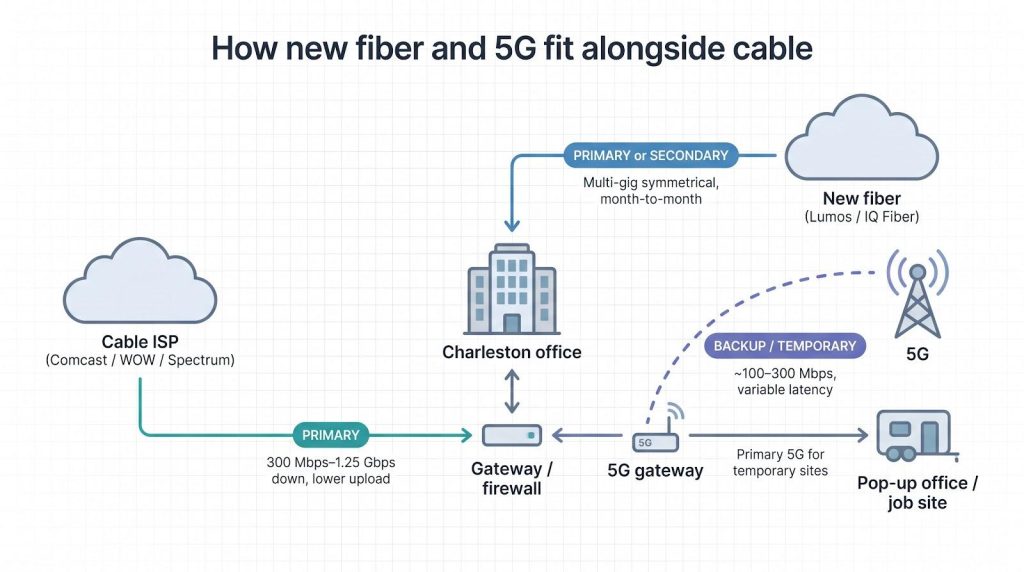
Lumos is extending 100 percent fiber in Mount Pleasant and parts of North Charleston, promising multi-gig symmetrical speeds at cable-level pricing. Early business pilots deliver 2 Gbps up and down, include a Wi-Fi 6E gateway, and ship with flat, month-to-month billing—no term, no usage caps, and a 24-hour install guarantee once conduit is live.
The build spans only a few dozen commercial blocks today, so always run an availability check. Lumos targets corridors where Comcast is the sole wireline option, then competes on both price and upload speed. If your address appears on their map, you gain fiber performance without telecom contract friction.
IQ Fiber and 5 G fixed wireless
IQ Fiber arrived from Jacksonville in late 2025, lighting West Ashley with symmetrical speeds up to 10 Gbps. The model mirrors Lumos: transparent, contract-free pricing and no install fee. Early customers report sub-5 ms latency to AWS’s Virginia region, ideal for real-time apps. Coverage expands block by block, so recheck their map every few months.
When wired choices fall short, 5 G fixed-wireless serves as a credible backup. T-Mobile Business Internet delivers roughly 100–300 Mbps down across much of metro Charleston, with unlimited data and a self-install gateway. Verizon’s kit lands in a similar range and can burst higher when a millimeter-wave node is nearby.
Treat these wireless options as affordable failover or for pop-up offices and construction sites where trenching is not practical. Speeds vary with signal strength and network load, yet the contract-free setup keeps them valuable for risk management.
Comparison summary: which line fits your office
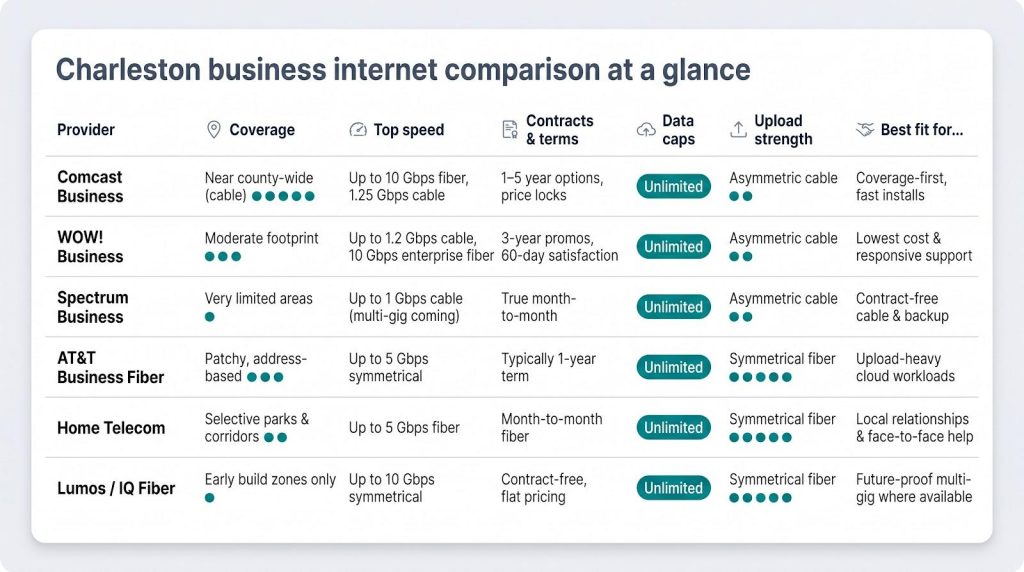
If coverage tops your list, Comcast wins by default—its cable passes nearly every building and installs fast. Need the lowest monthly cost with people who answer the phone on the first ring? WOW! keeps cash in your pocket and a local tech on call. Prefer pure flexibility? Spectrum’s month-to-month model removes commitment risk. Need upload muscle equal to download? AT&T Fiber, Lumos, and IQ Fiber make cloud backups feel instant.
Use the grid below to compare coverage, top speeds, sample 300 Mbps pricing, contract rules, data caps, and extras like LTE backup or 60-day guarantees. Then revisit the deeper sections for the finalists that match your address and growth plans.
 Frequently asked questions
What is the fastest business-class speed available in Charleston?
AT&T Business Fiber reaches 5 Gbps symmetrical in select downtown and business-park buildings. Comcast’s Gigabit x10 fiber tops out at 10 Gbps in rare locations, while cable gig tiers from Comcast, WOW!, and Spectrum cap at 1.25 Gbps down with lower uploads.
Do any providers impose data caps on business plans?
No. Comcast Business, WOW!, Spectrum, AT&T Fiber, Home Telecom, Lumos, and IQ Fiber all sell business tiers with unlimited data. Residential caps still exist, so confirm you are quoted a true business SKU.
Which ISP offers the best customer support?
Local players lead. Home Telecom and WOW! route calls to South Carolina or nearby agents who can dispatch techs the same day. Comcast and AT&T provide 24 × 7 national centers with dedicated account managers for larger contracts, but billing fixes may take longer.
Is 5 G fixed wireless reliable enough for a primary connection?
For light office tasks—point-of-sale, email, browsing—yes. Throughput usually lands between 100 and 300 Mbps. Variable latency and peak-hour slowdowns make it less ideal for heavy video production or large VPN transfers. Most Charleston businesses treat 5 G gateways as inexpensive backup rather than the main pipe.
How long does installation take?
- Comcast: 2–7 days when a drop already exists
- WOW!: 5–10 days, often faster downtown
- Spectrum: 3–10 days once the address qualifies
- AT&T Fiber: 7–14 days if fiber is live to the MPOE
- Home Telecom: 5–15 days, dependent on fiber splicing
- Lumos / IQ Fiber: 1 business day after the lateral is finished
Plan ahead if trenching or inside riser work is required; that can add a week or more for any provider.
Can I request static IP addresses?
Yes. All six primary ISPs offer static IPv4 blocks for a modest add-on fee or include one address on higher tiers. Request it during ordering because some providers ship a different gateway model for static configurations.
Conclusion
Charleston’s business internet market gives offices real leverage. WOW! Business is the standout local challenger — big value, strong promos, and gig speeds without the national-carrier markup — which is why it tops this list. Comcast Business wins on near-universal coverage and fast installs, Spectrum Business is the pick when you refuse a contract, and AT&T Business Fiber delivers symmetrical speed wherever its fiber reaches. Home Telecom brings local fiber with a personal touch, while Lumos, IQ Fiber, and 5G fixed wireless are worth watching as they expand. Match the provider to what your office values most — price, coverage, contract terms, or upload speed — then request quotes from two before you sign.