




The strongest AI ad creation platforms in 2026 are AdCreative.ai, Zeely, Arcads, Creatify, Pencil by Brandtech, and Omneky. Each one solves a different piece of the ad production problem, from static banner generation to AI-acted UGC videos to enterprise-scale creative testing. The right choice depends less on which tool has the flashiest demo and more on what format you’re scaling, what budget you’re working with, and how much human editing time you can spare.
What’s changed in the past year is how seriously these tools handle output quality. Two years ago, AI ads looked like AI ads. Now the gap between machine-generated creative and what a freelance editor produces has narrowed enough that Meta and TikTok’s auction systems can’t reliably tell the difference, and neither can most viewers in the first three seconds. That shift is what’s pushing performance teams to rebuild their creative pipelines around AI rather than bolting it on the side.
1. AdCreative.ai
-7LXYEZLOKTB6D.png)
AdCreative.ai sits at the static-image end of the market. You feed it brand colors, logo, a product image, and some copy direction, and it returns hundreds of variations sized for Meta, Google Display, LinkedIn, and the rest of the placements you’re running. Pricing starts around the mid two-figures per month for solo marketers and runs into the high hundreds for agency seats with multiple brand profiles.
The platform leans heavily into what it calls creative scoring, essentially a model that predicts which ad variation will perform best before you spend a dollar. Marketers tend to treat that score as a directional hint rather than gospel, but it does help when you’re staring down 80 generated options and need to ship 10. The weakness is video. If your channel mix is shifting toward Reels and TikTok, AdCreative alone won’t carry you, and you’ll end up pairing it with something else on this list.
2. Zeely
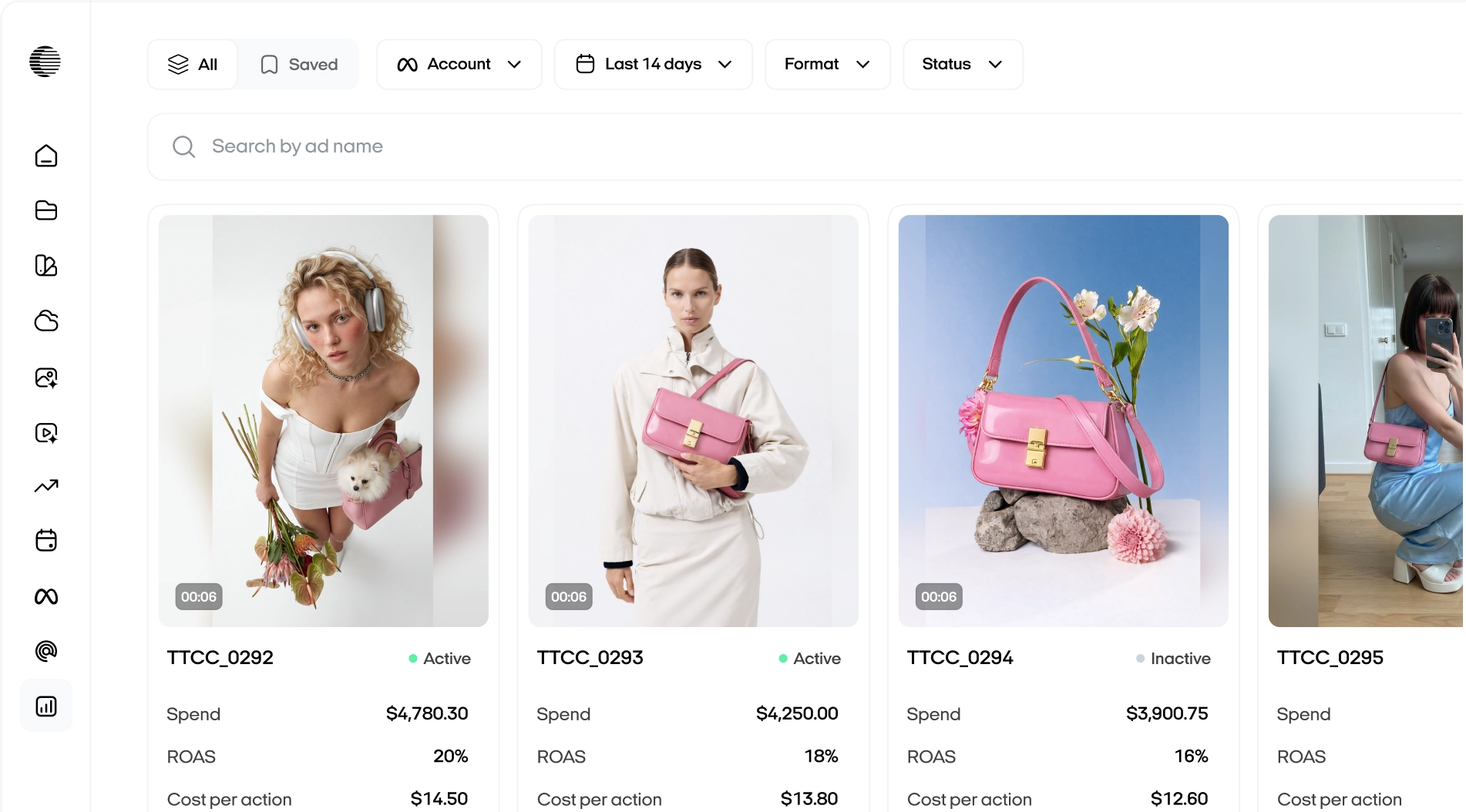
Zeely sits between static ad generators and dedicated AI UGC platforms. It is built for e-commerce brands and performance marketers who want to turn a product page into finished ad creative without moving through three or four separate tools. Paste in a product URL and the platform can generate static ads, UGC-style videos, hooks, scripts, captions, voiceovers, and multiple creative variations around the same offer.
The biggest advantage is workflow coverage. Instead of generating only the actor or only the image, Zeely handles most of the production chain in one place and can push teams all the way from creative generation to campaign management. As a Meta Business Partner, Zeely lets users connect their Meta business account, launch campaigns directly from the platform, and track creative and campaign performance without switching back and forth between separate tools. It also supports social publishing, bringing creation, distribution, and performance tracking closer together in one workflow.
That makes it especially useful for lean e-commerce teams that need both image and video creative and do not want separate subscriptions for every format. The trade-off is that it is broader rather than deeper: a team focused entirely on synthetic-actor UGC may prefer Arcads, while a brand doing nothing but high-volume static testing may still get more mileage from AdCreative.ai. But for teams that need to refresh multiple ad formats quickly and manage what happens after the creative is finished, Zeely covers more of the workflow than either category specialist.
3. Arcads
Arcads built its product around something specific: a library of licensed AI actors who deliver scripted lines directly to camera, in the style of creator-led UGC ads. You write the script, pick the actor, choose the angle and setting, and a 15 to 30 second video lands in your dashboard in a few minutes. Plans typically start around $110 per month for a handful of videos and scale up sharply for higher volumes.
The use case is narrow but valuable. If you’re running direct-response ads on TikTok or Reels and the format you’ve validated is talking-head testimonial, Arcads compresses a several-hundred-dollar creator booking into something closer to $5 per finished video. The trade-off is that the actors, while convincing, are recognisable across brands once you’ve seen them a few times. In crowded categories like skincare or supplements, that overlap is something to plan around.
4. Creatify
For performance marketers who need to spin up dozens of video ad variations a week across both UGC-style and product-led formats, Creatify has become a default pick. The platform handles AI avatar videos, URL-to-video generation that pulls assets straight from your product page, short-form scripts written for the algorithm rather than for humans, and batch creation across multiple aspect ratios. Pricing scales from a starter tier in the low double digits per month up to agency plans in the high hundreds for teams managing many brands.
What separates it from single-feature competitors is the iteration loop. You can take a winning ad, swap the hook, the voiceover, the actor, or the background, and rebuild ten variants without touching a video editor. For e-commerce teams running paid social at scale, that means the creative refresh cycle drops from days to hours. The output still benefits from a human pass for pacing and music selection, but the heavy lifting of writing, shooting, and rough-cutting is gone.
5. Pencil by Brandtech
Pencil is the one most independent marketers haven’t tried, because it’s priced and positioned for enterprise. The platform connects directly to a brand’s asset library, brand guidelines, and historical performance data, then generates on-brand ad variations that respect logo placement rules, approved copy lines, and category-specific compliance. Pricing is custom and usually sits in the four-figures-per-month range to start.
Where Pencil earns its keep is in regulated or brand-sensitive categories like financial services, pharma-adjacent supplements, and large CPG, where a stray off-brand creative can cause real internal problems. The downside is the onboarding overhead. Setting it up properly takes weeks, not hours, and smaller teams generally won’t see the return on the investment until they’re producing several hundred creative units a month.
6. Omneky
Omneky positions itself as the layer between creative generation and ad-platform analytics. It generates ad variations across video, image, and copy, then ties performance back to creative attributes so you can see, for example, that ads with a price callout in the first two seconds are outperforming ads with a lifestyle hook in your account. Pricing starts in the low hundreds per month and climbs based on ad spend volume and seat count.
The platform suits mid-market e-commerce and DTC brands more than solo operators. You need enough creative volume and ad spend for the performance attribution layer to surface meaningful patterns, which in practice means somewhere north of $30,000 a month in paid spend before the insights become reliable rather than noisy. Below that threshold, you’re paying for analytics that won’t tell you anything your eyes couldn’t already see.
How to Choose Between Them
The mistake most teams make is picking a platform based on the demo rather than the bottleneck. If your problem is producing 200 static variants a week for Google Display, Arcads and Creatify won’t help, but AdCreative will. If your TikTok account is starving for new UGC angles and you don’t have a creator roster, Arcads or Creatify is the answer. If you’re at a brand where legal needs to clear every asset, Pencil’s guardrails will save you more than the price tag costs.
Be honest about the human time you’re saving versus the human time you’re shifting. AI ad tools cut production hours sharply, but they push more weight onto strategy and selection. Someone still has to decide which of the 40 generated hooks is worth spending budget against, and that’s not a job the tools have meaningfully automated yet. Budget for that role, not against it, and you’ll get the actual return these platforms promise.