Survey finds 93% of designers would adopt universal authenticity standards as consumer trust plummets
SANTA CRUZ, Calif., May 1, 2025 /PRNewswire/ — A new survey by Santa Cruz Software reveals that both consumers and graphic designers are routinely exposed to inauthentic visual content—and increasingly, they don’t trust what they see. The findings show a clear call for stronger protections, new standards, and design practices rooted in trust and transparency.

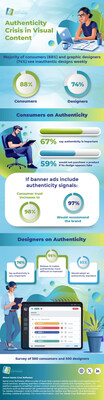
The study, which surveyed over 500 consumers and 500 graphic designers, found that 88% of consumers and 74% of designers report encountering inauthentic or fake-looking content—ads, emails, websites—on a daily or weekly basis. These are not rare occurrences: they are a regular feature of the modern visual landscape.
For brands, the stakes are high. Two thirds (67%) of consumers say authenticity is important in design. Over half (59%) say they would not purchase a product if its design appears fake or inconsistent. And when banner ads include authenticity signals—such as visual or metadata-based markers verifying content origin—consumer trust jumps to 98%, with 97% saying they would recommend the brand.
Designers are just as concerned with 76% saying authenticity is very important in their work. A strong majority are eager for a systemic fix: an overwhelming 93% say they would adopt such a standard, particularly through approaches like embedded metadata (such as Content Credentials) and imperceptible watermarking—technologies that already exist but remain underutilized.
“Trust is the foundation of every brand interaction, and designers are telling us they’re ready to build that foundation more deliberately,” said Mark Hilton, CEO of Santa Cruz Software. “This is about protecting the integrity of visual communication.”
As generative AI tools continue to proliferate, 95% of designers believe AI will make authenticity even harder to maintain—underscoring the urgency of addressing the issue now. While designers acknowledge some barriers to implementation—including client hesitancy, cost, and workflow complexity—the will to solve these challenges is strong. The survey results indicate that the creative industry is aligned around a simple idea: authenticity isn’t a luxury—it’s the baseline.
Santa Cruz Software is responding by adopting the Content Credential standard and applying it to all designs processed through its solutions. Content Credentials, developed by the Content Authenticity Initiative (CAI) and the Coalition for Content Provenance and Authenticity (C2PA)—with leadership from Adobe, Microsoft, Nikon, Leica, and others—adds tamper-evident metadata to digital content, allowing creators to attach transparent, machine-readable information about authorship and provenance.
“In a world where content can be generated instantly and manipulated endlessly, authenticity must be verifiable,” Hilton added. “We’re proud to support the Content Credentials initiative and help lead the way toward a more trusted future for design.”
About Santa Cruz Software
Santa Cruz Software offers a suite of tools that connect Adobe and Microsoft applications to cloud services, enabling seamless collaboration across creative and marketing teams. Its platform supports simplified version control, brand compliance, and creative automation with solutions such as BannersUI (AI-powered banner ad generator), PrintUI (dynamic templates for Adobe InDesign), LinkrUI (DAM connectors for Adobe and Microsoft), and BrandingUI (turnkey collateral portals). For more information, visit the Santa Cruz Software website.
Media Contact:
David Haefele
FortyThree, Inc.
[email protected]
831.888.9011
 View original content to download multimedia:https://www.prnewswire.com/news-releases/survey-reveals-authenticity-crisis-in-visual-content-302444394.html
SOURCE Santa Cruz Software