As 2027 approaches, the leading question in team meetings and boardrooms is a strategic one: How does our brand show up in AI?
We all know by now – AI search is fundamentally changing how customers find a product or whether they trust a brand. Moreover, this new search behavior is expanding: a Semrush analysis found that U.S. users of ChatGPT are spending more than nine minutes per session in 2026, and nearly 11 minutes on Claude. That’s an extraordinary amount of time, especially compared to a simple Google search. Marketing leaders aiming to grow their brand discovery in the AI era need to build a strong AI visibility strategy – not next year, but now.
Most CMOs understand that growing AI visibility is a board level priority. Yet if you ask the average SEO or GEO practitioner, chances are they’re still pursuing a piecemeal approach: simply replacing keywords with prompts, tracking isolated LLM prompts, obsessing over phrasing, and celebrating fleeting mentions.
By chasing one standalone prompt at a time, today’s marketers are struggling to create readable, trusted brand content for both prospective customers and AI crawlers, especially at scale. The key for marketers to build lasting AI brand visibility is to stop focusing on individual prompts, and instead, plan around topic clusters in order to build topical authority.
Owning a Topic Increases Your Odds on Every Related Prompt
At Semrush, we define a “topic” as the full set of questions people might ask about a subject, across search surfaces. Take payroll software: A buyer asks what it is, compares vendors, hunts for alternatives, checks whether it fits their business needs, and finally asks which one to buy.
Then, as a byproduct of today’s digitally rich landscape, users spread these questions across channels, be it places like Google, ChatGPT, YouTube, and Reddit, to name a few. Treating these interactions as disconnected channels (i.e.,tracking keywords in one dashboard and prompts in another) creates a fragmented and unsustainable strategy.
To the buyer, despite searching across platforms, this still relates to a single decision. Thus, at Semrush, we plan, measure and optimize at the topic level, wherever those questions are asked.
Many enterprise teams and agencies are moving from keyword lists to topic maps, but most are doing it manually: mapping keywords to subtopics, building content hierarchies, and trying to line up pillar pages with prompts. In our survey of 481 marketers, 40% still check their AI visibility by typing prompts into the tools themselves, and 29% have no unified view of how they show up across Google and AI.
Prompt-level tracking also conceals how fluid most topics remain. We recently studied more than one thousand ChatGPT topics and found that among the 50,000 brands we analyzed, not a single brand appeared in even three of the five related prompts for any topic.
For example, within the topic ‘American bank accounts’, no single bank dominated across related prompts like ‘What are the benefits of choosing an American bank?’, ‘What are the benefits of choosing an American bank for my banking needs?’ and ‘How do I open an account?’. That means a brand can win one prompt and completely miss the next.
Winning a single prompt is a roll of the dice, and it’s just step one. Owning the entire topic shifts the odds in your favor across every related query, so your brand gets mentioned more often, and for the right reasons. Most importantly, it also gives you a clear, reliable metric: category ownership relative to competitors.
Owning a Topic Requires Depth, Not Domain Strength
Together with Kevin Indig and Growth Memo, we tracked 1,094 categories in ChatGPT from January to June 2026 to see which brands surfaced and what drove their presence.
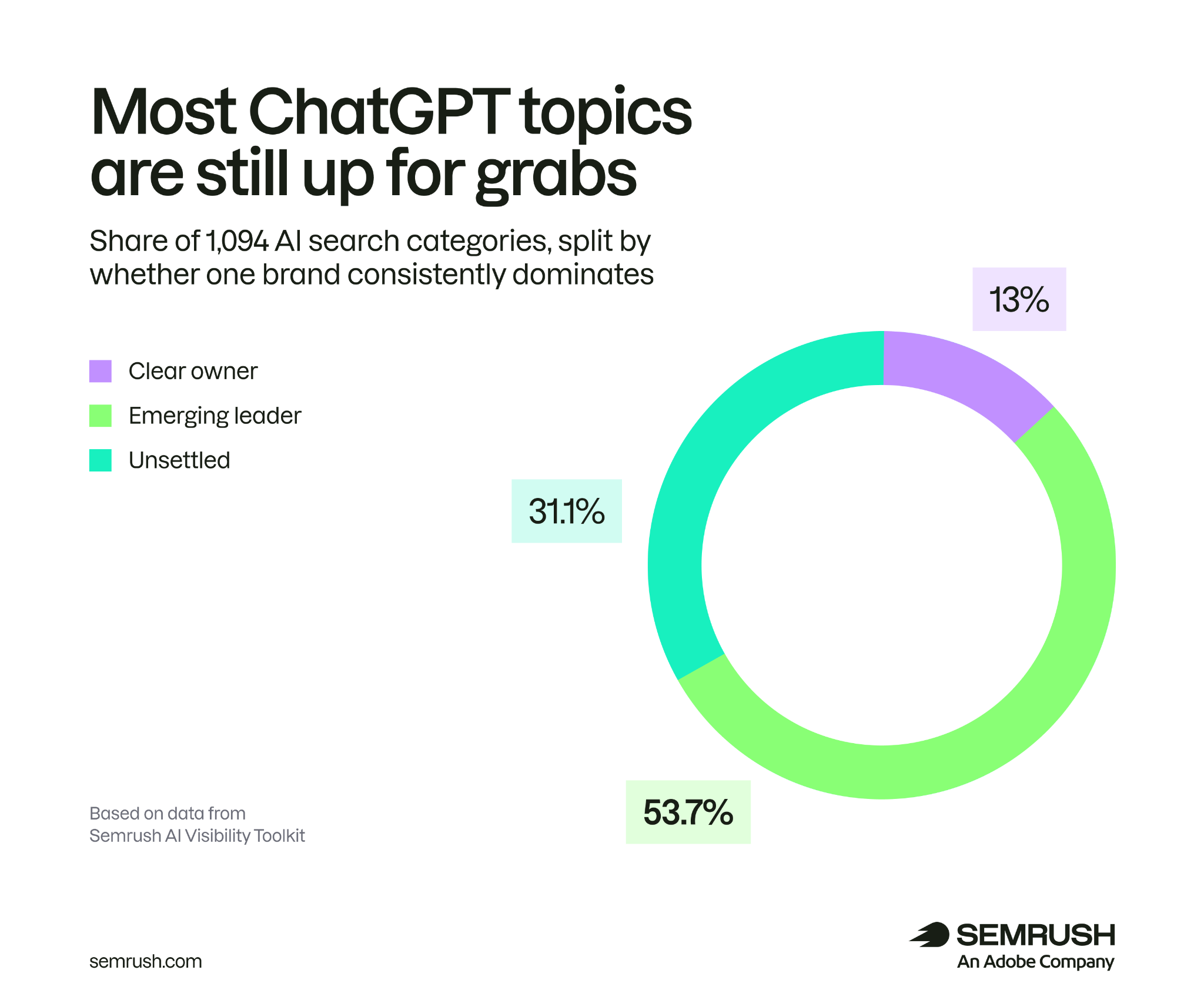
The research revealed several key findings:
- Most topics do not yet have an owner: 85% of topics we tracked have no established owner. A brand owns a topic when it appears in at least four of five core prompts with a 5+ percentage-point lead over the runner-up. In the highest-volume commercial categories, we found that only 11% have a clear owner. Right now, there is a wide open opportunity for brands to win their relevant topics.
- Domain authority offers no guarantees: Topic leaders held a higher Authority Score than the runner-up in only 53% of cases, and more organic traffic in just 48%. That’s essentially a coin flip. Strong classic SEO helps a brand get into the answer, but it doesn’t determine topical ownership.
- Citations don’t equal brand mentions: Only 21% of the most-cited domains in a category were also its most-mentioned brand. ChatGPT frequently uses a brand as a source yet still names a competitor in the answer. In Growth Memo’s research, 74% of users chose the top-mentioned brand as their final pick. That means mentions drive conversion.
- Depth beats breadth: In our follow-up study, 46% of ChatGPT citations in the categories closest to a brand’s core expertise also named the brand, compared with 18% in the most distant ones. Plus, a brand could show up once in 20 categories and own zero of them. Going deep instead of wide can lead to a higher share of brand mentions.
- Ownership sticks: Defending a topic is far easier than winning one, because once a brand owns a topic in ChatGPT, it tends to hold on to it. Established topic owners kept first place in 90% of month-over-month comparisons. The ones that lost it had a median lead of just 1.3 points.
AI Judges Your Topical Authority by More Than Your Website
For years, topical authority was treated as an on-site exercise: pillar pages, internal links, and technical SEO. That foundation remains vital: In our survey of U.S. B2B professionals who use AI at work, 63% search for the company on Google after an AI platform recommends a vendor. But your website is only one slice of the equation.
AI models form their view of your brand from the broader digital landscape: industry publications, community forums, independent reviews, social media, and partner sites, along with your own content. We think of this broader view as topical gravity – where your brand sits in an AI model’s conceptual map of a topic relative to your competitors.
Managing this dynamic comes down to three operational layers:
- What to control: your website, content, technical access, and positioning.
- What you can only influence: reviews, press coverage, community conversations, creators, and partners.
- What you monitor: competitors moves and how models weigh their sources.
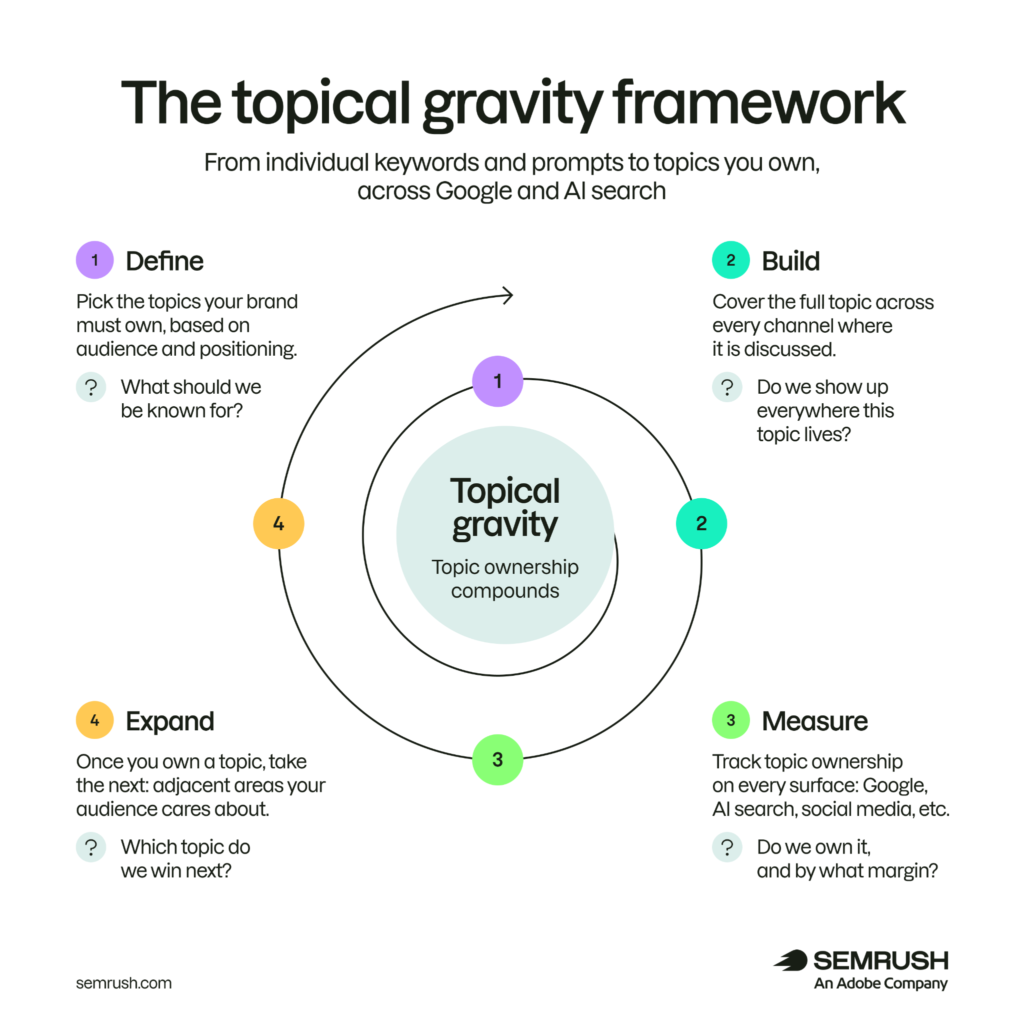
In practice, it runs as a cycle: define the topics you need to own, build presence across them, measure your share against competitors, and expand once you lead.
3 Things Marketing Leaders Should Do
If you lead an organic search or growth team, focus your strategy on three priorities:
- Prioritize your topics, not your channels. Identify the 2-3 core topics where buyer painpoints, your product or brand positioning, and actual pipeline overlap. Then go deep on the topic closest to your core before you spread to adjacent ones.
- Build authority beyond your website. Cover every question in your topic on your own site, then earn mentions in the places AI pulls from for that topic: review sites, industry press, and the communities where your buyer compares options.
- Unify your search team under a single scorecard. Stop running SEO and AI search as separate workflows, and report your share of each topic against competitors across every place buyers search. In our recent survey of nearly 500 marketers, 81% of teams with fully integrated SEO and AI search execution reported more traffic or leads connected to AI platforms, compared with 36% of teams running them separately.
We’re building topic-level measurement into the Adobe and Semrush platform, because leadership doesn’t need another sprawling spreadsheet of prompt-tracking data. It needs evidence that you’re measuring the right thing that moves the business forward. By January, your board deck should answer two questions: How much of our category do we own, and who owns the rest?