A modern laser cutter can finish a programmed job in minutes. But the machine doesn’t produce anything efficiently on its own. Material shows up late. The job queue gets sequenced badly. An operator loses twenty minutes just squaring up a sheet on the bed. The bending and welding stations downstream can’t absorb what the laser just handed them. The cutting head is rarely the actual bottleneck anymore. What surrounds it usually is.
That’s the real story behind smart manufacturing as it applies to laser cutting, and it has almost nothing to do with artificial intelligence taking over a shop floor. It’s a slower, more practical shift: connecting the stages around the machine so the laser source stops behaving like an isolated island sitting in the middle of everything else.
Laser Cutting Is Becoming Part of a Connected Production System
A laser cutter used to be treated as a standalone tool. Load a file, run the job, unload the part, repeat. Smart manufacturing reframes it as one node in a longer information chain. A customer order becomes a CAD/CAM file. That file feeds nesting and programming. Programming feeds a production schedule. The schedule drives material selection, loading, and cutting. Cutting gets followed by monitoring, sorting, whatever comes downstream — bending, welding — and finally quality and traceability records.
No shop needs to automate every link in that chain, and most don’t. What smart manufacturing really means here is that these stages increasingly share data and software instead of running as separate steps tracked on paper travelers and whatever an individual operator happens to remember.
Automation Is Moving Beyond the Cutting Head
Automation in laser cutting used to just mean CNC control of the beam path. That definition has widened. Sheet storage systems queue material on their own. Loading and unloading systems move sheets in and out of the work envelope without someone physically handling each piece. Sorting systems separate finished parts by job or destination. Job queues get sequenced around material availability or downstream capacity instead of whatever order the tickets happened to arrive in.
TRUMPF’s Smart Factory installations are a useful real-world example: automated storage feeding cutting machines directly, integrated cutting-and-bending cells, material handling that moves a part from the laser straight into the next process without a human transfer step. These aren’t concept demos. They’re running installations. How much of that makes sense for a given shop is a different question — it depends heavily on part variety, batch size, and what the capital budget can actually support. A job shop running high-mix, low-volume work is looking at a completely different automation calculus than a plant running long series production.
Krämer Brennteile, a German job shop with around 40 employees, is a documented example of exactly that calculus playing out. Managing director Martin Krämer had long resisted automation, believing it was too rigid for a shop built around small, urgent, one-off orders. What changed his mind, according to TRUMPF’s published account of the project, was a third pallet station added alongside the automated system — a manually loaded buffer position that lets an urgent job or an oversized sheet get inserted without disrupting the automated flow running on the other two pallets. TRUMPF reports the change freed up two operators per shift for other work and increased overall productivity, without forcing Krämer’s shop to give up the order-by-order flexibility that was the whole reason he’d resisted automation in the first place.
Data Is Becoming as Important as Cutting Speed
What data a cutting operation can actually pull depends entirely on the machine, its controller, whatever software is connected, and how much sensing the facility has bothered to install. On a reasonably instrumented setup, that might include machine status, the current job, cutting-plan details, runtime and downtime, alarms, material use, scrap, throughput, part counts, maintenance indicators. An older unconnected machine might offer almost none of that. A newer networked system paired with a manufacturing execution system might offer quite a lot. There’s no baseline here — it varies by setup.
The payoff shows up in specific places, not as a vague productivity glow. Production visibility means a manager can see what’s actually running, waiting, or stopped without walking the floor. Utilization data shows whether an expensive laser is cutting parts or just sitting there between jobs, which matters a great deal for equipment that costs what these machines cost. Scheduling improves once it’s based on real job status instead of assumed status. Maintenance can move from a fixed calendar toward condition-based intervals when the machine data actually supports it. And historical records tie a finished part back to the job, material lot, and machine that made it, which is most of what traceability requires.
Where AI Actually Fits Into Laser-Cutting Operations
AI’s real role in laser cutting is narrower than most headlines suggest, and it’s worth being precise about where the line actually sits. The 2026 Roadmap on Artificial Intelligence and Machine Learning for Smart Manufacturing, published through NIST-affiliated research, frames AI and ML’s contribution mainly around industrial big-data analytics, advanced sensing and perception, and increasingly autonomous systems. It also spends real space on what isn’t solved yet: the complexity of industrial data, the difficulty of integrating sensing and control systems that were never designed to talk to each other, and the need for AI systems that are trustworthy and explainable rather than opaque black boxes running in a high-stakes production environment.
Applied to actual cutting operations, that narrows down to a handful of realistic use cases. Anomaly detection in process signals that might catch a developing fault before it becomes a scrapped part. Computer-vision inspection of cut edges or finished parts. Forecasting models built from historical operating data that inform maintenance planning. Scheduling optimization that weighs machine availability against material constraints. None of that is the same thing as automation, and conflating the two causes real confusion. Automation runs a predefined task with less manual intervention — load this sheet, execute this queued job, unload this part. Analytics looks at collected data for patterns or performance issues. AI and machine learning build models that classify conditions, forecast events, or optimize decisions, and the output is probabilistic rather than fixed. The NIST roadmap is fairly blunt about not blurring these together, and it’s a distinction worth holding onto even in casual shop-floor conversation.
Not every feature marketed as “smart” actually runs on AI. A buyer evaluating equipment should ask what’s actually doing the work underneath the marketing language — a rules-based automation sequence, a dashboard built on sensor data someone already had, or an actual trained model making a probabilistic call.
Why Fiber Laser Cutting Fits the Smart-Manufacturing Model
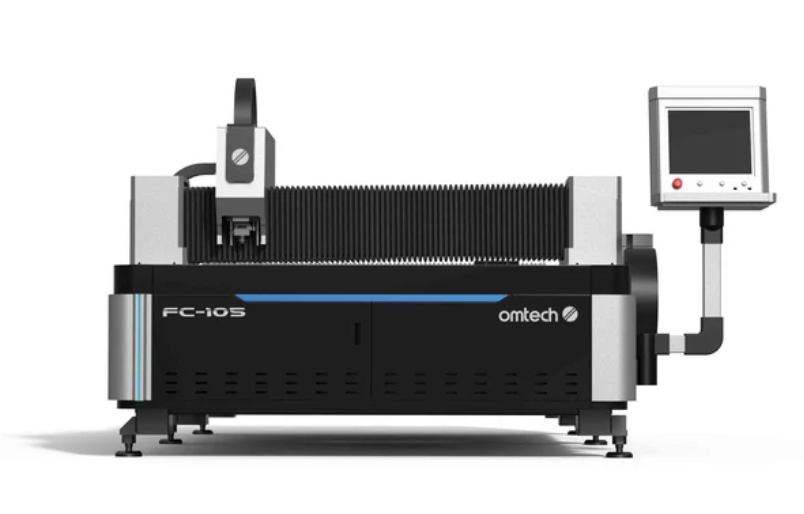
Fiber laser cutting fits naturally into connected production, and the reason has more to do with control architecture than raw speed. These are CNC-driven systems from the ground up. The cutting program originates as a CAD/CAM file, the machine runs it through a digital controller, and that same digital pathway is exactly what makes it possible to plug the machine into nesting software, job queues, and monitoring systems. A manually guided or mechanically operated cutting process just doesn’t offer the same connection points — there’s no clean digital layer to hook anything into.
Manufacturers evaluating the equipment layer of a connected metal-cutting workflow will find today’s fiber laser cutting systems spanning a range of power levels, working areas, and configurations, most running standard CNC control software that handles nesting, edge-seeking, and collision-path planning against imported CAD files. That digital foundation is what lets a cutting machine participate in a larger production system instead of sitting there as an isolated tool — whether or not a shop ever adds full material-handling automation on top of it.
Smart Manufacturing Is About the Entire Workflow, Not One Fast Machine
Worth stating plainly, because it’s easy to lose sight of: an industrial laser cutter is expensive capital equipment, and its business value depends on a lot more than top cutting speed. It depends on how fast jobs actually reach the machine. How long setup and changeover eat into the day. How much loading and unloading delays the next cut. Whether material shows up when the schedule needs it. Whether bending, welding, or finishing downstream can absorb what the laser produces without backing up into a queue.
A shop can own the fastest cutter on the market and still post mediocre overall throughput if any one of those surrounding steps is the real constraint. That’s the actual argument for putting smart-manufacturing investment into scheduling, material flow, and data visibility rather than chasing another few percent of cutting speed.
FBT Feinblechtechnik, a small German sheet-metal job shop, illustrates the point directly. Before bringing in TRUMPF’s consulting arm, the company’s first move wasn’t buying faster equipment — it was mapping the complete flow from customer inquiry and production planning through programming and dispatch, then reorganizing the shop floor into a more efficient layout based on what that mapping found. Only after that groundwork was newer cutting capability and software added. According to TRUMPF’s published account, work the company had previously sent out for external cutting, at a cost of 5 to 15 days, could afterward be completed in-house within 24 to 48 hours. The lesson holds regardless of company size: layout, programming, and workflow can matter as much as the intelligence built into the machine itself.
What Manufacturers Should Measure
The right metrics depend heavily on the specific shop, but a few tend to be useful almost everywhere: productive machine time against idle time, downtime broken out by cause, setup and changeover time, throughput against schedule, scrap and material utilization, queue time between process steps, rework rate, on-time delivery. None of these numbers mean much as an industry benchmark. What matters is whether a shop tracks them consistently enough to see its own trend line and actually do something about it.
The Challenges Behind a Connected Laser-Cutting Operation
None of this comes free, and pretending otherwise does a disservice to anyone actually budgeting for it. Interoperability between equipment from different eras and different vendors is a real, ongoing headache — a five-year-old cutter and a freshly installed monitoring platform don’t automatically speak the same language. Legacy equipment may offer little or no connectivity at all, full stop. Data quality is a problem before it’s ever an analytics problem: a dashboard or model built on inconsistent production data just produces confident-looking nonsense. Integration costs and cybersecurity exposure both grow with connectivity, since every networked machine and every data feed is also a new access point that needs permissions, patching, and someone paying attention to it. And none of it works without training and a real change-management process, because new systems change how operators, schedulers, and maintenance staff actually spend their day.
The NIST roadmap raises comparable concerns at the research level — industrial data complexity, integration across sensing and control systems that were never built to interoperate, the need for AI/ML that’s reliable and explainable rather than a black box. Those aren’t abstract academic worries. They’re the same practical wall a mid-size fabrication shop hits the first time it tries to connect a laser cutter to a scheduling system.
Smart Manufacturing Does Not Require a Fully Autonomous Factory
It’s worth separating the vision of a fully autonomous factory from what’s actually achievable for most manufacturers, especially small and midsize shops. Adoption tends to go better as a gradual process than an all-at-once overhaul. A shop might start by digitizing job preparation and nesting. Add basic machine monitoring next. Connect scheduling across a few machines after that. Automate a specific material-handling step once the volume justifies it. Eventually integrate production data across systems that used to run separately. None of that is a mandatory sequence — plenty of shops skip steps or reorder them — but it reflects how connected manufacturing tends to actually get adopted: in stages, each one justified on its own, not purchased as a single finished system.
Even in a more connected shop, machine selection still starts where it always has: material, thickness, required precision, production volume. Automation and data considerations layer on top of that decision, not in place of it. A shop weighing laser cutting machines for a smart-factory-oriented upgrade still has to answer those basic questions first. Connectivity gets built around the right machine choice. It doesn’t substitute for one.
The Real Competitive Advantage
Cutting speed still matters, and it always will. But for a growing number of manufacturers, the bigger competitive edge isn’t the laser source by itself — it’s how efficiently information, material, and decisions move around that machine. A well-connected mid-power system with tight scheduling and decent data visibility can out-produce a faster machine stuck in a clumsy workflow. Once the hype gets set aside, that’s the actual lesson sitting underneath the smart-manufacturing conversation.