AI Adoption is Up, But Teams Aren’t Spending More Time Using It
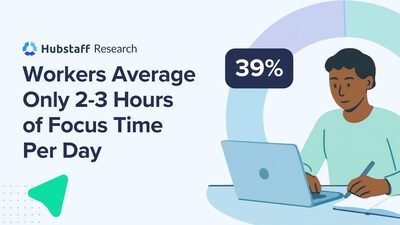
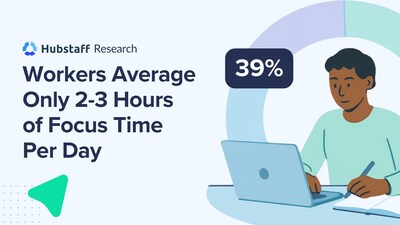
INDIANAPOLIS, Jan. 26, 2026 /PRNewswire/ — Hubstaff, a leading time tracking platform, has released new data showing that the average worker now gets just 2–3 hours of focus time per day. Focus time refers to uninterrupted work periods without meetings, messages, or tool switching.
Hubstaff analyzed tracked work time from 140,000+ workers across 17,000 organizations, and the data tells an uncomfortable story for workers.
Key findings from the Hubstaff 2026 Global Benchmarks Report:
- Hybrid teams report the lowest share of uninterrupted work
- Managers and team leaders average just 27% of hours in focus
- Meeting volume has doubled
- Employees use an average of 18 apps per day
- AI adoption is rising, but time spent using AI is not growing
“Our data proves that teams aren’t failing at productivity, they’re working in systems that constantly disrupt focus,” said Jared Brown, CEO of Hubstaff. “When a worker’s day is fragmented by meetings, messages and tool switching, real focus is out of reach. If leaders want better performance and real returns on their AI investments, they need to treat focus time as a core operating principle, not simply a personal responsibility.”
Meetings Reduce Focus Time at Work
Increased meeting volume and poor scheduling are getting in the way of focus time. Hubstaff data shows the average person is now sitting in twice as many meetings per year and the typical organization is running almost six times as many meetings, compared to just two years ago.
Timing matters: Hubstaff data show that roughly a quarter of all tracked meeting time is during peak deep work hours and nearly a third are outside of standard business hours.
As debates around return to office continue, it’s notable that hybrid teams reported the least amount of focus time, with just 31% of hours in deep focus. Fully committed work styles reported the most focus time with 41% of hours for remote teams and 45% for in-office teams.
How Tool Overload and Context Switching Reduce Employee Focus
If meetings and notifications weren’t a big enough challenge, workers are struggling to navigate numerous tools that draw their attention. Hubstaff data shows workers are using an average of 18 apps per day. Workers in sales/marketing, customer success and admin/HR roles are averaging more than 20 apps per day.
In addition to fragmentation of attention, offering more tools did not mean that workers were more efficient.
AI Adoption is Rising, but Not Tracked Employee Time Using It
As businesses invest big in AI, they need to consider how their teams are using the tools. While adoption is up, workers are not tracking more hours using AI tools. Hubstaff data shows the share of total tracked time spent in AI apps slipped from around 4% to 3% year-over-year. This suggests that AI is going wide, but not significantly shifting how workers spend their hours.
AI adoption varies widely by industry and role, but there are notable differences in workstyles, including:
- Hybrid teams are the only group using AI deeply and by a huge margin; use jumped from ~5% to ~11% of the day in 2025.
- Remote and office-based teams only spend 1–2% of their day in AI apps.
“Business leaders can’t fix focus if they don’t know how teams are spending their time,” said Brown. “Employee time tracking data is the key to diagnosing inefficient workflows and creating a plan to reclaim focus.”
How Can I Track My Employee’s Time?
Hubstaff is a leading time tracking platform that turns work hours into insights through built-in productivity monitoring, automated payments, and workforce analytics. Time is tracked using desktop and mobile apps that record work activity with transparency and user control. By analyzing app and website usage, task time, and activity signals, Hubstaff provides visibility into how work time is distributed across tools and workflows.
Read Next
The 2026 Global Benchmarks Report: Tracking How Work Gets Done explores six critical shifts in tracked time and offers leaders a live “operating system for global work” so they can redesign rhythm, protect focus, streamline tools, embed AI, and catch 50+ hour weeks before they burn people out.
The dataset spans organizations across North America, EMEA, APAC, and Latin America, providing a global view of how work time is distributed. The analysis is based on anonymized, aggregated time tracking data and does not evaluate individual employee performance.
This release follows Hubstaff’s research, More Profit, Less Burnout: How Smart Agencies Scale, The AI Productivity Shift and Workstyle Revolution: Debunking Myths and Unlocking Distributed Team Potential. Keep following Hubstaff for future reports on time tracking, productivity monitoring and workforce analytics.
About Hubstaff
Hubstaff is a leading time tracking platform built for global teams. Track time, automate payments, monitor productivity, and get actionable productivity insights — all in one tool.
About the Research
Research findings are built on anonymized work data collected from more than 140,000 users across 17,000 organizations in the Hubstaff platform. For more detail on our methodology, please see the report.
Media Contact:
Carey Morgan
[email protected]

 View original content to download multimedia:https://www.prnewswire.com/news-releases/new-hubstaff-research-finds-workers-average-only-2-3-hours-of-focus-time-per-day-302669569.html
SOURCE Hubstaff